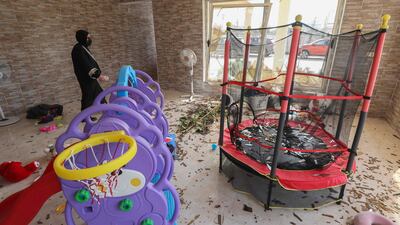
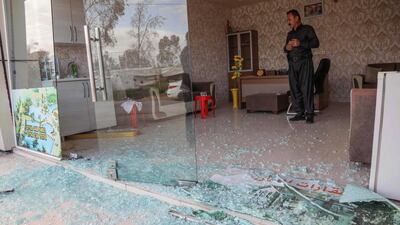
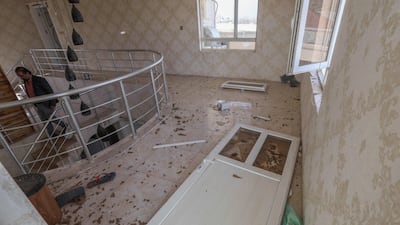
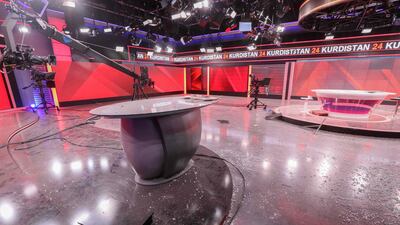
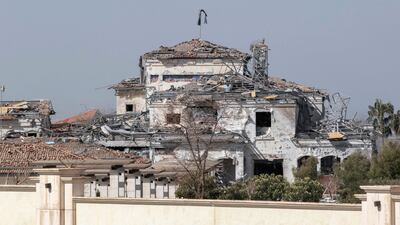
A damaged building in the aftermath of missile attacks in Erbil, Iraq, on March 13, 2022. Reuters

Iraq finds no evidence of Mossad link in Erbil attack


Mina Aldroubi
  • English
  • Arabic

Baghdad has not found evidence to support Iran’s claims that an Israeli intelligence centre was based in Erbil, officials said on Monday.

Last month, Tehran took responsibility for missile strikes on the northern Iraq city, saying it had hit an Israeli “strategic centre”.

Missiles struck a villa owned by Baz Karim Barzanji, a Kurdish businessman. He runs the KAR Group, which operates the largest oil refinery in the Kurdish region, among a portfolio of projects that includes water and power.

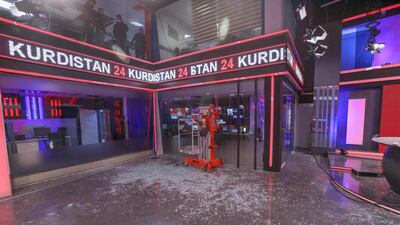
Speculation had surfaced as to why his house was struck in the attack, which left much of the mansion in ruins and damaged a nearby TV studio.

  • A woman inspects damage in a children's room following an overnight attack in Erbil, the capital of the northern Iraqi Kurdish autonomous region. All photos by AFP
    A woman inspects damage in a children's room following an overnight attack in Erbil, the capital of the northern Iraqi Kurdish autonomous region. All photos by AFP
  • Damage at a shop.
    Damage at a shop.
  • A man inspects the damage at his home.
    A man inspects the damage at his home.
  • The damaged studio at the Kurdistan 24 TV building.
    The damaged studio at the Kurdistan 24 TV building.
  • Twelve missiles were fired early on Sunday, the state news agency and local leaders said.
    Twelve missiles were fired early on Sunday, the state news agency and local leaders said.
  • A man cleans debris in the Kurdistan 24 TV building.
    A man cleans debris in the Kurdistan 24 TV building.
  • A damaged building after the overnight attack in Erbil. US officials, speaking to AFP, said the missiles came from Iran.
    A damaged building after the overnight attack in Erbil. US officials, speaking to AFP, said the missiles came from Iran.
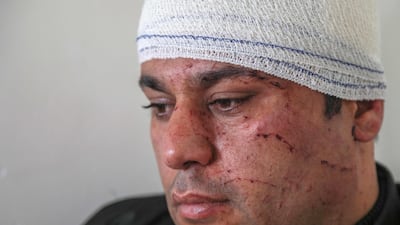
  • Ziryan Wazir rests at home after being wounded in the attack.
    Ziryan Wazir rests at home after being wounded in the attack.

Iran initially said it was in retaliation for the deaths of two members of the Islamic Revolutionary Guard Corps in Syria in an alleged Israeli air strike.

Officials in Baghdad who are following the investigation into the attacks said “Tehran had informed them of its anger about the presence of Iranian opposition in the Kurdistan region but did not mention Mossad until after the attacks”.

“Iraq had demanded that the Iranians support their allegations about Israel with evidence that can be examined,” an official told Asharq Al Awsat newspaper.

Another official said claims by the former Iranian ambassador to Iraq, Iraj Masjedi, that Mossad has a base in the north were not sufficient.

“We have only seen accusations and speculation,” said the second official.

The IRGC confirmed it had fired the projectiles, and claimed its targets were sites used by Israel.

A “strategic centre for conspiracy and mischief of the Zionists was targeted by powerful precision missiles fired by the Islamic Revolutionary Guard Corps”, the IRGC said in a statement.

Iraq had opened an investigation into the attack and had sent a technical team to inspect the target house but did not find any evidence to support the Iranian accusations.

An official said the rubble revealed “an unsuspecting civilian building”.

Officials with links to the investigation said they “were frustrated with the way Iran was formulating dangerous allegations, during highly sensitive local and regional circumstance”.

Iran has claimed that there are more than “three military divisions” of opposition groups in the Kurdistan region near the border.

“The investigators felt they were dealing with a narrative that is not based on facts,” the Iraqi official said.


COMPANY%20PROFILE
%3Cp%3E%3Cstrong%3EName%3A%20%3C%2Fstrong%3ETelr%3Cbr%3E%3Cstrong%3EBased%3A%20%3C%2Fstrong%3EDubai%2C%20UAE%3Cbr%3E%3Cstrong%3ELaunch%20year%3A%3C%2Fstrong%3E%202014%3Cbr%3E%3Cstrong%3ENumber%20of%20employees%3A%20%3C%2Fstrong%3E65%3Cbr%3E%3Cstrong%3ESector%3A%20%3C%2Fstrong%3EFinTech%20and%20payments%3Cbr%3E%3Cstrong%3EFunding%3A%20%3C%2Fstrong%3Enearly%20%2430%20million%20so%20far%3C%2Fp%3E%0A
Company%20Profile
%3Cp%3E%3Cstrong%3EName%3A%3C%2Fstrong%3E%20Neo%20Mobility%3Cbr%3E%3Cstrong%3EStarted%3A%3C%2Fstrong%3E%20February%202023%3Cbr%3E%3Cstrong%3ECo-founders%3A%3C%2Fstrong%3E%20Abhishek%20Shah%20and%20Anish%20Garg%3Cbr%3E%3Cstrong%3EBased%3A%3C%2Fstrong%3E%20Dubai%3Cbr%3E%3Cstrong%3EIndustry%3A%3C%2Fstrong%3E%20Logistics%3Cbr%3E%3Cstrong%3EFunding%3A%3C%2Fstrong%3E%20%2410%20million%3Cbr%3E%3Cstrong%3EInvestors%3A%3C%2Fstrong%3E%20Delta%20Corp%2C%20Pyse%20Sustainability%20Fund%2C%20angel%20investors%3C%2Fp%3E%0A
Squid Game season two

Director: Hwang Dong-hyuk 

Stars:  Lee Jung-jae, Wi Ha-joon and Lee Byung-hun

Rating: 4.5/5

FFP EXPLAINED

What is Financial Fair Play?
Introduced in 2011 by Uefa, European football’s governing body, it demands that clubs live within their means. Chiefly, spend within their income and not make substantial losses.

What the rules dictate? 
The second phase of its implementation limits losses to €30 million (Dh136m) over three seasons. Extra expenditure is permitted for investment in sustainable areas (youth academies, stadium development, etc). Money provided by owners is not viewed as income. Revenue from “related parties” to those owners is assessed by Uefa's “financial control body” to be sure it is a fair value, or in line with market prices.

What are the penalties? 
There are a number of punishments, including fines, a loss of prize money or having to reduce squad size for European competition – as happened to PSG in 2014. There is even the threat of a competition ban, which could in theory lead to PSG’s suspension from the Uefa Champions League.

Results:

5pm: Maiden (PA) | Dh80,000 | 1,200 metres

Winner: Jabalini, Szczepan Mazur (jockey), Younis Kalbani (trainer)

5.30pm: UAE Arabian Derby (PA) | Prestige | Dh150,000 | 2,200m

Winner: Octave, Gerald Avranche, Abdallah Al Hammadi

6pm: Arabian Triple Crown Round 3 (PA) | Group 3 Dh300,000 | 2,200m

Winner: Harrab, Richard Mullen, Mohamed Ali

6.30pm: Emirates Championship (PA) | Group 1 | Dh1million | 2,200m

Winner: BF Mughader, Szczepan Mazur, Younis Al Kalbani

7pm: Abu Dhabi Championship (TB) | Group 3 | Dh380,000 | 2,200m

Winner: GM Hopkins, Patrick Cosgrave, Jaber Ramadhan

7.30pm: Wathba Stallions Cup (PA) | Conditions | Dh70,000 | 1,600m

Winner: AF La’Asae, Tadhg O’Shea, Ernst Oertel

What can you do?

Document everything immediately; including dates, times, locations and witnesses

Seek professional advice from a legal expert

You can report an incident to HR or an immediate supervisor

You can use the Ministry of Human Resources and Emiratisation’s dedicated hotline

In criminal cases, you can contact the police for additional support

MATCH INFO

Jersey 147 (20 overs) 

UAE 112 (19.2 overs)

Jersey win by 35 runs

While you're here
Who was Alfred Nobel?

The Nobel Prize was created by wealthy Swedish chemist and entrepreneur Alfred Nobel.

  • In his will he dictated that the bulk of his estate should be used to fund "prizes to those who, during the preceding year, have conferred the greatest benefit to humankind".
  • Nobel is best known as the inventor of dynamite, but also wrote poetry and drama and could speak Russian, French, English and German by the age of 17. The five original prize categories reflect the interests closest to his heart.
  • Nobel died in 1896 but it took until 1901, following a legal battle over his will, before the first prizes were awarded.

Mercer, the investment consulting arm of US services company Marsh & McLennan, expects its wealth division to at least double its assets under management (AUM) in the Middle East as wealth in the region continues to grow despite economic headwinds, a company official said.

Mercer Wealth, which globally has $160 billion in AUM, plans to boost its AUM in the region to $2-$3bn in the next 2-3 years from the present $1bn, said Yasir AbuShaban, a Dubai-based principal with Mercer Wealth.

Within the next two to three years, we are looking at reaching $2 to $3 billion as a conservative estimate and we do see an opportunity to do so,” said Mr AbuShaban.

Mercer does not directly make investments, but allocates clients’ money they have discretion to, to professional asset managers. They also provide advice to clients.

“We have buying power. We can negotiate on their (client’s) behalf with asset managers to provide them lower fees than they otherwise would have to get on their own,” he added.

Mercer Wealth’s clients include sovereign wealth funds, family offices, and insurance companies among others.

From its office in Dubai, Mercer also looks after Africa, India and Turkey, where they also see opportunity for growth.

Wealth creation in Middle East and Africa (MEA) grew 8.5 per cent to $8.1 trillion last year from $7.5tn in 2015, higher than last year’s global average of 6 per cent and the second-highest growth in a region after Asia-Pacific which grew 9.9 per cent, according to consultancy Boston Consulting Group (BCG). In the region, where wealth grew just 1.9 per cent in 2015 compared with 2014, a pickup in oil prices has helped in wealth generation.

BCG is forecasting MEA wealth will rise to $12tn by 2021, growing at an annual average of 8 per cent.

Drivers of wealth generation in the region will be split evenly between new wealth creation and growth of performance of existing assets, according to BCG.

Another general trend in the region is clients’ looking for a comprehensive approach to investing, according to Mr AbuShaban.

“Institutional investors or some of the families are seeing a slowdown in the available capital they have to invest and in that sense they are looking at optimizing the way they manage their portfolios and making sure they are not investing haphazardly and different parts of their investment are working together,” said Mr AbuShaban.

Some clients also have a higher appetite for risk, given the low interest-rate environment that does not provide enough yield for some institutional investors. These clients are keen to invest in illiquid assets, such as private equity and infrastructure.

“What we have seen is a desire for higher returns in what has been a low-return environment specifically in various fixed income or bonds,” he said.

“In this environment, we have seen a de facto increase in the risk that clients are taking in things like illiquid investments, private equity investments, infrastructure and private debt, those kind of investments were higher illiquidity results in incrementally higher returns.”

The Abu Dhabi Investment Authority, one of the largest sovereign wealth funds, said in its 2016 report that has gradually increased its exposure in direct private equity and private credit transactions, mainly in Asian markets and especially in China and India. The authority’s private equity department focused on structured equities owing to “their defensive characteristics.”

Cricket World Cup League 2

UAE squad

Rahul Chopra (captain), Aayan Afzal Khan, Ali Naseer, Aryansh Sharma, Basil Hameed, Dhruv Parashar, Junaid Siddique, Muhammad Farooq, Muhammad Jawadullah, Muhammad Waseem, Omid Rahman, Rahul Bhatia, Tanish Suri, Vishnu Sukumaran, Vriitya Aravind

Fixtures

Friday, November 1 – Oman v UAE
Sunday, November 3 – UAE v Netherlands
Thursday, November 7 – UAE v Oman
Saturday, November 9 – Netherlands v UAE

Updated: April 18, 2022, 6:15 PM