Security concerns were the top priority for Iraqi Foreign Minister Fuad Hussein during a visit to Iran this week in the wake of Tehran’s recent attack on the northern Kurdish region.
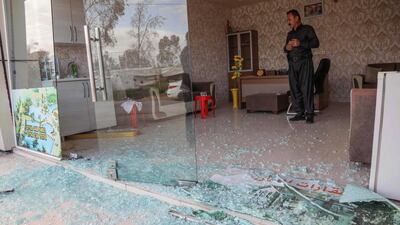
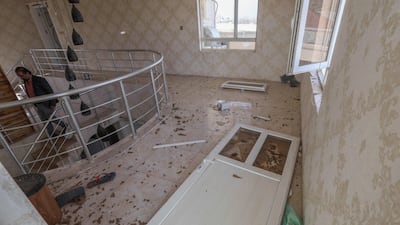
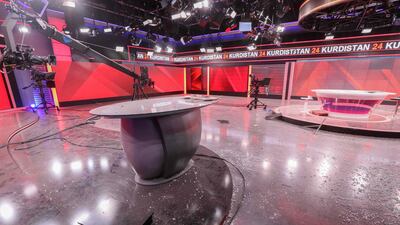
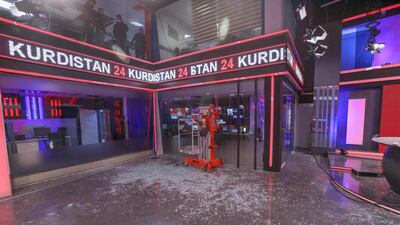
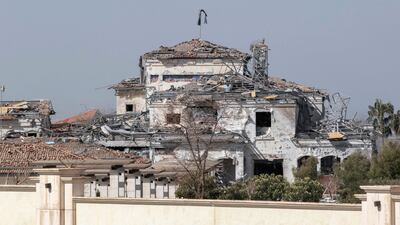
Iran last month accused Iraq’s autonomous Kurdistan Regional Government of hosting an Israeli “strategic centre” and targeted a building in Erbil, the KRG’s capital, with a dozen ballistic missiles that wounded two civilians.
Mr Fuad's visit to Tehran this week sought to ease those tensions and prevent further escalation.
“The Iraqi foreign minister met various Iranian leaders and discussed the region’s political and security situations and ways to improve efforts in reducing tensions by giving priority to dialogue between states,” Iraq’s Foreign Ministry spokesman Ahmad Al Sahaf told The National.
“Iraq wants security and stability to prevail in the region,” he said.
Mr Hussein was accompanied by Iraq’s national security adviser, Qassem Al Araji, and several other officials, Mr Al Sahaf said.
The Iraqi foreign minister said Baghdad wants to “build bridges of trust between neighbouring countries, including Iran, in order to have an open dialogue to create security”, he said.
“Iraq’s stability is of importance to Iran.”
Iranian President Ebrahim Raisi met Mr Hussein and said that he will not allow Iraqi soil to be used for activities that disrupt his country’s security, his office said.
“The president emphasised that Iran strongly expects neighbouring countries, especially Iraq, not to allow any presence that is disruptive to the security of the Islamic Republic,” read a statement from Mr Raisi’s office.
It said Iran is closely “watching Israel's movement and will not allow it to endanger the security of the region”.
Mr Raisi accused Iraq’s Kurdistan region of “negligence”.
Mr Hussein assured Mr Raisi that Iraq will not be used as a base for attacks on Iran.
“We are ready for extensive co-operation, including in the field of security, to prevent any threat to the interests of Iran,” Mr Hussein said, according to the statement from Mr Raisi's office.
Baghdad lies on the fault line between Shiite Muslim majority Iran and the Sunni-ruled countries that are some of Tehran's regional rivals.
The Iraqi minister also met his Iranian counterpart Hossein Amirabdollahian and called for peaceful dialogue when resolving conflict.
"Our doors are open for dialogue and we hope Tehran will also be open to this as it is the only solution to resolving outstanding issues," Mr Hussein said during a press conference with Mr Amirabdollahian.
"It is clear that Iran has complaints about some security issues which we must talk about frankly so that they are resolved through diplomatic means,” he said on Wednesday.
The Iraqi minister said that dialogue was continuing between Iran and Saudi Arabia with the presence of international representatives.
"Baghdad's goal is to bring Iran and Saudi Arabia's visions closer together," he said.
Dialogue between the two states is expected to resume soon, the Iraqi minister said.
During the past year, Baghdad hosted several rounds of talks between officials from its two neighbours and mutual adversaries to defuse tensions.

UAE currency: the story behind the money in your pockets
Real estate tokenisation project
Dubai launched the pilot phase of its real estate tokenisation project last month.
The initiative focuses on converting real estate assets into digital tokens recorded on blockchain technology and helps in streamlining the process of buying, selling and investing, the Dubai Land Department said.
Dubai’s real estate tokenisation market is projected to reach Dh60 billion ($16.33 billion) by 2033, representing 7 per cent of the emirate’s total property transactions, according to the DLD.
Ten tax points to be aware of in 2026
1. Domestic VAT refund amendments: request your refund within five years
If a business does not apply for the refund on time, they lose their credit.
2. E-invoicing in the UAE
Businesses should continue preparing for the implementation of e-invoicing in the UAE, with 2026 a preparation and transition period ahead of phased mandatory adoption.
3. More tax audits
Tax authorities are increasingly using data already available across multiple filings to identify audit risks.
4. More beneficial VAT and excise tax penalty regime
Tax disputes are expected to become more frequent and more structured, with clearer administrative objection and appeal processes. The UAE has adopted a new penalty regime for VAT and excise disputes, which now mirrors the penalty regime for corporate tax.
5. Greater emphasis on statutory audit
There is a greater need for the accuracy of financial statements. The International Financial Reporting Standards standards need to be strictly adhered to and, as a result, the quality of the audits will need to increase.
6. Further transfer pricing enforcement
Transfer pricing enforcement, which refers to the practice of establishing prices for internal transactions between related entities, is expected to broaden in scope. The UAE will shortly open the possibility to negotiate advance pricing agreements, or essentially rulings for transfer pricing purposes.
7. Limited time periods for audits
Recent amendments also introduce a default five-year limitation period for tax audits and assessments, subject to specific statutory exceptions. While the standard audit and assessment period is five years, this may be extended to up to 15 years in cases involving fraud or tax evasion.
8. Pillar 2 implementation
Many multinational groups will begin to feel the practical effect of the Domestic Minimum Top-Up Tax (DMTT), the UAE's implementation of the OECD’s global minimum tax under Pillar 2. While the rules apply for financial years starting on or after January 1, 2025, it is 2026 that marks the transition to an operational phase.
9. Reduced compliance obligations for imported goods and services
Businesses that apply the reverse-charge mechanism for VAT purposes in the UAE may benefit from reduced compliance obligations.
10. Substance and CbC reporting focus
Tax authorities are expected to continue strengthening the enforcement of economic substance and Country-by-Country (CbC) reporting frameworks. In the UAE, these regimes are increasingly being used as risk-assessment tools, providing tax authorities with a comprehensive view of multinational groups’ global footprints and enabling them to assess whether profits are aligned with real economic activity.
Contributed by Thomas Vanhee and Hend Rashwan, Aurifer
Other workplace saving schemes
- The UAE government announced a retirement savings plan for private and free zone sector employees in 2023.
- Dubai’s savings retirement scheme for foreign employees working in the emirate’s government and public sector came into effect in 2022.
- National Bonds unveiled a Golden Pension Scheme in 2022 to help private-sector foreign employees with their financial planning.
- In April 2021, Hayah Insurance unveiled a workplace savings plan to help UAE employees save for their retirement.
- Lunate, an Abu Dhabi-based investment manager, has launched a fund that will allow UAE private companies to offer employees investment returns on end-of-service benefits.
UPI facts
More than 2.2 million Indian tourists arrived in UAE in 2023
More than 3.5 million Indians reside in UAE
Indian tourists can make purchases in UAE using rupee accounts in India through QR-code-based UPI real-time payment systems
Indian residents in UAE can use their non-resident NRO and NRE accounts held in Indian banks linked to a UAE mobile number for UPI transactions