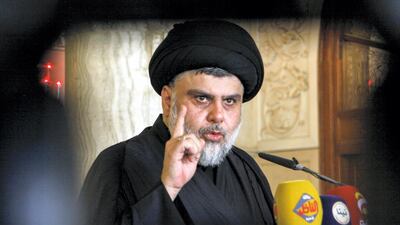
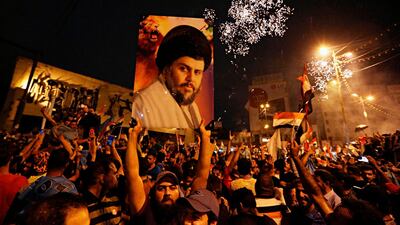
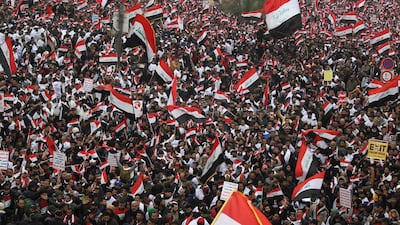
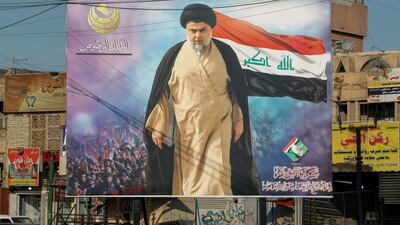
Iraqi populist cleric Moqtada Al Sadr said on Wednesday his country will form a national government free of external influences after the ratification of election results that confirmed gains for the Shiite leader.
Mr Al Sadr's coalition secured 73 of the Parliament's 329 seats in the national elections, gaining more than any other party and up from 54 in 2018 polls.
“In the name of God ... a government of national unity, neither eastern nor western,” Mr Al Sadr said on Twitter after meeting with leaders of the Iraqi Co-ordination Framework, the umbrella group of Shiite parties contesting the election’s results.
The meeting with Shiite leaders included paramilitary leader Hadi Al Amiri, who leads the Fatah party, and Qais Al Khazali who is secretary general of the Iran-backed Asaib Ahl Al Haq, and Falih Al Fayyadh, head of the government's Popular Mobilisation Commission.
The cleric is a former leader of an anti-American militia who has often surprised observers with his political manoeuvres.
He has long said that he is pushing to be in the majority government but not in a coalition with weaker parties. He believes that a coalition government fails to serve the interests of Iraqis.
The decision made by the Federal Supreme Court places Mr Al Sadr at the centre of Iraq's lengthy government formation process.
A dispute was raised by an Iran-backed Shiite bloc that contested gains by a rival Shiite political bloc that had stalled the formation of a government.
After the announcement of the court’s decision on Monday, Mr Al Sadr thanked the electoral commission and the Iraqi people on Twitter.
Moqtada Al Sadr: from warlord to political leader - in pictures
Tips for used car buyers
- Choose cars with GCC specifications
- Get a service history for cars less than five years old
- Don’t go cheap on the inspection
- Check for oil leaks
- Do a Google search on the standard problems for your car model
- Do your due diligence. Get a transfer of ownership done at an official RTA centre
- Check the vehicle’s condition. You don’t want to buy a car that’s a good deal but ends up costing you Dh10,000 in repairs every month
- Validate warranty and service contracts with the relevant agency and and make sure they are valid when ownership is transferred
- If you are planning to sell the car soon, buy one with a good resale value. The two most popular cars in the UAE are black or white in colour and other colours are harder to sell
Tarek Kabrit, chief executive of Seez, and Imad Hammad, chief executive and co-founder of CarSwitch.com
Specs
Engine: Dual-motor all-wheel-drive electric
Range: Up to 610km
Power: 905hp
Torque: 985Nm
Price: From Dh439,000
Available: Now
Zodi%20%26%20Tehu%3A%20Princes%20Of%20The%20Desert
%3Cp%3E%3Cstrong%3EDirector%3A%20%3C%2Fstrong%3EEric%20Barbier%26nbsp%3B%3C%2Fp%3E%0A%3Cp%3E%3Cstrong%3EStarring%3A%20%3C%2Fstrong%3EYoussef%20Hajdi%2C%20Nadia%20Benzakour%2C%20Yasser%20Drief%3C%2Fp%3E%0A%3Cp%3E%3Cstrong%3ERating%3A%3C%2Fstrong%3E%204%2F5%3C%2Fp%3E%0A
How Apple's credit card works
The Apple Card looks different from a traditional credit card — there's no number on the front and the users' name is etched in metal. The card expands the company's digital Apple Pay services, marrying the physical card to a virtual one and integrating both with the iPhone. Its attributes include quick sign-up, elimination of most fees, strong security protections and cash back.
What does it cost?
Apple says there are no fees associated with the card. That means no late fee, no annual fee, no international fee and no over-the-limit fees. It also said it aims to have among the lowest interest rates in the industry. Users must have an iPhone to use the card, which comes at a cost. But they will earn cash back on their purchases — 3 per cent on Apple purchases, 2 per cent on those with the virtual card and 1 per cent with the physical card. Apple says it is the only card to provide those rewards in real time, so that cash earned can be used immediately.
What will the interest rate be?
The card doesn't come out until summer but Apple has said that as of March, the variable annual percentage rate on the card could be anywhere from 13.24 per cent to 24.24 per cent based on creditworthiness. That's in line with the rest of the market, according to analysts
What about security?
The physical card has no numbers so purchases are made with the embedded chip and the digital version lives in your Apple Wallet on your phone, where it's protected by fingerprints or facial recognition. That means that even if someone steals your phone, they won't be able to use the card to buy things.
Is it easy to use?
Apple says users will be able to sign up for the card in the Wallet app on their iPhone and begin using it almost immediately. It also tracks spending on the phone in a more user-friendly format, eliminating some of the gibberish that fills a traditional credit card statement. Plus it includes some budgeting tools, such as tracking spending and providing estimates of how much interest could be charged on a purchase to help people make an informed decision.
* Associated Press
Indoor cricket in a nutshell
Indoor Cricket World Cup - Sep 16-20, Insportz, Dubai
16 Indoor cricket matches are 16 overs per side
8 There are eight players per team
9 There have been nine Indoor Cricket World Cups for men. Australia have won every one.
5 Five runs are deducted from the score when a wickets falls
4 Batsmen bat in pairs, facing four overs per partnership
Scoring In indoor cricket, runs are scored by way of both physical and bonus runs. Physical runs are scored by both batsmen completing a run from one crease to the other. Bonus runs are scored when the ball hits a net in different zones, but only when at least one physical run is score.
Zones
A Front net, behind the striker and wicketkeeper: 0 runs
B Side nets, between the striker and halfway down the pitch: 1 run
C Side nets between halfway and the bowlers end: 2 runs
D Back net: 4 runs on the bounce, 6 runs on the full
More from Rashmee Roshan Lall
Tamkeen's offering
- Option 1: 70% in year 1, 50% in year 2, 30% in year 3
- Option 2: 50% across three years
- Option 3: 30% across five years