

A rare antique clay tablet that bears a portion of the Epic of Gilgamesh was returned to Iraq from the US on Tuesday in a victory for the war-torn nation in its long-running struggle to repatriate stolen artefacts.
The 127mm by 152mm fragment dates back 3,500 to 4,000 years. It was part of a group of more than 17,000 artefacts smuggled from Iraq decades ago and illegally imported to nations around the world. The tablets and other objects were seized from the Oklahoma-based Hobby Lobby company.
The chain of arts and crafts shops was forced by the US government to relinquish the items in 2017 and fined $3 million for failing to act on expert advice that the objects may have been looted or to declare their provenance to the authorities.

Iraqi Culture Minister, Hassan Nazim, told reporters the tablet had two points of value to the Iraqi people.
“In addition to its historical value, it has a symbolic value for restitution,” Mr Nazim said at a ceremony to celebrate the return at the Foreign Ministry.
“It is a message to all those who smuggle and sell our antiquities in auctions that in the end they will be repatriated."
Foreign Minister, Fuad Hussein, hailed it as a “victory against the desperate attempts to steal our long-standing history and civilisation”.
The epic poem, depicted in part on the tablet, follows the story of mythological hero-king of Uruk in southern Mesopotamia, Gilgamesh – two-thirds God and one-third human – and his half-wild best friend Enkidu.
Both undertake a series of dangerous quests and adventures in leaving Uruk. When Enkidu dies, Gilgamesh starts searching for immortality, embarking on a long and perilous journey.
The story also includes a separate account of the great flood similar to that which afflicts Noah in the biblical book of Genesis.
The artefact returned on Tuesday is known as the Dream Tablet and is written in the Akkadian language in cuneiform script.
-
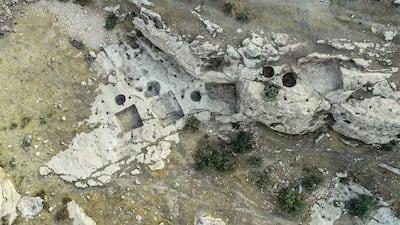
Archaeologists have discovered the remains of an ancient wine factory in the Nineveh region of northern Iraq. All photos by AFP -
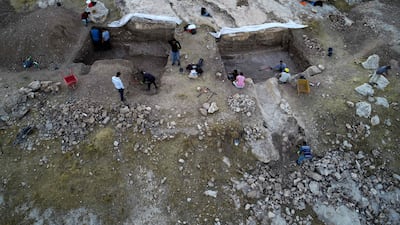
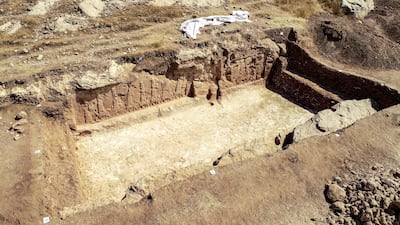
A team of Iraqi-Kurdish and Italian archaeologists excavate an ancient irrigation canal near Faydeh, in the Nineveh region. -
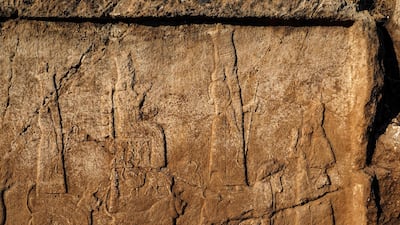
Carvings discovered on the walls of the ancient irrigation canal. -
The carvings, made in the stone bas-relief style, show kings praying to deities -
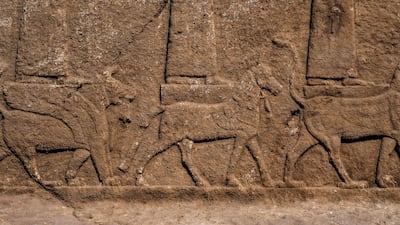
The carvings also show animals that were revered by the ancient Assyrians. -
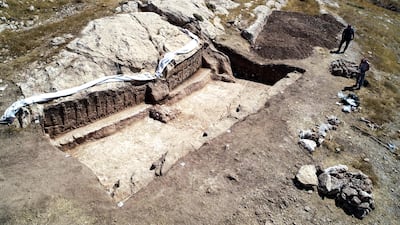
The carvings date from the reigns of Sargon II (721-705 BC) and his son Sennacherib. -
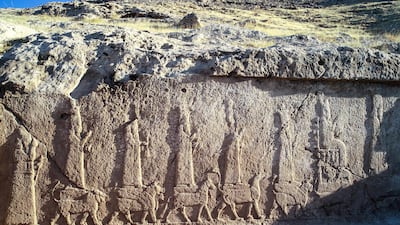
Experts say the carvings were made to remind people of the king who ordered the canal's construction. -

The director of antiquities in the Dohuk governorate of the Kurdistan Region of Iraq, Bekas Brefkany, announces the results of the archaeological excavations. -

Morandi Bonacossi, professor of Near Eastern archaeology at Italy's University of Udine and co-director of the Italian archaeology team, speaks at the Dohuk National Museum.


It is believed that the priceless relics were looted from Iraq and smuggled on the black market over the decades, mainly after the First Gulf War, when former dictator Saddam Hussein began to lose control of many remote parts of the country.
The Director of the Iraqi State Board of Antiquities and Heritage, Dr Laith Majid Hussein, denied that the tablet was stolen from a museum, saying it was illegally dug up and smuggled out of Iraq.
More stolen artefacts will be returned soon, Mr Hussein said without giving details.
Along with the tablet, Tuesday's event marked the return of a sheep statue dating back to 2,900-2,650 BC, also repatriated from the US and another tablet from the time of the Neo-Babylonian Empire, from 626 to 539 BC, seized in London.
The Mesopotamian literature, whether in poetic or prose forms written in Sumerian and Akkadian languages, addressed different issues of concern to the inhabitants whether in their private or public life.
Top among these issues were the origin of the universe, the mystery of death and life, the life after death and immortality, good and evil as well as the social values, behaviour and spiritual and emotional feelings.
That rich literature came in texts of varied natures, such as myths, epics, flood deluge, eschatology, wisdom, disputation, dialogue, satire, fables, proverbs, hymns, lamentation and love.
Most researchers agree that the Epic of Gilgamesh was written during the Old Babylonian period 2,000-1,500 BC when writing, collecting and categorising flourished.
The Epic influenced the minds of the people of ancient civilisations.
Different fragments were found not only in Southern Mesopotamian, known as the Land of Sumer and Akkad, but also in Assyria to the north and even in Anatolia, southern Turkey and Tell Megiddo in Palestine. Some were found translated into other languages.
The first fragments of the epic tablets were discovered among more than 1,000 tablets in the Royal Library of the 7th century Assyrian king Ashurbanipal in Nineveh in mid-19th century by the British traveller and archaeologist Austin Henry Layard and his assistant Hormized Rassam. Then, they unearthed 12 tablets.
More were found during excavations by foreign and local archaeologists during the last century.

