


Iraq’s Parliament was dissolved on Thursday, three days before an early general election on Sunday, Parliament Speaker Mohammed Al Halbousi said.
The election will be the fifth to be held since the American-led invasion of 2003 that ended Saddam Hussein’s decades long dictatorship and brought in a complex political system that is dominated by parties based on sect or ethnicity.
"Today will be the end of the fourth parliamentary session, and the people will choose their representatives on the 10th of October,” Mr Al Halbousi said on Twitter.
He said the early election was “the people’s choice” and thanked members of parliament for their efforts.
Parliament voted in March to dissolve on October 7 "provided that the elections are held on schedule".
Prime Minister Mustafa Al Kadhimi on Thursday called on Iraqis to turn out for the election.
"Our people have an opportunity to choose a new legislature, safeguard our nation and build our state," he said on Twitter.
"Vote for those who represent you as proud Iraqis. Create change through your own free will."
The early election was one of the main demands of anti-government protesters who took to the streets in late 2019 over rampant corruption, poor services, lack of employment opportunities and security.
The protests were met with deadly force by security forces who killed more than 600 demonstrators and injured over 20,000.
An electoral law that allowed a number of independent civil rights groups and political parties run for parliament. They are seen as opposition to the political class that has dominated governance of Iraq since 2003.
Mr Al Kadhimi promised to hold an early election after taking office in May last year.
He was appointed following the resignation of his predecessor, Adel Abdul Mahdi, in response to pressure from the protesters.
The protesters also called for the adoption of a new electoral law, which was ratified by Parliament last November, that allows independents to run for parliament for the first time since 2003.
The new law divides each of the country’s 18 provinces into electoral districts and prevents parties from running on unified lists, which helped them to sweep all the seats in a province in past elections. Instead, the seats will now go to whoever gets the most votes in an electoral district.
Who are the main contenders?
Powerful political parties linked to Iraq's Shiite majority are expected to maintain their dominance in the 329-seat legislature. However, these groups are deeply divided over the influence of Iran on Iraq's internal affairs.
Political parties formed by protesters are expected to win a few seats, but some are boycotting the election to protest against the system.
Women are guaranteed at least 83 seats in parliament under the new election law.
Who is expected to win?
The Sairoon alliance backed by populist Shiite cleric Moqtada Al Sadr is expected to emerge once again as the biggest bloc in parliament.
Sairoon won 54 seats in the 2018 election, giving Mr Al Sadr considerable sway over the government's formation and control over vital aspects of the state.
The cleric's Sadrist Movement is running on a nationalist platform, seeking to set itself apart from Shiite groups allied to Iran.
The Iran-backed groups are also expected to win a large number of seats. The most influential group is the Fatah Alliance led by paramilitary leader Hadi Al Amiri, which got 48 seats in 2018.
-
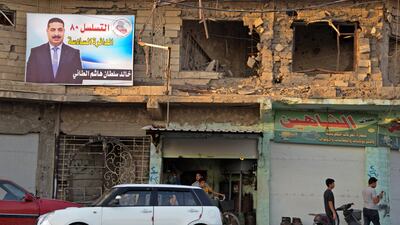
A banner for a candidate is seen in Iraq's second city of Mosul. Iraq's elections will go ahead as planned on October 10, officials say. AFP -
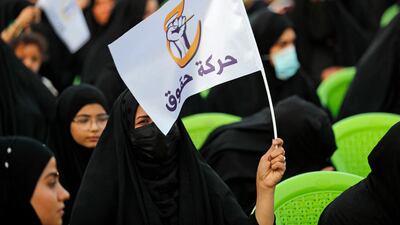
A woman holds a flag of the Huquq electoral list during a campaign rally in Baghdad. AFP -
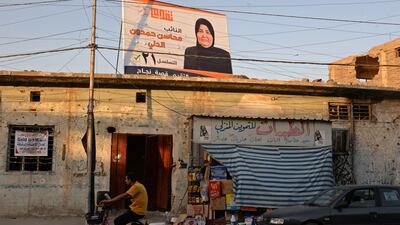
A banner for a candidate installed on a rooftop in Mosul. AFP -
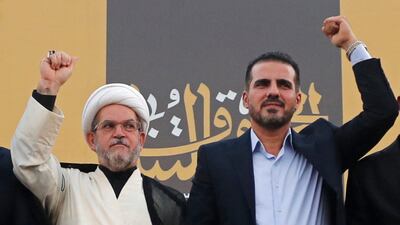
Abu Ali Al Askari, right, spokesman of Iraqi Kataeb Hezbollah, during a campaign rally in Baghdad. AFP -
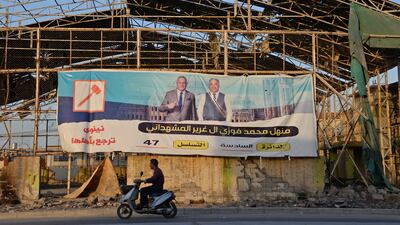
Experts are predicting a muted turnout in the October vote because of distrust in the country’s electoral system. AFP -

Candidates of the Huquq electoral list during a campaign rally in Baghdad. AFP -
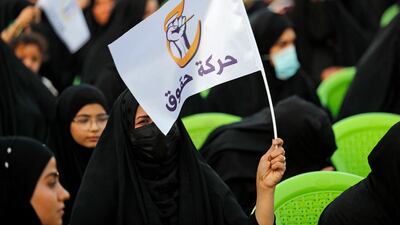
A woman holds a flag of the Huquq electoral list during a campaign rally in Baghdad. AFP -
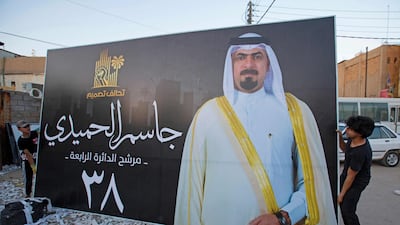
Workers prepare to transport campaign banners in Iraq's southern port city of Basra, ahead of the upcoming parliamentary elections. AFP -
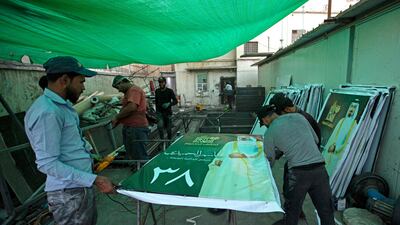
Workers prepare campaign banners in Iraq's southern port city of Basra ahead of the upcoming parliamentary elections. AFP -
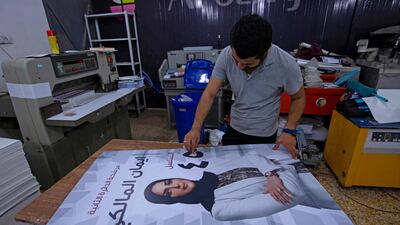
A worker prepares a campaign poster in Iraq's southern port city of Basra on September 12, 2021, ahead of the upcoming parliamentary elections. (Photo by Hussein FALEH / AFP) -
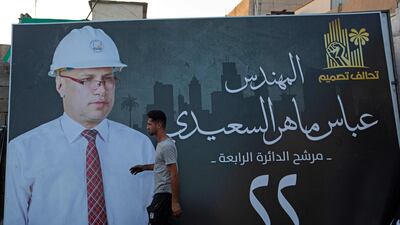
A worker walks by a campaign banner at a workshop in Iraq's southern port city of Basra on, ahead of the upcoming parliamentary elections. AFP -
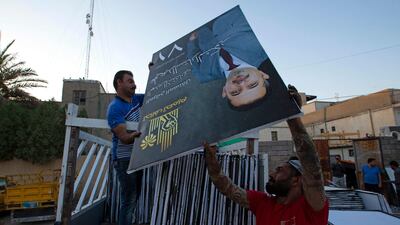
Workers prepare to transport campaign banners in Iraq's southern port city of Basra, ahead of the upcoming parliamentary elections. AFP -
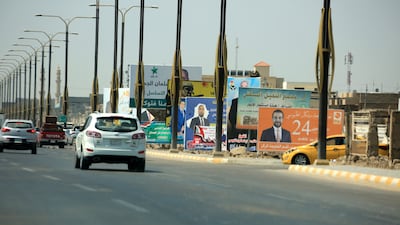
Iraqis pass by-election campaign posters for Iraqi candidates at a street in Fallujah city, 60 kilometres west of Baghdad, Iraq. The Special Representative for the United Nations Assistance Mission for Iraq, Jeanine Antoinette Hennis-Plasschaert, announced on 07 September 2021, that a group of 130 international experts and around 600 supporting staff will be monitoring Iraq’s upcoming elections. EPA -
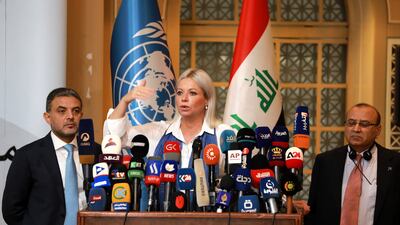
The Special Representative for the United Nations Assistance Mission for Iraq, Jeanine Antoinette Hennis-Plasschaert, speaks during a press conference in Baghdad, Iraq. A group of 130 international experts and around 600 supporting staff will be monitoring Iraq’s upcoming elections, Plasschaert said during the press conference. EPA


The Fatah Alliance includes the political wing of Asaib Ahl Al Haq, which the United States has designated a terrorist group, and also represents the Badr Organisation, which has longstanding ties with Tehran and fought alongside Iran in the 1980-1988 Iran-Iraq war.
Among the Sunni blocs, one of the most influential is the Taqaddum, or progress, alliance led by Mr Al Halbousi that includes leaders from the Sunni-majority north and west of Iraq.
Kurdish parties also play an important role in the government's formation.
The two main groups are the Kurdistan Democratic Party (KDP), which dominates the government of Iraq's semi-autonomous Kurdish region, and the Patriotic Union of Kurdistan (PUK) party, which holds sway in areas along the border with Iran and is headquartered in Sulaimaniya.
The KDP won 25 seats in the 2018 election and the PUK won 18. They are expected to retain the lion's share of Kurdish votes, followed by smaller parties. The total tally by seven Kurdish parties in 2018 was 58.

