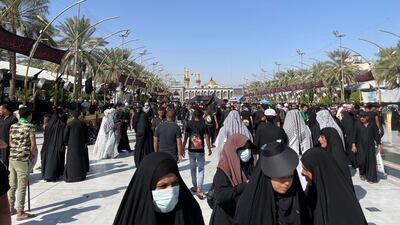
• Shiite Muslim pilgrims gather at the shrine of Imam Al Abbas in the central Iraqi holy city of Karbala, ahead of the Arbaeen religious festival. AFP
    Shiite Muslim pilgrims gather at the shrine of Imam Al Abbas in the central Iraqi holy city of Karbala, ahead of the Arbaeen religious festival. AFP
  • Every year, Shiite pilgrims converge in large numbers to the holy Iraqi cities of Najaf and Karbala ahead of Arbaeen, which marks the 40th day after Ashura, commemorating the seventh century killing of Prophet Mohammed's grandson Imam Hussein. AFP
    Every year, Shiite pilgrims converge in large numbers to the holy Iraqi cities of Najaf and Karbala ahead of Arbaeen, which marks the 40th day after Ashura, commemorating the seventh century killing of Prophet Mohammed's grandson Imam Hussein. AFP
  • Shiite Muslim pilgrims gather at the shrine of Imam Al Abbas in the central Iraqi holy city of Karbala. AFP
    Shiite Muslim pilgrims gather at the shrine of Imam Al Abbas in the central Iraqi holy city of Karbala. AFP
  • Every year, Shiite pilgrims converge in large numbers to the holy Iraqi cities of Najaf and Karbala. AFP
    Every year, Shiite pilgrims converge in large numbers to the holy Iraqi cities of Najaf and Karbala. AFP
  • Iranian pilgrims sit waiting upon their arrival to Iraq via the Al Shalamija border crossing, west of the southern city of Basra, before starting their journey toward the holy city of Karbala. AFP
    Iranian pilgrims sit waiting upon their arrival to Iraq via the Al Shalamija border crossing, west of the southern city of Basra, before starting their journey toward the holy city of Karbala. AFP
  • Every year, Shiite pilgrims converge in large numbers to the holy Iraqi cities of Najaf and Karbala ahead of Arbaeen. AFP
    Every year, Shiite pilgrims converge in large numbers to the holy Iraqi cities of Najaf and Karbala ahead of Arbaeen. AFP
  • A young Iranian pilgrim waits at the Al-Shalamija border crossing, west of the southern Iraqi city of Basra, before crossing to Iraq to mark the Arbaeen religious festival, following the reopening of the border that was shut due to the coronavirus pandemic. AFP
    A young Iranian pilgrim waits at the Al-Shalamija border crossing, west of the southern Iraqi city of Basra, before crossing to Iraq to mark the Arbaeen religious festival, following the reopening of the border that was shut due to the coronavirus pandemic. AFP
  • A young Iranian pilgrim waits at the Al-Shalamija border crossing, west of the southern Iraqi city of Basra, before crossing to Iraq to mark the Arbaeen religious festival, on September 25, 2021, follwoing the reopening of the border that was shut due to the coronavirus pandemic. - Every year, Shiite pilgrims converge in large numbers to the holy Iraqi cities of Najaf and Karbala ahead of Arbaeen, which marks the 40th day after Ashura, commemorating the seventh century killing of Prophet Mohammed's grandson Imam Hussein. (Photo by Hussein FALEH / AFP)
    A young Iranian pilgrim waits at the Al-Shalamija border crossing, west of the southern Iraqi city of Basra, before crossing to Iraq to mark the Arbaeen religious festival, on September 25, 2021, follwoing the reopening of the border that was shut due to the coronavirus pandemic. - Every year, Shiite pilgrims converge in large numbers to the holy Iraqi cities of Najaf and Karbala ahead of Arbaeen, which marks the 40th day after Ashura, commemorating the seventh century killing of Prophet Mohammed's grandson Imam Hussein. (Photo by Hussein FALEH / AFP)
  • A young Iranian pilgrim reacts upon his arrival to Iraq via the Al-Shalamija border crossing, west of the southern city of Basra, to mark the Arbaeen religious festival, follwoing the reopening of the border that was shut due to the coronavirus pandemic. - Every year, Shiite pilgrims converge in large numbers to the holy Iraqi cities of Najaf and Karbala ahead of Arbaeen, which marks the 40th day after Ashura, commemorating the seventh century killing of Prophet Mohammed's grandson Imam Hussein. AFP
    A young Iranian pilgrim reacts upon his arrival to Iraq via the Al-Shalamija border crossing, west of the southern city of Basra, to mark the Arbaeen religious festival, follwoing the reopening of the border that was shut due to the coronavirus pandemic. - Every year, Shiite pilgrims converge in large numbers to the holy Iraqi cities of Najaf and Karbala ahead of Arbaeen, which marks the 40th day after Ashura, commemorating the seventh century killing of Prophet Mohammed's grandson Imam Hussein. AFP
  • Iranian pilgrims react upon their arrival to Iraq via the Al Shalamija border crossing. AFP
    Iranian pilgrims react upon their arrival to Iraq via the Al Shalamija border crossing. AFP
  • Pilgrims arrive to participate in the holy Shi'ite ritual of Arbaeen, on the Iraqi side of the Shalamcha Border Crossing in Basra, Iraq. REUTERS
    Pilgrims arrive to participate in the holy Shi'ite ritual of Arbaeen, on the Iraqi side of the Shalamcha Border Crossing in Basra, Iraq. REUTERS
  • An Iranian Shi'ite pilgrim man arrives to participate in the holy Shi'ite ritual of Arbaeen, on the Iraqi side of the Shalamcha Border Crossing in Basra, Iraq. REUTERS
    An Iranian Shi'ite pilgrim man arrives to participate in the holy Shi'ite ritual of Arbaeen, on the Iraqi side of the Shalamcha Border Crossing in Basra, Iraq. REUTERS
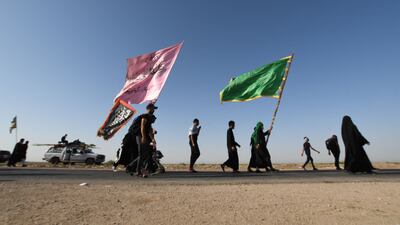
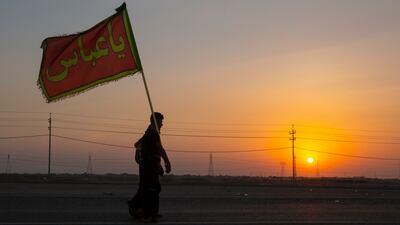
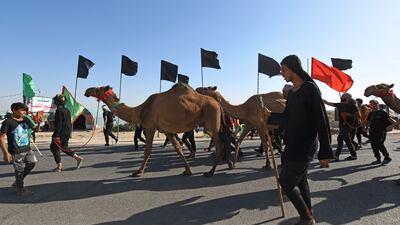
  • Shiite pilgrims march from the city of Najaf to the holy city of Karbala in central Iraq early, to mark the Arbaeen religious festival. AFP
    Shiite pilgrims march from the city of Najaf to the holy city of Karbala in central Iraq early, to mark the Arbaeen religious festival. AFP
  • Shi'ite Muslim pilgrims walk to the holy city of Kerbala, ahead of the holy Shi'ite ritual of Arbaeen in Baghdad, Iraq. REUTERS
    Shi'ite Muslim pilgrims walk to the holy city of Kerbala, ahead of the holy Shi'ite ritual of Arbaeen in Baghdad, Iraq. REUTERS
  • Shi'ite Muslim pilgrims walk to the holy city of Kerbala, ahead of the holy Shi'ite ritual of Arbaeen in Baghdad, Iraq. REUTERS
    Shi'ite Muslim pilgrims walk to the holy city of Kerbala, ahead of the holy Shi'ite ritual of Arbaeen in Baghdad, Iraq. REUTERS
  • Shi'ite Muslim pilgrims walk to the holy city of Kerbala, ahead of the holy Shi'ite ritual of Arbaeen in Baghdad, Iraq. REUTERS
    Shi'ite Muslim pilgrims walk to the holy city of Kerbala, ahead of the holy Shi'ite ritual of Arbaeen in Baghdad, Iraq. REUTERS

Arbaeen draws thousands of Shiites to Iraq’s Karbala


Sinan Mahmoud
  • English
  • Arabic

Hundreds of thousands of black-clad Shiite Muslim pilgrims thronged to Iraq’s revered shrine city of Karbala on Tuesday to observe a major religious event amid tight security measures.

The annual pilgrimage, known as Arbaeen, marks the end of a 40-day mourning period for the killing of the 7th century grandson of the Prophet Mohammed, Imam Hussein, along with his family members and loyalists.

At the time, Imam Hussein had revolted against the Damascus-based second Umayyad caliph, Yazid bin Muawiyah, moving from Madinah to outside Karbala in modern day Iraq, where a battle took place.

Surviving family members were then taken to Damascus as prisoners.

Arbaeen occurs forty days after the day of Ashoura, when Imam Hussein was killed. It marks the return of his family to Karbala from Damascus, to bid farewell and grieve for their loved ones while on their way to Madinah.

Sitting cross-legged inside the ornately decorated plaza that surrounds the tomb, worshippers wept and beat their chests in grief as a sheikh on a podium recited the story of the return, with elegies.

Those inside scrambled to touch Imam Hussein’s sarcophagus, which is encased in engraved gold and silver. Those who reached the silver protective bar held it tight, recited prayers and broke down in tears.

Outside, different factions of Iraqi security forces, including the government-sanctioned Popular Mobilisation Forces, an umbrella group that is made up mainly of pro-Iran Shiite militias, closed off all roads leading to Karbala to protect the pilgrims. Military helicopters hovered overhead.

  • A pilgrim holds a Popular Mobilisation Forces flag outside the revered shrines of Imam Hussein and Abbas, the grandsons of the Prophet Mohammed, in Iraq. Sinan Mahmoud / The National
    A pilgrim holds a Popular Mobilisation Forces flag outside the revered shrines of Imam Hussein and Abbas, the grandsons of the Prophet Mohammed, in Iraq. Sinan Mahmoud / The National
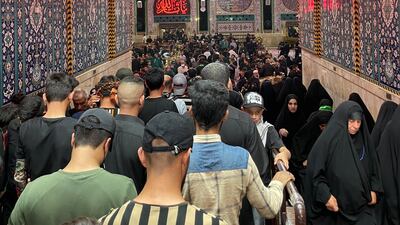
  • Pilgrims scramble to touch and kiss the protective bars of Imam Hussein's tomb. Sinan Mahmoud / The National
    Pilgrims scramble to touch and kiss the protective bars of Imam Hussein's tomb. Sinan Mahmoud / The National
  • Travel restrictions have eased in Iraq, allowing people to attend the Arbaeen pilgrimage. Sinan Mahmoud / The National
    Travel restrictions have eased in Iraq, allowing people to attend the Arbaeen pilgrimage. Sinan Mahmoud / The National
  • The Al Taj hotel in Karbala prepares to welcome guests. Sinan Mahmoud / The National
    The Al Taj hotel in Karbala prepares to welcome guests. Sinan Mahmoud / The National
  • Pilgrims enter the shrine of Imam Hussein. Sinan Mahmoud / The National
    Pilgrims enter the shrine of Imam Hussein. Sinan Mahmoud / The National
  • In the past, the holy day meant hotels like the Al Taj were fully booked. Sinan Mahmoud / The National
    In the past, the holy day meant hotels like the Al Taj were fully booked. Sinan Mahmoud / The National
  • Hoping to see the tourists return this year, Ameer Bashir, 23, displays souvenirs in his shop in Karbala. Sinan Mahmoud / The National.
    Hoping to see the tourists return this year, Ameer Bashir, 23, displays souvenirs in his shop in Karbala. Sinan Mahmoud / The National.
  • A boy distributes sweets to Iraqi Shiite Muslim pilgrims marching from the southern port city of Basra to the holy city of Karbala, ahead of the Arbaeen festival. AFP
    A boy distributes sweets to Iraqi Shiite Muslim pilgrims marching from the southern port city of Basra to the holy city of Karbala, ahead of the Arbaeen festival. AFP
  • Each year, pilgrims head to the holy cities of Najaf and Karbala ahead of the festival. AFP
    Each year, pilgrims head to the holy cities of Najaf and Karbala ahead of the festival. AFP
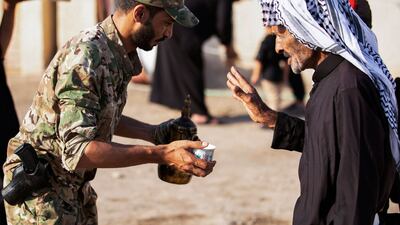
  • A member of Iraq's Hashed al-Shaabi (Popular Mobilisation) paramilitary forces offers coffee to a pilgrim. AFP
    A member of Iraq's Hashed al-Shaabi (Popular Mobilisation) paramilitary forces offers coffee to a pilgrim. AFP
  • Arbaeen marks the 40th day after Ashura, commemorating the seventh-century killing of the Prophet Mohammed's grandson, Imam Hussein. AFP
    Arbaeen marks the 40th day after Ashura, commemorating the seventh-century killing of the Prophet Mohammed's grandson, Imam Hussein. AFP
  • Pilgrims march from the country's southern city of Nasiriyah in the Dhi Qar province to Karbala. AFP
    Pilgrims march from the country's southern city of Nasiriyah in the Dhi Qar province to Karbala. AFP

Sunni extremist militants often attack Shiites during their religious festivals, viewing them as heretics. But attacks have become rare over the years after the successive defeats of Al Qaeda in Iraq and later, ISIS. No attacks were reported this year.

“Thank God, the pilgrimage was wonderful and everything went well,” Iranian pilgrim Khadiga Ismael told The National over the phone from Karbala.

Ms Ismael, 50, arrived Karbala on Tuesday morning after crossing the Shalamcha border crossing in Basra. She's from Bushehr province in southern Iran and is travelling with her two daughters, two grandsons and a son-in-law.

“This is the first time to do Arbaeen pilgrimage. I feel energetic and not feeling at all tired despite my diabetes and other health problems, thanks to Imam Hussein's blessings,” she said.

“I prayed for my family as well as Iraq and Iraqis to live in peace and security,” she added.

The event usually draws millions of pilgrims from around the world to visit the gold-domed shrines of Imam Hussein and his brother Imam Abbas.

The main ritual for the event is the traditional long-walk to Karbala from different areas inside and outside of Iraq to show support for Imam Hussein’s family, who walked from Damascus to Karbala.

Volunteers set up tents along the roads to distribute free food and drinks and offer places for pilgrims to relax.

The story of Imam Hussein is deeply ingrained in the Shiite consciousness. For them, it is a story of a revolution against tyranny and the sacrifice of an extraordinary, revered figure for the sake of reform.

The event “embodies the most beautiful noble human principles of reform and peace and rejects injustice and tyranny, to live with dignity,” Iraqi President Barham Salih said during his speech at the UN General Assembly meeting in New York this month.

“Our people are determined to protect the country and to continue moving on the path of reform and fighting corruption and protecting the right to live a dignified life,” Mr Salih added.

The country’s Prime Minister, Mustafa Al Kadhimi, said of the commemoration: “The revolution of Imam Hussein is one of the most prominent historic examples of protest against human rights violations.”

“We are reminded today that confronting such violations is never an easy task, and requires more than good intentions,” Mr Al Kadhimi added — obliquely referencing the current national youth protest movement, which he claims to support.

Such gatherings have been a challenge to Iraqi health authorities struggling to contain the coronavirus pandemic. Protective measures are not observed properly, and only a minority of people wear masks.

In a bid to control the number of pilgrims, the Iraqi government prevented foreign Shiite pilgrims from entering Iraq last year.

This year, it decided to allow to 80,000 pilgrims to enter with a quota of 60,000 pilgrims for Iran and the rest from other countries.

The travellers can enter Iraq only through airports and will have to show a negative Covid test within three days of their arrival.

But the number entering through the airports of Baghdad and Najaf alone was about 100,000, according to Jihad Al Diwan, the spokesman of the Iraqi Aviation Authority.

After pressure from the Iranian government, thousands of other Iranian pilgrims were allowed to enter the country after gathering at overland border crossings.

In recent weeks, Iraq emerged from a third wave of Covid-19, with recorded cases peaking in late July.

On Monday, the country registered 2,447 new cases and 32 deaths, taking the total number of infections to 1,996,214 and fatalities to 22,948.


UAE currency: the story behind the money in your pockets
COMPANY PROFILE

Name: Lamsa

Founder: Badr Ward

Launched: 2014

Employees: 60

Based: Abu Dhabi

Sector: EdTech

Funding to date: $15 million

First Person
Richard Flanagan
Chatto & Windus 

About Krews

Founder: Ahmed Al Qubaisi

Based: Abu Dhabi

Founded: January 2019

Number of employees: 10

Sector: Technology/Social media 

Funding to date: Estimated $300,000 from Hub71 in-kind support


Company profile

Name: The Concept

Founders: Yadhushan Mahendran, Maria Sobh and Muhammad Rijal

Based: Abu Dhabi

Founded: 2017

Number of employees: 7

Sector: Aviation and space industry

Funding: $250,000

Future plans: Looking to raise $1 million investment to boost expansion and develop new products

The team

Videographer: Jear Velasquez 

Photography: Romeo Perez 

Fashion director: Sarah Maisey 

Make-up: Gulum Erzincan at Art Factory 

Models: Meti and Clinton at MMG 

Video assistant: Zanong Maget 

Social media: Fatima Al Mahmoud  

Updated: September 28, 2021, 3:53 PM