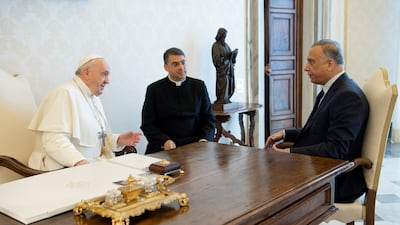
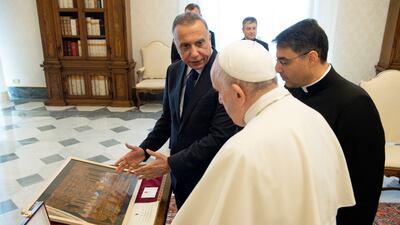
Chaldean Patriarch Louis Raphael Sako and Pope Francis in 2018. Cardinal Sako has met Iraqi Prime Minister Mustafa Al Kadhimi about supporting the minority community. Getty

Iraqi Christians see little prospect of returning to former homes


Mina Aldroubi
  • English
  • Arabic

Iraqi Christians say they despair about ever returning to the homes they fled after the rise of ISIS, despite government assurances about their safety.

Prime Minister Mustafa Al Kadhimi praised the minority community's contribution to Iraq during a meeting with Chaldean Patriarch Louis Raphael Sako on Sunday and promised his government's support to help Christians return home.

“The presence of Christians in Iraq is one of the most important pillars of the deep diversity in Iraqi society which today contributes to protecting the democratic system and provides solutions to political differences,” Mr Al Kadhimi said.

“Full support will be provided to facilitate the safe return and stability of Christians.”

The struggles of Iraq’s Christians came into focus as ISIS swept through the country's north in June 2014 after seizing Mosul, the region's main city.

The extremists committed atrocities against Christians and other religious and ethnic groups in the area, forcing thousands to seek refuge in Iraq’s autonomous Kurdish region as well as neighbouring countries.

We appreciate the call made by Prime Minister Mustafa Al Kadhimi, but we are scared
Eva Putros,
Iraqi Christian living in Erbil

“I wish I could return home to Mosul and we appreciate the call made by Prime Minister Mustafa Al Kadhimi, but we are scared,” said Eva Putros, an Iraqi Christian living in the Kurdish city of Erbil.

“We left Mosul a few weeks after ISIS took over and we were allowed entry into the Kurdish region because of my car’s license plate. I bought it in Erbil a few years before the takeover,” she told The National.

Ms Putros and her family left their home and belongings in the care of neighbours until they could return. However, she learnt that other people moved in soon after they left, claiming to be the new owners.

Several years later, armed groups turned her home into a command centre.

“My family and I have set up our lives in Erbil. I’ve put the past behind me and what happened to us. We lost everything – it’s all gone – but at least we have each other,” Ms Putros said.

She has not returned to Mosul since July 2014.

The Iraqi government has repeatedly called for Christians to return to their homes following the defeat of ISIS in 2017. However, many say they have lost hope in the state's ability to protect them.

Charles Hanna, an internally displaced Iraqi Christian, said the government was unable to provide the public with security or even basic services such as electricity or water.

“We are searching for a better future than the one the Iraqi government can provide us. This will unfortunately mean that we need to leave the land of our ancestors,” Mr Hanna, 65, told The National.

Since 2003, when a US-led invasion toppled dictator Saddam Hussein, Iraq's Christian population has dropped from about 1.5 million to an estimated 250,000.

Mr Hanna, a retired schoolteacher, fled Mosul two years after ISIS took over. He lived in the Virgin Mary Refugee Camp in Baghdad with his family until it closed earlier this year.

The camp has now been turned into an unofficial residential area for those displaced Christians who preferred to stay put rather than return to their region of origin.

Many displaced Iraqis prefer to live in modest camps rather than go back to the places they fled.

“We have no one and fear for Iraqi Christians who are still inside the country,” Mr Hanna said.

Cardinal Sako and his delegation also met President Barham Salih, who said the Christian community of Iraq was a vital component of the region.

“Christians stood by their brothers from all sects in Iraq’s society to face challenges, and their contributions had a profound impact. The East cannot be imagined without Christians,” Mr Salih said.

In March, Pope Francis made a historic four-day trip to Iraq, where he preached inter-faith coexistence.

The pontiff's visit was intended to boost the morale of Iraq's Christians and encourage those who fled abroad to return home.


Al Jazira's foreign quartet for 2017/18

Romarinho, Brazil

Lassana Diarra, France

Sardor Rashidov, Uzbekistan

Mbark Boussoufa, Morocco

The White Lotus: Season three

Creator: Mike White

Starring: Walton Goggins, Jason Isaacs, Natasha Rothwell

Rating: 4.5/5

The major Hashd factions linked to Iran:

Badr Organisation: Seen as the most militarily capable faction in the Hashd. Iraqi Shiite exiles opposed to Saddam Hussein set up the group in Tehran in the early 1980s as the Badr Corps under the supervision of the Iran Revolutionary Guards Corps (IRGC). The militia exalts Iran’s Supreme Leader Ali Khamenei but intermittently cooperated with the US military.

Saraya Al Salam (Peace Brigade): Comprised of former members of the officially defunct Mahdi Army, a militia that was commanded by Iraqi cleric Moqtada Al Sadr and fought US and Iraqi government and other forces between 2004 and 2008. As part of a political overhaul aimed as casting Mr Al Sadr as a more nationalist and less sectarian figure, the cleric formed Saraya Al Salam in 2014. The group’s relations with Iran has been volatile.

Kataeb Hezbollah: The group, which is fighting on behalf of the Bashar Al Assad government in Syria, traces its origins to attacks on US forces in Iraq in 2004 and adopts a tough stance against Washington, calling the United States “the enemy of humanity”.

Asaeb Ahl Al Haq: An offshoot of the Mahdi Army active in Syria. Asaeb Ahl Al Haq’s leader Qais al Khazali was a student of Mr Al Moqtada’s late father Mohammed Sadeq Al Sadr, a prominent Shiite cleric who was killed during Saddam Hussein’s rule.

Harakat Hezbollah Al Nujaba: Formed in 2013 to fight alongside Mr Al Assad’s loyalists in Syria before joining the Hashd. The group is seen as among the most ideological and sectarian-driven Hashd militias in Syria and is the major recruiter of foreign fighters to Syria.

Saraya Al Khorasani:  The ICRG formed Saraya Al Khorasani in the mid-1990s and the group is seen as the most ideologically attached to Iran among Tehran’s satellites in Iraq.

(Source: The Wilson Centre, the International Centre for the Study of Radicalisation)

Mercer, the investment consulting arm of US services company Marsh & McLennan, expects its wealth division to at least double its assets under management (AUM) in the Middle East as wealth in the region continues to grow despite economic headwinds, a company official said.

Mercer Wealth, which globally has $160 billion in AUM, plans to boost its AUM in the region to $2-$3bn in the next 2-3 years from the present $1bn, said Yasir AbuShaban, a Dubai-based principal with Mercer Wealth.

Within the next two to three years, we are looking at reaching $2 to $3 billion as a conservative estimate and we do see an opportunity to do so,” said Mr AbuShaban.

Mercer does not directly make investments, but allocates clients’ money they have discretion to, to professional asset managers. They also provide advice to clients.

“We have buying power. We can negotiate on their (client’s) behalf with asset managers to provide them lower fees than they otherwise would have to get on their own,” he added.

Mercer Wealth’s clients include sovereign wealth funds, family offices, and insurance companies among others.

From its office in Dubai, Mercer also looks after Africa, India and Turkey, where they also see opportunity for growth.

Wealth creation in Middle East and Africa (MEA) grew 8.5 per cent to $8.1 trillion last year from $7.5tn in 2015, higher than last year’s global average of 6 per cent and the second-highest growth in a region after Asia-Pacific which grew 9.9 per cent, according to consultancy Boston Consulting Group (BCG). In the region, where wealth grew just 1.9 per cent in 2015 compared with 2014, a pickup in oil prices has helped in wealth generation.

BCG is forecasting MEA wealth will rise to $12tn by 2021, growing at an annual average of 8 per cent.

Drivers of wealth generation in the region will be split evenly between new wealth creation and growth of performance of existing assets, according to BCG.

Another general trend in the region is clients’ looking for a comprehensive approach to investing, according to Mr AbuShaban.

“Institutional investors or some of the families are seeing a slowdown in the available capital they have to invest and in that sense they are looking at optimizing the way they manage their portfolios and making sure they are not investing haphazardly and different parts of their investment are working together,” said Mr AbuShaban.

Some clients also have a higher appetite for risk, given the low interest-rate environment that does not provide enough yield for some institutional investors. These clients are keen to invest in illiquid assets, such as private equity and infrastructure.

“What we have seen is a desire for higher returns in what has been a low-return environment specifically in various fixed income or bonds,” he said.

“In this environment, we have seen a de facto increase in the risk that clients are taking in things like illiquid investments, private equity investments, infrastructure and private debt, those kind of investments were higher illiquidity results in incrementally higher returns.”

The Abu Dhabi Investment Authority, one of the largest sovereign wealth funds, said in its 2016 report that has gradually increased its exposure in direct private equity and private credit transactions, mainly in Asian markets and especially in China and India. The authority’s private equity department focused on structured equities owing to “their defensive characteristics.”

Benefits of first-time home buyers' scheme
  • Priority access to new homes from participating developers
  • Discounts on sales price of off-plan units
  • Flexible payment plans from developers
  • Mortgages with better interest rates, faster approval times and reduced fees
  • DLD registration fee can be paid through banks or credit cards at zero interest rates
UAE currency: the story behind the money in your pockets
F1 The Movie

Starring: Brad Pitt, Damson Idris, Kerry Condon, Javier Bardem

Director: Joseph Kosinski

Rating: 4/5

The%20Emperor%20and%20the%20Elephant
%3Cp%3E%3Cstrong%3EAuthor%3A%20%3C%2Fstrong%3ESam%20Ottewill-Soulsby%3C%2Fp%3E%0A%3Cp%3E%3Cstrong%3EPublisher%3A%20%3C%2Fstrong%3EPrinceton%20University%20Press%3C%2Fp%3E%0A%3Cp%3E%3Cstrong%3EPages%3A%20%3C%2Fstrong%3E392%3C%2Fp%3E%0A%3Cp%3E%3Cstrong%3EAvailable%3A%20%3C%2Fstrong%3EJuly%2011%3C%2Fp%3E%0A
Skoda Superb Specs

Engine: 2-litre TSI petrol

Power: 190hp

Torque: 320Nm

Price: From Dh147,000

Available: Now

The Sky Is Pink

Director: Shonali Bose

Cast: Priyanka Chopra Jonas, Farhan Akhtar, Zaira Wasim, Rohit Saraf

Three stars

Day 2, Dubai Test: At a glance

Moment of the day Pakistan’s effort in the field had hints of shambles about it. The wheels were officially off when Wahab Riaz lost his run up and aborted the delivery four times in a row. He re-measured his run, jogged in for two practice goes. Then, when he was finally ready to go, he bailed out again. It was a total cringefest.

Stat of the day – 139.5 Yasir Shah has bowled 139.5 overs in three innings so far in this Test series. Judged by his returns, the workload has not withered him. He has 14 wickets so far, and became history’s first spinner to take five-wickets in an innings in five consecutive Tests. Not bad for someone whose fitness was in question before the series.

The verdict Stranger things have happened, but it is going to take something extraordinary for Pakistan to keep their undefeated record in Test series in the UAE in tact from this position. At least Shan Masood and Sami Aslam have made a positive start to the salvage effort.

The specs: 2019 Infiniti QX50

Price, base: Dh138,000 (estimate)
Engine: 2.0L, turbocharged, in-line four-cylinder
Transmission: Continuously variable transmission
Power: 268hp @ 5,600rpm
Torque: 380Nm @ 4,400rpm
Fuel economy: 6.7L / 100km (estimate)

Spider-Man%202
%3Cp%3E%3Cstrong%3EDeveloper%3A%3C%2Fstrong%3E%20Insomniac%20Games%0D%3Cbr%3E%3Cstrong%3EPublisher%3A%3C%2Fstrong%3E%20%20Sony%20Interactive%20Entertainment%0D%3Cbr%3E%3Cstrong%3EConsole%3A%20%3C%2Fstrong%3EPlayStation%205%0D%3Cbr%3E%3Cstrong%3ERating%3A%3C%2Fstrong%3E%205%2F5%3C%2Fp%3E%0A
Updated: August 16, 2021, 3:23 PM