


“We are not going back to Iraq, but you cannot tell anyone”.
I was 10 years old when I heard those words. I was staying in a hotel in Jeddah with my parents and sister, having come back from performing Umrah, the mini-pilgrimage in Makkah. We had packed up our home of only 10 months in Riyadh and were getting ready to head back to Baghdad. My parents decided on a stop in Makkah. The following day, October 9, 1990, we were due to fly to Amman and from there take a 12-hour drive to Baghdad. We would eventually make that journey, but not for many years.
My mother sat me down to tell me that our plans had changed. Going back to Baghdad was no longer possible. This came after a tumultuous two-month period, during which my parents’ lives had been turned upside down, as had the lives of millions of fellow Iraqis and Kuwaitis. The Iraqi regime had invaded Kuwait on August 2, upending the regional order – and with it all semblance of normality for the people of both countries.
From that day, our lives changed forever. A sense of fear of the unknown entered our lives and has yet to dissipate. We watched as Iraq became a pariah state, as all hopes of Saddam Hussein stepping back from the folly of the Kuwait invasion were dashed. Six months later, Iraq would retreat from Kuwait but only after great damage had been done to the two nations.
My father, a diplomat and consul in Iraq’s embassy in Riyadh, decided very soon after Saddam’s invasion of Kuwait that he could no longer represent the regime. My mother strongly agreed. A diplomat for more than 20 years and hailing from a family dedicated to public service, it was not an easy decision. But as a couple who opposed much of Saddam’s behaviour, there was no longer a way of carrying on. My parents had made a bold decision and had to find a way out. My father reached out secretly to Saudi authorities. The request for refuge was accepted and a plan was put into motion for our “disappearance”.
My sister, who was 12 at the time and had the maturity of someone twice her age, was informed in advance. I was too young – and too talkative – to be trusted with such a life or death decision. So I was only told the night before we were going to change course.
-
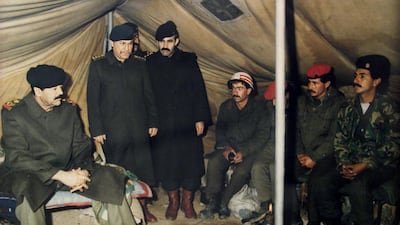
Saddam Hussein (L) with Iraqi troops in occupied Kuwait in 1990-1991. AFP -
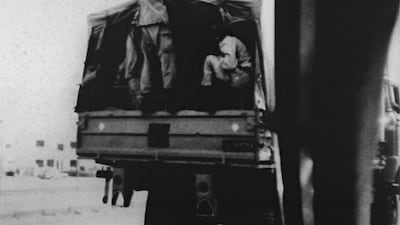
Iraqi soldiers in Kuwait City on August 3, 1990. AFP -

Sheikh Fahd Al Ahmed al-Sabah (C), brother of Emir of Kuwait, during the 1982 World Cup in Valladolid, Spain. He was killed by Iraqi troops during the invasion of Kuwait in 1990. AFP -
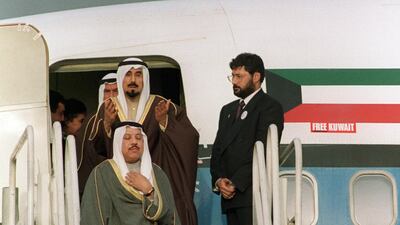
Sheikh Jaber Al Ahmad Al Sabah (top), Emir of Kuwait, disembarks on March 14, 1991 upon his arrival at Kuwait after seven months in exile during the Iraqi occupation of his country. AFP -
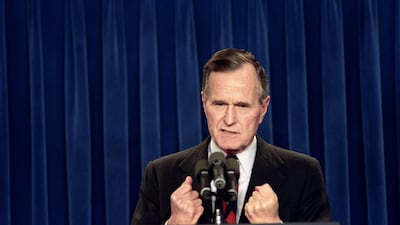
US President George Bush, the architect of the liberation of Kuwait, in Washington, on November 30, 1990. AFP -
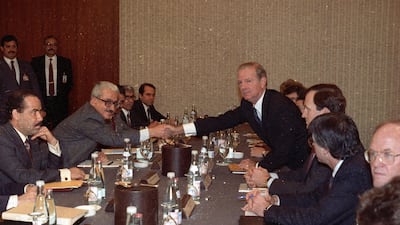
US Secretary of State James Baker (5th R) and Iraqi Foreign Minister Tariq Aziz in Geneva January 9, 1991. The meeting failed to convince Saddam to leave Kuwait, setting the scene for the Gulf War. Reuters -
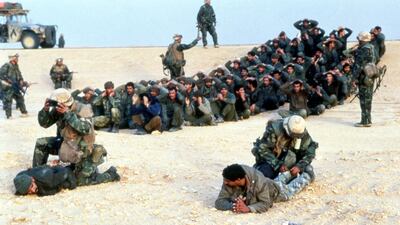
Iraqi prisoners of war in Saudi Arabian after giving themselves up to US troops in 1991. AP -
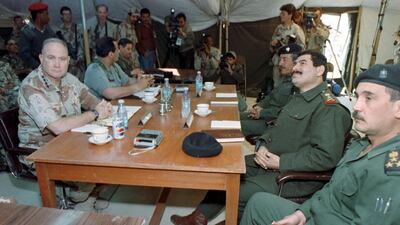
Allied Forces Commander Norman Schwarzkopf (L) meeting with Iraqi General Sultan Hashim (2nd R) in Safwan in Iraq on March 3, 1991, to set conditions for Iraq's surrender in the Gulf War. Reuters -
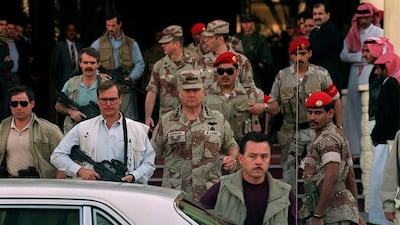
US General Norman Schwarzkopf (C), in Riyadh on February 10, 1991. AFP -
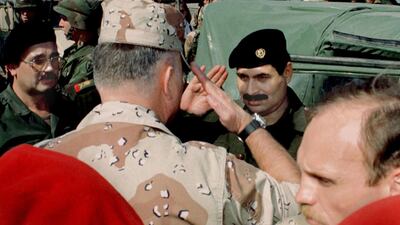
US General Norman Schwarzkopf (L), Allied Gulf War Commander, and General Sultan Hashim of Iraq (R) after talks to discuss Iraqi surrender terms in the Gulf War, in Safwan in south Iraq, on March 3, 1991. Reuters -
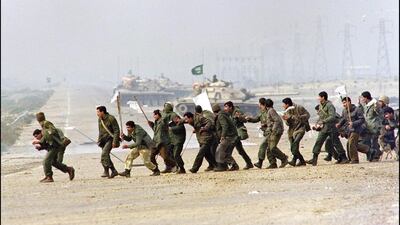
Iraqi soldiers carrying surrender flags on February 25, 1991 in Kuwait City. AFP -
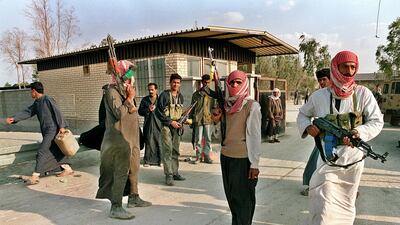
Shiite rebels on the outskirts of the southern Iraqi city of Nasiriyah on March 27, 1991. Saddam crushed the rebellion, although he was defeated in the Gulf War. AFP -
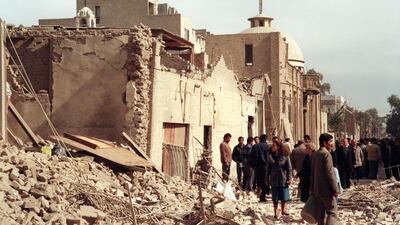
A photo dated February 16, 1991 showing damage near a church caused by an allied bombing raid in Baghdad. AFP -
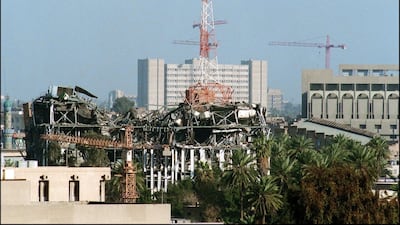
A view dated March 8, 1991 of damage in downtown Baghdad from an Allied air strike or missiles raid. AFP -
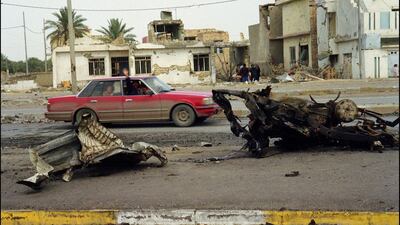
A car on February 7, 1991 in Samawa, south of Baghdad, after an allied bombing raid. AFP


The following morning, we went to the airport to head to Iraq via Jordan. Being a diplomat, my father was escorted by colleagues in the Iraqi consulate at Jeddah airport, adding to the complication of trying to pull off an escape. When finally we were alone, at the gate, we were met by a Saudi officer who took us to another gate and another future.
The flight manifest of the Jeddah-Amman flight said that the Al-Oraibi family boarded the plane ... but they never landed in Amman. Instead, we were escorted to another aircraft that took us back to Riyadh, with new documents, new names and a new life. Upon our return to Riyadh, we moved into a safe house and didn’t step outside its front door for months. My sister and I did not go to school until the Iraqi embassy in Riyadh closed and we felt safer leaving home. Even then, we were enrolled under aliases.
My father had sought political asylum which meant going back to his homeland became an impossibility – along with many others who rejected Saddam’s crimes. And while he met with leaders of “the opposition”, he never formally joined them, sensing early on much of the angst they would later bring to Iraq.
-

Picture taken on August 14, 1990 at Ruwaished showing Arab refugees from different countries waiting for the permission to return to their homelands at the Iraq-Jordan border checkpoint as thousands of foreigners flee the war in Iraq and Kuwait. AFP -
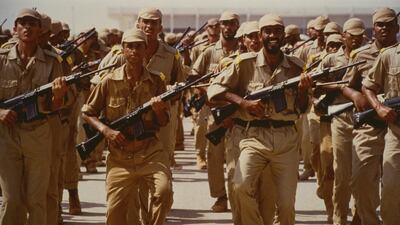
August 1990: A training camp for new recruits in the United Arab Emirates, following the country's appeal for servicemen on the 11th August 1990, during the Gulf Crisis. Getty -
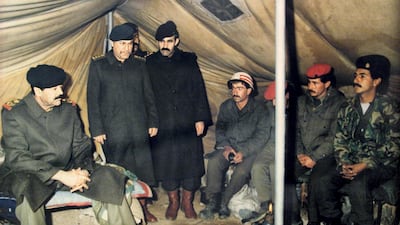
A reproduction of a picture displayed at the Nasr or Victory Museum in Baghdad shows Iraqi President Saddam Hussein (L) visiting Iraqi troops at a military camp in occupied territory in Kuwait after the August 2, 1990 invasion of the Gulf emirate. Getty -

The Emir of Kuwait Jaber Al Sabah (R) walks with Egyptian President Hosni Mubarak 9 August 1990 upon his arrival for the emergency Arab Summit to discuss Iraq's invasion of Kuwait and the worsening situation. AFP -
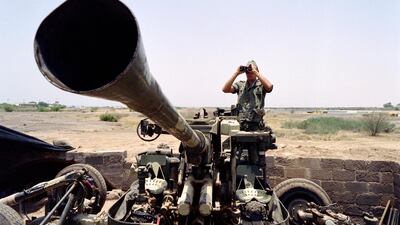
A French soldier looks through binoculars as he mans an anti-craft gun near Djibouti airport, on August 20, 1990, as French army was deployed in the Persian Gulf since Iraq's invasion of Kuwait on August 02, 1990, leading to a conflict between Iraq and Kuwait and an international military intervention. AFP -
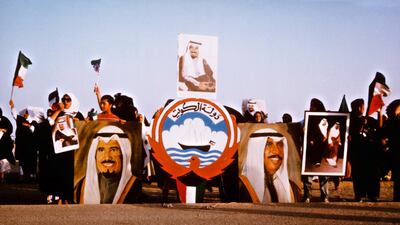
A demonstration in Kuwait, following the country's invasion by Iraq at the start of the Gulf War, 4th-6th August 1990. In the centre is the Emblem of Kuwait, adopted in 1962. Getty -
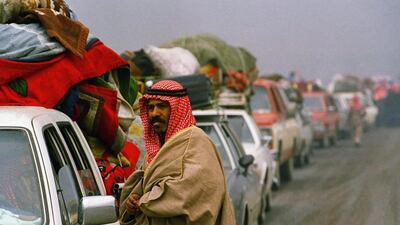
A Kuwaiti refugee stands beside his car outside Kuwait City after Iraq invaded 30 years ago. Scott Applewhite / AP


And yet, we were lucky. We found safety in Saudi Arabia and the authorities delivered on their promise of protecting us and ensuring my sister and I had good schooling. We eventually settled in the UK and became British citizens, where my sister and I thrived. It took a decade for us to have our own travel documents and to this day I carry my British passport with me wherever I go.
Only as an adult did I begin to realise the magnitude of my parents’ decision. That night, 30 years ago, as a child I had only two concerns: what school would I go to? And when would I see my beloved extended family again? For the first, my mother explained it would take some time before my sister and I could go back to our school, Manarat Al Riyadh, as our family effectively went into hiding in Saudi Arabia. As for the second question, “only God knows”.
My parents had made the decision to defect without telling a single member of our family – it was the best protection for them when inevitably they would be questioned by the Iraqi intelligence services. My parents were cut off from their families by virtue of deciding to get out of government work. In Saddam’s Iraq, resigning from the government was not an option. Soon after we got word that all my father’s assets had been seized, including our beloved family home.
It ended up being 13 years until we could go back to Iraq. Years of exile and fear of the unknown were compounded by longing for our loved ones back in Iraq. Only when we returned to Baghdad in December 2003 did I realise how much had been lost. From 1990 to 2003 we lived our lives waiting for the day we could “go back”. It turns out there is no “going back”.
Saddam eventually withdrew from Kuwait after a 42-day war known as “Operation Desert Storm” led by the US that left Baghdad weaker than ever before. The sanctions that followed crippled Iraqi society, particularly its middle class, but did little to weaken Saddam’s regime. Iraq has still not recovered from the breakdown of the state’s institutions, healthcare, and education services, compounded by ensuing years of conflict.
Around 2.7 million claims with a total value of $352.5 billion (Dh1.294 trillion) were made against the Iraqi state for the invasion of Kuwait with the United Nations Compensation Commission. It was only in 2005 that the commission announced it had concluded processing claims, amounting to $52.4bn for 1.5 million successful claims. However, no money or entity in the world can compensate those who lost loved ones or for the years of their lives paying for the fall-out from that terrible invasion.
As for my family, my father went back to serve Iraq in 2003, as a non-political civil servant, among a number of diplomats in exile who were encouraged to return to the Ministry of Foreign Affairs and re-establish Iraq’s diplomatic presence around the world.
How Iraq could have fared, had it not been for the disastrous 1990 invasion, we will never know. But with Saddam at the helm, it would have been just a matter of time before another aggression hit Iraq. The political ramifications of the invasion of Kuwait are rarely mentioned in Iraq today, as so much devastation has occurred in the last three decades.
As for the young people on the streets of Baghdad, Najaf, Sulaimania or Basra today, most were born after the occupation – the 2003 American one of Iraq, rather than the 1990 occupation of Kuwait. And so, this 30-year anniversary passes without much notice in Iraq, as people struggle with a broken economy, militia rule and a pandemic.
But for older generations, it is a sombre moment to mark how much we have lost since that fateful day of the Kuwait invasion that cost Iraq dearly and destroyed its future. So much potential lost in one of the world's richest nations, both in natural and human resource. And that is why the young protesters’ chants of "nureed watan" (we want a homeland) resonate across generations, especially those displaced over the past decades.

