

Iran has developed a hypersonic missile capable of penetrating all defence systems, the commander of its Revolutionary Guard's aerospace unit said on Thursday.
The announcement came on the same day that UN nuclear watchdog, the International Atomic Energy Agency, said Iran had once again stepped up production of highly enriched uranium.
Experts say Iran has enough highly enriched uranium to create a nuclear bomb, if it so desired. The IAEA also re-iterated in a recent report that Iran had yet to co-operate in an inquiry into unexplained traces of uranium at three sites, which experts say points to a cover up of nuclear activities.
“This hypersonic ballistic missile was developed to counter air defence shields,” Gen Amirali Hajizadeh told Iran's Fars news agency.
“It will be able to breach all the systems of anti-missile defence.”
The move is likely to increase concerns about Iran's missile capabilities, which Iran has made a pillar of its regional military strategy.
-
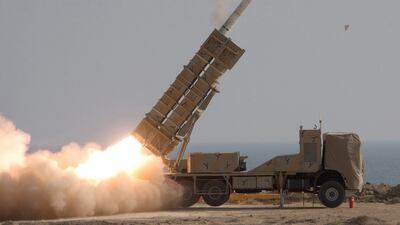
Iranian soldiers fire a missile in Baluchestan, near the shore of the Sea of Oman, during a military exercise on November 8, 2021. Iranian Army via AFP -
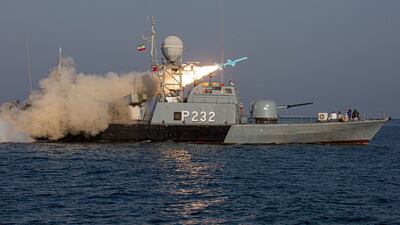
Iranian troops fire a Ghaidr missile during the second day of military exercise in the northern Sea of Oman, on November 8, 2021. Iranian Army via EPA -
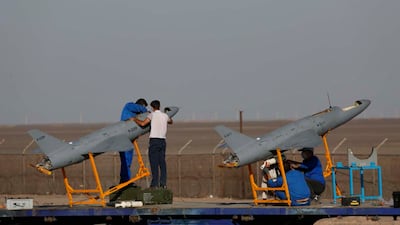
Iranian Army and Air Force personnel work on missile air-defence systems during an exercise at an undisclosed site in Iran on October 21, 2021, when the country began a nationwide air force drill. Iranian Army via EPA -
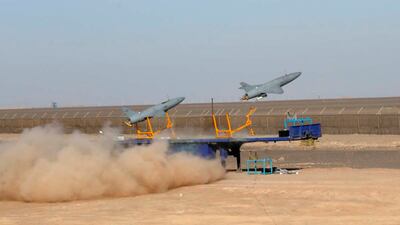
One week earlier, it had conducted a massive air defence exercise, state media reported. Iranian Army via EPA -
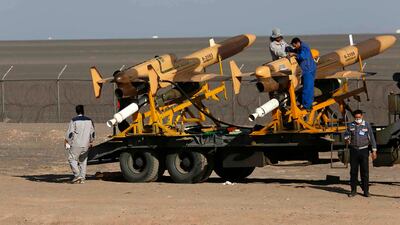
Iranian Air Force personnel work on air defence missiles during a nationwide drill on October 21, 2021. Iranian Army via AP -
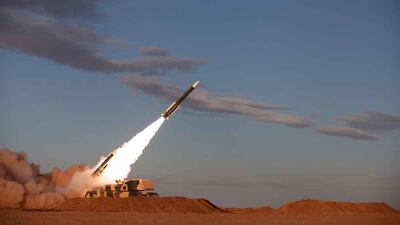
Iran holds a major air defence drill. In this image, made available on October 12, 2021, missiles are launched during a joint exercise between the Iranian Army and the country’s Islamic Revolutionary Guard Corps, in the desert of central Iran. Iranian Army via EPA


Hypersonic missiles can fly at least five times faster than the speed of sound and on a complex trajectory, which makes them difficult to intercept.
There have been no reports of such a missile being tested by Iran. While the country has developed a large domestic arms industry in the face of international sanctions and embargoes, western military analysts say Tehran sometimes exaggerates its weapons capabilities.
Concerns about Iran's ballistic missiles did, however, contribute to a US decision in 2018 under president Donald Trump to pull out of the nuclear agreement that Tehran signed with world powers in 2015.
Last week, Iran said it tested the Ghaem 100, its first three-stage space launch vehicle, which would be able to place satellites weighing 80 kilograms in an orbit 500 kilometres above the Earth's surface, according to state media.
The US has called such actions destabilising because it believes space launch vehicles could be used to transport a nuclear warhead.
Iran denies wanting to develop a nuclear weapon.
Earlier, Sky News reported that Russia handed a British anti-tank missile it had captured in Ukraine to Iran as part of an exchange deal for drones.
The next-generation light anti-tank weapon is said to have been flown to Tehran on a Russian military cargo plane with £120 million ($139m) in cash. The shipment included a Javelin anti-tank missile and a Stinger anti-aircraft defence system the US had donated to Kyiv.
In return, Russia received dozens of drones that it uses to target energy infrastructure and civilians in Ukraine.
The flight landed at an airport in the Iranian capital in the early hours of August 20, according to a security source who spoke to Sky News. The insider said the weapons had been destined for Ukrainian troops but “fell into Russian hands”.
Uranium warning
The news of Iran's moves to increase its missile capabilities came as Tehran stepped up its stockpile of highly enriched uranium, moving the country closer to being able to create a nuclear weapon, the IAEA said on Thursday.
The watchdog, along with world powers, have repeatedly sought assurances from Iran that its nuclear research programme is being used for civilian purposes, in the absence of a return to a 2015 nuclear deal.
That agreement, which limited Iran’s nuclear programme through UN inspections in exchange for a lifting of harsh trade sanctions, was abandoned by former president Donald Trump in 2018.
Since 2020 however, the Biden administration, the EU and other world powers including China and Russia, have sought a return to the agreement.
Iran has failed to satisfy inquiries made by the IAEA asking about traces of “man made” uranium that have been found at sites not previously declared to IAEA inspectors.
Experts say the failure to explain the presence of enriched uranium at the sites points to past Iranian cover ups and a general lack of transparency.
In its quarterly report, the IAEA said that according to its assessment, as of October 22, Iran has an estimated 62.3 kilograms of uranium enriched to up to 60 per cent fissile purity. That amounts to an increase of 6.7kg since the IAEA's last report in September.
That enrichment to 60 per cent purity is a short step away from weapons-grade levels of 90 per cent. Non-proliferation experts have warned in recent months that Iran now has enough 60 per cent-enriched uranium to reprocess into fuel for at least one nuclear bomb.
The IAEA report, which was seen by the Associated Press, also estimated that as of October 22, Iran's stockpile of all enriched uranium was at 3673.7kg — a decrease of 267.2kg since the last quarterly report in September.
The Vienna-based IAEA said it was unable to verify the exact size of Iran’s stockpile of enriched uranium due to limitations that Tehran imposed on UN inspectors last year and the removal of the agency’s monitoring and surveillance equipment in June.
A separate report, also seen by AP, said IAEA director general Rafael Grossi is “seriously concerned” that Iran has still not engaged on the agency's probe into the man-made uranium particles.
Mr Grossi met with Mohammad Eslami, vice president and head of Iran's Atomic Energy Organisation, in late September to discuss the topic. The second report on Thursday noted that IAEA officials will travel to Tehran for a technical visit by the end of November.
AFP contributed to this report

