



Iran is rapidly expanding its ability to enrich uranium with advanced centrifuges at its underground plant at Natanz and now intends to go further than previously planned, a confidential UN nuclear watchdog report has said.
While indirect talks between Iran and the US on reviving the 2015 Iran nuclear deal have stalled, Tehran has brought on-stream an ever larger number of advanced centrifuges that is has been banned by the deal from using to produce enriched uranium.
These machines are far more efficient than the first-generation IR-1, the only centrifuge that the deal lets Iran use to grow its stock of enriched uranium, Reuters reported on Monday.
Iran has been adding them, particularly at two underground sites at Natanz and Fordow that may be designed to withstand potential aerial bombardment.
The third of three cascades, or clusters, of advanced IR-6 centrifuges recently installed at the underground Fuel Enrichment Plant (FEP) at Natanz has now come on-stream, said the International Atomic Energy Agency report to member states.
Diplomats say the IR-6 is Iran's most advanced centrifuge.
Iran has also quickly completed the installation of seven cascades that were either not finished or at a very early stage of installation on August 31, the ad hoc report showed. The end of August marked the last visit by inspectors mentioned in the agency's most recent quarterly report.
Those seven cascades, one of IR-4 centrifuges and six of IR-2m machines, were fully installed but not yet enriching uranium, Monday's report said.
Iran also informed the agency of its plans to add an extra three cascades of IR-2m machines at the FEP, on top of the 12 already announced and now installed, the report showed.
-
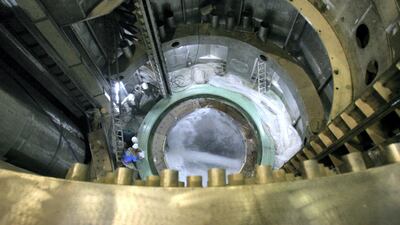
Russian contractors work at the Bushehr nuclear reactor site in 2007. The plant opened four years later. Bloomberg -
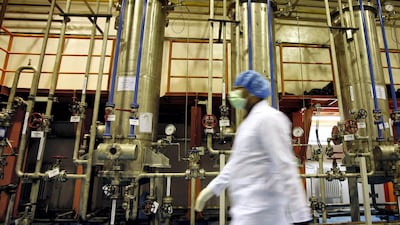
An Iranian technician at the International Atomic Energy Agency inspects the country's Isfahan plant in 2007. Tehran is no longer co-operating with the agency at nuclear sites across the country. EPA -

Workers wait to begin constructing a second reactor at the Bushehr nuclear power plant in 2019. AFP -
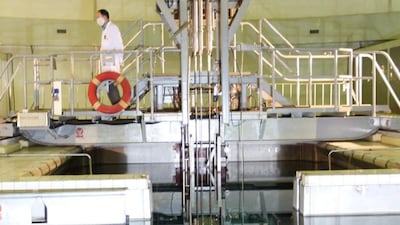
A metal-encased rod with 20 per cent enriched nuclear fuel is inserted into a reactor in Tehran in 2012. AFP -
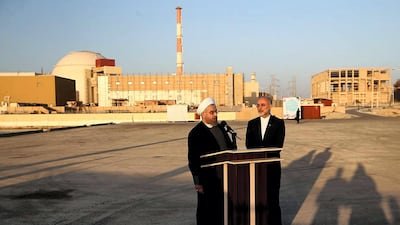
Fomer Iranian President Hassan Rouhani and the country's Atomic Energy Organisation chief Ali Akbar Salehi speak at the Bushehr nuclear site in 2015. AFP -
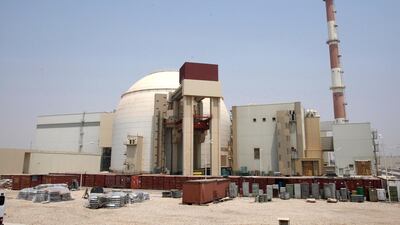
Iran's Bushehr nuclear plant has been restarted. EPA -
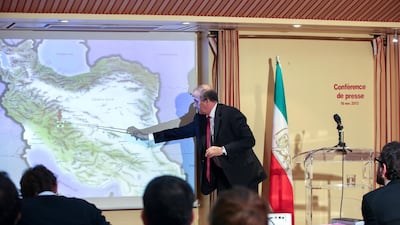
Mehdi Abrichamtchi, chairman of the Peace and Security Committee at the National Council of Resistance of Iran, shows journalists the location of a secret nuclear site in Iran in 2013. AFP -
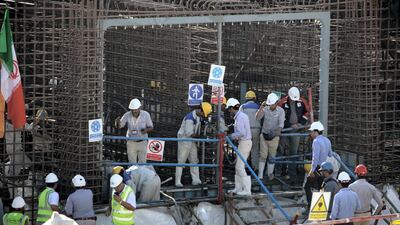
Workers prepare to begin the construction of a second reactor at the Bushehr site. AFP


Of those three extra IR-2m cascades, installation has already started on two of them, the report said.
The report also showed that all the centrifuges enriching at Natanz are still producing uranium hexafluoride (UF6) gas enriched to up to 5 per cent. They are now being fed with natural UF6.
That is in contrast to the quarterly report issued in September that said the centrifuges were being fed with UF6 enriched to up to 2 per cent on August 31. It did not explain the change.
In 2018, Donald Trump, US president at the time, pulled his country out of the Iran deal and reimposed sanctions against Iran that had been lifted under the deal.
Iran responded by breaching the restrictions on its nuclear activities imposed by the deal.
If the deal is revived Iran will have to put its advanced centrifuges into storage, diplomats say.

