

Iran, the US and the European Union said on Wednesday that they would send representatives to Vienna amid what appears to be a last-ditch effort at reviving talks over Tehran's tattered 2015 nuclear deal with world powers.
The EU official leading the talks, Enrique Mora, said negotiations would focus on the most recent draft to restore the agreement, while Iran said it was dispatching nuclear negotiator Ali Bagheri Kani to the Austrian capital.
Iranian state media cited foreign ministry spokesman Nasser Kanaani as saying that Tehran was ready to reach a deal that guarantees its rights.
“Bagheri Kani will leave Tehran in a few hours … In this round of talks, which will be held as usual with the co-ordination of the European Union, ideas presented by different sides will be discussed,” Mr Kanaani said
US Special Representative for Iran Rob Malley wrote on Twitter that he was also preparing to travel to Vienna for the talks. He cautioned that US “expectations are in check” over negotiations.
The prospects for the deal's restoration have dimmed in the past few months with major sticking points remaining, including Tehran's demand that Washington provide guarantees that it will not quit the pact again and that it will lift terrorism sanctions on Iran's Islamic Revolutionary Guard Corps.
The Vienna talks come after the UN nuclear watchdog warned on Tuesday that good words from Iran are not enough to satisfy international inspectors.
Rafael Grossi, Director General of the International Atomic Energy Agency, said he hoped Tehran was ready to be transparent about its nuclear programme, which was “moving ahead very, very fast”.
So far, Iran and the US have been unable to re-establish the deal signed between Tehran and world powers in 2015, in which it curbed its nuclear programme in return for economic sanctions relief.
Mr Grossi said Iran must give IAEA inspectors access “commensurate to the size” of its uranium enrichment programme if the agency is to credibly assure that it is peaceful.
“When it comes to nuclear, good words will not do it,” he said. “What you need to do is to be transparent and compliant and work with us.
“We are ready and I hope they will be as well. They have a very ambitious nuclear programme that needs to be verified in the appropriate way.
“The programme is moving ahead very, very fast and not only ahead, but sideways as well, because it's growing in ambition and in capacity.”
Meanwhile, Saudi Arabia’s new Permanent Representative to the United Nations Ambassador Dr. Abdulaziz Al Wasil said on Wednesday that Iran’s practices increase the risks of nuclear proliferation.
Mr Al Wasil was speaking at the Tenth Review Conference of the Parties to the Treaty on the Non-Proliferation of Nuclear Weapons in New York.
He said that freeing the Middle East from nuclear weapons is a collective responsibility.
“Transparency is necessary for the peaceful use of nuclear energy. Iran’s lack of transparency with the International Atomic Energy Agency violates the UN Charter,” he said in statements carried by the Arabic service of the Saudi news agency and local media.
He pledged the Kingdom’s support to the expansion of the Non-Proliferation Treaty.
Mr Al Wasil indicated that Saudi Arabia supported all efforts aimed at preventing Iran from acquiring a nuclear weapon.
Iran's nuclear sites — in pictures
-
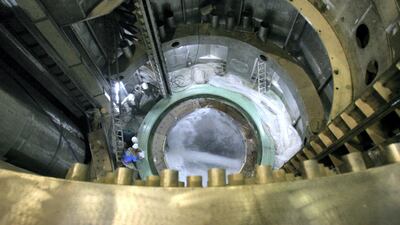
Russian contractors work at the Bushehr nuclear reactor site in 2007. The plant opened four years later. Bloomberg -
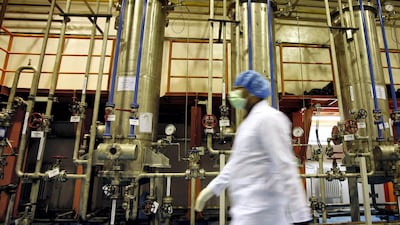
An Iranian technician at the International Atomic Energy Agency inspects the country's Isfahan plant in 2007. Tehran is no longer co-operating with the agency at nuclear sites across the country. EPA -

Workers wait to begin constructing a second reactor at the Bushehr nuclear power plant in 2019. AFP -
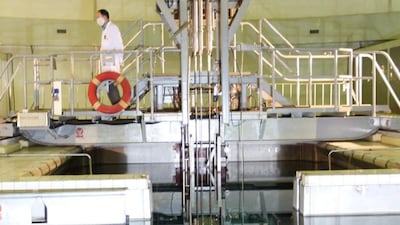
A metal-encased rod with 20 per cent enriched nuclear fuel is inserted into a reactor in Tehran in 2012. AFP -
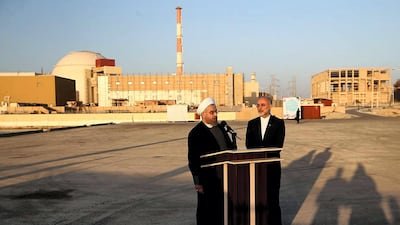
Fomer Iranian President Hassan Rouhani and the country's Atomic Energy Organisation chief Ali Akbar Salehi speak at the Bushehr nuclear site in 2015. AFP -
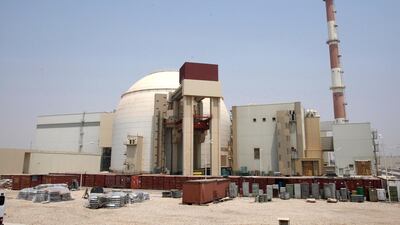
Iran's Bushehr nuclear plant has been restarted. EPA -
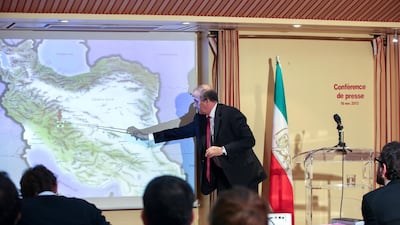
Mehdi Abrichamtchi, chairman of the Peace and Security Committee at the National Council of Resistance of Iran, shows journalists the location of a secret nuclear site in Iran in 2013. AFP -
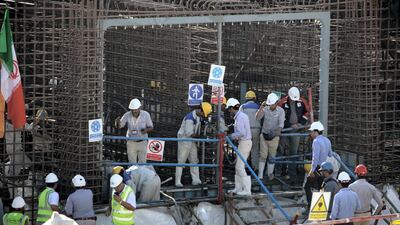
Workers prepare to begin the construction of a second reactor at the Bushehr site. AFP


Donald Trump, the US president at the time, reneged on the nuclear deal in 2018, restoring harsh sanctions to squeeze Iran's oil exports and prompting Tehran to start abandoning the agreement's nuclear limits about a year later.
On Monday, Iran's nuclear energy organisation chief said it had the technical capability to produce an atomic bomb but had no intention of doing so.
Iran is already enriching uranium to up to 60 per cent fissile purity, far above a cap of 3.67 per cent set under the 2015 deal.
Uranium enriched to 90 per cent is suitable for a nuclear bomb.
The Associated Press contributed to this report

