


Funeral services have been held in Iraq for 16 of the 27 migrants who drowned in the English Channel trying to reach Britain.
Grieving families had to wait weeks for the bodies to be identified, released by French authorities and returned to Iraq.
One of the funerals was for Baran, a woman who dreamt of a "better life" in Britain, where she would be reunited with her fiance.
At the airport in the Iraqi Kurdish city of Erbil, her family hung a banner on the back of a moving ambulance that carried her body back to her home town of Soran.
A banner alongside a smiling picture of the young woman said “Bride of the Sea".
Maryam Nuri Hama Amin – known as Baran to her family, a name meaning “rain” in Kurdish – was only in her 20s when she set off on the trip.
She was one of the first Kurdish victims to be identified from the disaster.
The bodies arrived before dawn on Sunday at the airport in Erbil, where dozens of men, women and children had gathered.
Some of the mourners hugged as grieving people wept and others clutched photos of their lost relatives.
The November 24 tragedy has been described by the International Organisation for Migration as the largest single loss of life in the English Channel since the UN agency started recording data in 2014.

Britain represents the final, albeit dangerous, last leg of the trek. The sail, often in unseaworthy vessels offers a tempting reward for the migrants.
From Erbil, the plain wooden coffins were taken by ambulances to their hometowns of Darbandikhan, Qadrawa, Ranya and Soran.
One elderly man with a white beard showed a photo on his phone of his son Afrasia, who was 24 years old.
A woman sobbed as she pressed her face up against a window. Close by, two teenagers appeared similarly shaken. One of them rested his head against a casket, bidding his final farewell.
In the centre of Ranya, hundreds gathered in a mosque to honour the three victims from the Kurdish town.
Shakar Ali, 30, left his home two months ago, making the long trip through Turkey, Greece and Italy, before his journey ended in France.
“He attempted the crossing to Britain seven times,” his older brother Shamal said. “Each time, he failed.”
Shakar, who had a degree in petroleum geology, was unemployed and saw hope in Europe, his brother said.
At the cemetery in Ranya, the young man's shrouded body was lifted on the shoulders of the men of the family. A crowd gathered as the body was lowered into the grave.
Ramyar, the youngest of the family, recalled his last conversation with his brother.
“He told us, 'We have started the crossing. If I call you, it means the coastguard has arrested us'," he said. "'If I don't call you back, it's because I will have arrived in England'.”

The 26 bodies identified in France were 17 men and seven women aged between 19 and 46, a 16-year-old and a child aged 7.
As well as the 16 Iraqi Kurds, the victims also included an Iranian Kurd, a Somalian, four Afghans and an Egyptian.
Only two survivors were found, an Iraqi Kurd and a Sudanese national. French investigators are still trying to establish a clear picture of what happened during the disaster.
Images from the tragedy
-
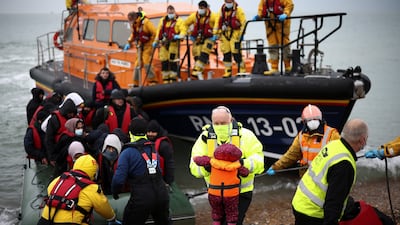
Migrants are brought ashore at Dungeness by RNLI Lifeboat members after crossing the Channel. Reuters -
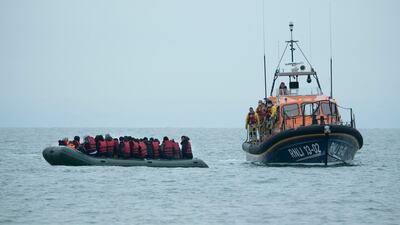
The past three years have seen a significant rise in attempted Channel crossings by migrants, despite the dangers. AFP -
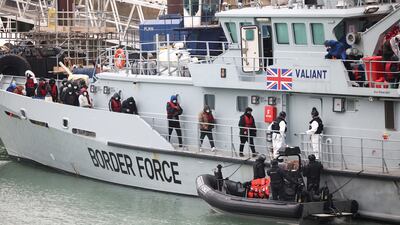
Migrants on board a Border Force rescue boat line up to disembark at Dover harbour after crossing the Channel. Reuters -
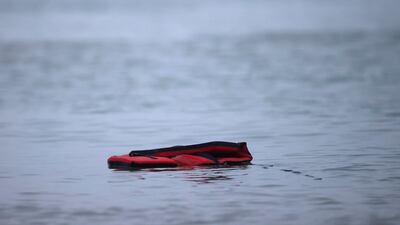
A life jacket is left in the water after a group of more than 40 migrants got on an inflatable dinghy to leave the coast of northern France and cross the Channel. Reuters -
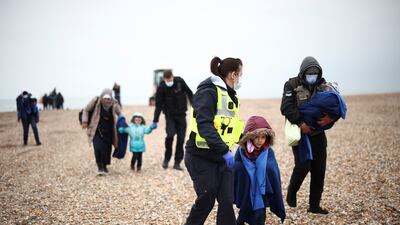
Migrants are escorted by Border Force staff in Dungeness, after being brought ashore by an RNLI lifeboat. Reuters -
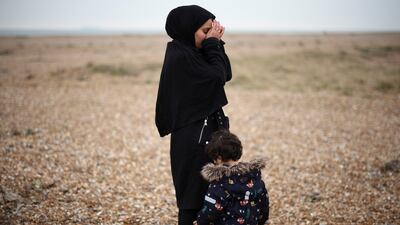
A woman with a child is brought ashore safely. Reuters -
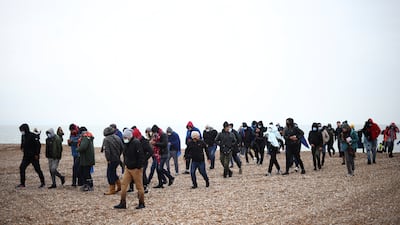
Migrants walk along a British beach after being brought ashore by an RNLI lifeboat. Reuters -

At least 27 migrants bound for Britain died on Wednesday when their boat sank in the English Channel. AP -
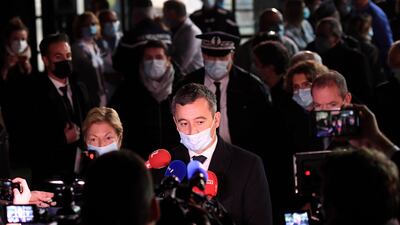
French Interior Minister Gerald Darmanin speaks to the press in Calais, northern France, after the tragedy. AP -
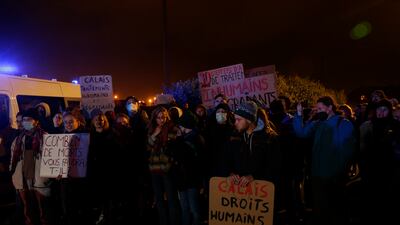
France's interior minister has called it the biggest tragedy involving migrants on the dangerous crossing to date. AP -
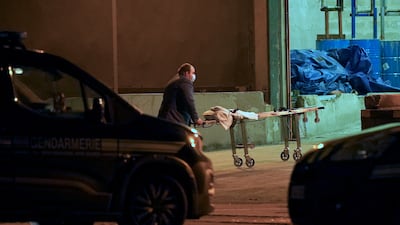
A man wheels a gurney into a warehouse in Calais, where it is believed the bodies of migrants are being transported. PA -
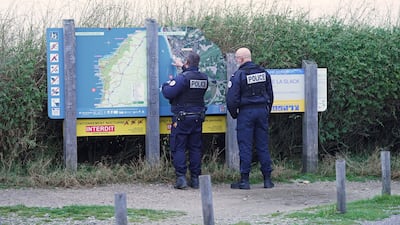
French police look at a map of the coast at Wimereux, in northern France. The stretch of beach is believed to be used by migrants aiming to cross the Channel. PA -
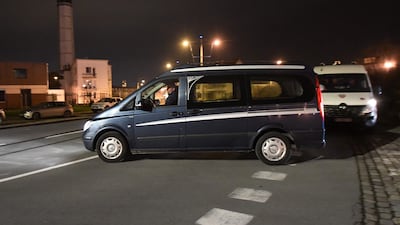
A funeral van leaves the port of Calais. AFP -
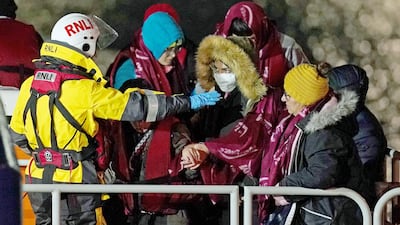
A group of people thought to be migrants are brought to Dover by the RNLI. PA



