Co-ordinator Enrique Mora and his entourage are scheduled to return to the Grand Hotel Wien, where talks with Iran are expected to resume this week. AP Photo

Iran election will not derail nuclear talks, Tehran says


Leila Gharagozlou
  • English
  • Arabic

Iran's policy towards the 2015 nuclear deal and negotiations with world powers over how to restore it will continue regardless of the result in this month's presidential elections, government spokesman Ali Rabiei said on Tuesday.

Mr Rabiei said the policy of engaging with other participants in the agreement, including the US, was made by supreme leader Ayatollah Ali Khamenei and had support from the highest levels of the establishment.

This will not change when President Hassan Rouhani leaves office, he said.

Iranians are scheduled to go to the polls on June 18 to elect their next president, expected by many to be cleric Ebrahim Raisi, who is generally regarded as hostile to engagement with the US and the West.

  • Iran's former top nuclear negotiator and former presidential candidate Saeed Jalili. AFP
    Iran's former top nuclear negotiator and former presidential candidate Saeed Jalili. AFP
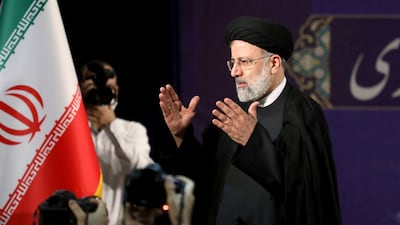
  • Ebrahim Raisi, head of Iran's judiciary. AP Photo
    Ebrahim Raisi, head of Iran's judiciary. AP Photo
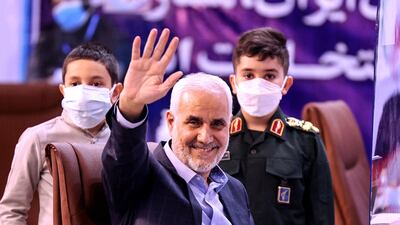
  • Former Iranian vice president Mohsen Mehralizadeh, accompanied by his grandsons, salutes supporters as he registers his candidacy at the Interior Ministry in the capital Tehran. AFP
    Former Iranian vice president Mohsen Mehralizadeh, accompanied by his grandsons, salutes supporters as he registers his candidacy at the Interior Ministry in the capital Tehran. AFP
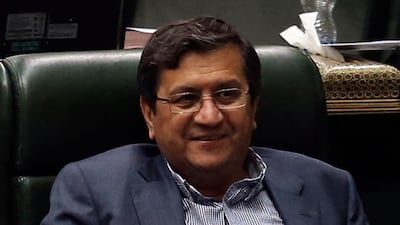
  • Abdolnaser Hemmati, Governor of the Central Bank of Iran, listens to a speech in parliament in Tehran. AFP
    Abdolnaser Hemmati, Governor of the Central Bank of Iran, listens to a speech in parliament in Tehran. AFP
  • Iranian conservative presidential candidate, Alireza Zakani. AFP
    Iranian conservative presidential candidate, Alireza Zakani. AFP
  • Amirhossein Ghazizadeh Hashemi.
    Amirhossein Ghazizadeh Hashemi.
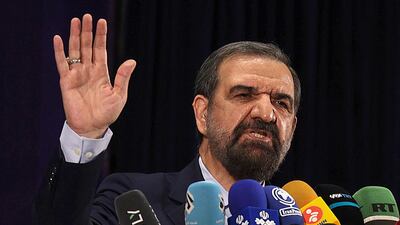
  • Iranian former chief of the Revolutionary Guards Mohsen Rezai. AFP
    Iranian former chief of the Revolutionary Guards Mohsen Rezai. AFP

The possibility of a hardline president had caused concern that were a new nuclear agreement not brokered before Mr Rouhani leaves office in August, any hope of diplomacy could be lost.

World powers are trying to broker an agreement between Iran and the US to revive the 2015 deal abandoned by former president Donald Trump in 2018 and ease economic sanctions on the Iran in exchange for it cutting back its atomic activities.

US Secretary of State Antony Blinken says there could be a breakout for Iranian nuclear technology 'in a matter of weeks' AFP

On Monday, US Secretary of State Antony Blinken highlighted the importance and urgency of getting a deal with Iran, telling the House foreign relations committee that Iran could cut its nuclear weapon breakout time to "a matter of weeks" if it continues to escalate its breaches of the 2015 nuclear deal.

“The agreement pushed [breakout time] into a year or more. It’s now down, by published reports, to a few months at best," he said.

"And if this continues, it will get down to a matter of weeks, exactly what we sought to avoid and what the agreement stopped.”

A sixth round of nuclear talks between Iran, the US and European nations is scheduled to start in Vienna, Austria, on Thursday. Negotiators took a brief break to head back to their home countries for consultations. News of the talks has thus far been optimistic, with both groups saying they are moving closer towards a resolution.


What drives subscription retailing?

Once the domain of newspaper home deliveries, subscription model retailing has combined with e-commerce to permeate myriad products and services.

The concept has grown tremendously around the world and is forecast to thrive further, according to UnivDatos Market Insights’ report on recent and predicted trends in the sector.

The global subscription e-commerce market was valued at $13.2 billion (Dh48.5bn) in 2018. It is forecast to touch $478.2bn in 2025, and include the entertainment, fitness, food, cosmetics, baby care and fashion sectors.

The report says subscription-based services currently constitute “a small trend within e-commerce”. The US hosts almost 70 per cent of recurring plan firms, including leaders Dollar Shave Club, Hello Fresh and Netflix. Walmart and Sephora are among longer established retailers entering the space.

UnivDatos cites younger and affluent urbanites as prime subscription targets, with women currently the largest share of end-users.

That’s expected to remain unchanged until 2025, when women will represent a $246.6bn market share, owing to increasing numbers of start-ups targeting women.

Personal care and beauty occupy the largest chunk of the worldwide subscription e-commerce market, with changing lifestyles, work schedules, customisation and convenience among the chief future drivers.

Mercer, the investment consulting arm of US services company Marsh & McLennan, expects its wealth division to at least double its assets under management (AUM) in the Middle East as wealth in the region continues to grow despite economic headwinds, a company official said.

Mercer Wealth, which globally has $160 billion in AUM, plans to boost its AUM in the region to $2-$3bn in the next 2-3 years from the present $1bn, said Yasir AbuShaban, a Dubai-based principal with Mercer Wealth.

Within the next two to three years, we are looking at reaching $2 to $3 billion as a conservative estimate and we do see an opportunity to do so,” said Mr AbuShaban.

Mercer does not directly make investments, but allocates clients’ money they have discretion to, to professional asset managers. They also provide advice to clients.

“We have buying power. We can negotiate on their (client’s) behalf with asset managers to provide them lower fees than they otherwise would have to get on their own,” he added.

Mercer Wealth’s clients include sovereign wealth funds, family offices, and insurance companies among others.

From its office in Dubai, Mercer also looks after Africa, India and Turkey, where they also see opportunity for growth.

Wealth creation in Middle East and Africa (MEA) grew 8.5 per cent to $8.1 trillion last year from $7.5tn in 2015, higher than last year’s global average of 6 per cent and the second-highest growth in a region after Asia-Pacific which grew 9.9 per cent, according to consultancy Boston Consulting Group (BCG). In the region, where wealth grew just 1.9 per cent in 2015 compared with 2014, a pickup in oil prices has helped in wealth generation.

BCG is forecasting MEA wealth will rise to $12tn by 2021, growing at an annual average of 8 per cent.

Drivers of wealth generation in the region will be split evenly between new wealth creation and growth of performance of existing assets, according to BCG.

Another general trend in the region is clients’ looking for a comprehensive approach to investing, according to Mr AbuShaban.

“Institutional investors or some of the families are seeing a slowdown in the available capital they have to invest and in that sense they are looking at optimizing the way they manage their portfolios and making sure they are not investing haphazardly and different parts of their investment are working together,” said Mr AbuShaban.

Some clients also have a higher appetite for risk, given the low interest-rate environment that does not provide enough yield for some institutional investors. These clients are keen to invest in illiquid assets, such as private equity and infrastructure.

“What we have seen is a desire for higher returns in what has been a low-return environment specifically in various fixed income or bonds,” he said.

“In this environment, we have seen a de facto increase in the risk that clients are taking in things like illiquid investments, private equity investments, infrastructure and private debt, those kind of investments were higher illiquidity results in incrementally higher returns.”

The Abu Dhabi Investment Authority, one of the largest sovereign wealth funds, said in its 2016 report that has gradually increased its exposure in direct private equity and private credit transactions, mainly in Asian markets and especially in China and India. The authority’s private equity department focused on structured equities owing to “their defensive characteristics.”

Our legal columnist

Name: Yousef Al Bahar

Advocate at Al Bahar & Associate Advocates and Legal Consultants, established in 1994

Education: Mr Al Bahar was born in 1979 and graduated in 2008 from the Judicial Institute. He took after his father, who was one of the first Emirati lawyers

%3Cp%3E%3Cstrong%3ETHE%20SPECS%3C%2Fstrong%3E%0D%3Cbr%3EEngine%3A%203.5-litre%20V6%0D%3Cbr%3ETransmission%3A%209-speed%20automatc%0D%3Cbr%3EPower%3A%20279hp%0D%3Cbr%3ETorque%3A%20350Nm%0D%3Cbr%3EPrice%3A%20From%20Dh250%2C000%0D%3Cbr%3EOn%20sale%3A%20Now%3C%2Fp%3E%0A
The specs

Engine: 4.0-litre V8 twin-turbocharged and three electric motors

Power: Combined output 920hp

Torque: 730Nm at 4,000-7,000rpm

Transmission: 8-speed dual-clutch automatic

Fuel consumption: 11.2L/100km

On sale: Now, deliveries expected later in 2025

Price: expected to start at Dh1,432,000

GAC GS8 Specs

Engine: 2.0-litre 4cyl turbo

Power: 248hp at 5,200rpm

Torque: 400Nm at 1,750-4,000rpm

Transmission: 8-speed auto

Fuel consumption: 9.1L/100km

On sale: Now

Price: From Dh149,900

Ten tax points to be aware of in 2026

1. Domestic VAT refund amendments: request your refund within five years

If a business does not apply for the refund on time, they lose their credit.

2. E-invoicing in the UAE

Businesses should continue preparing for the implementation of e-invoicing in the UAE, with 2026 a preparation and transition period ahead of phased mandatory adoption. 

3. More tax audits

Tax authorities are increasingly using data already available across multiple filings to identify audit risks. 

4. More beneficial VAT and excise tax penalty regime

Tax disputes are expected to become more frequent and more structured, with clearer administrative objection and appeal processes. The UAE has adopted a new penalty regime for VAT and excise disputes, which now mirrors the penalty regime for corporate tax.

5. Greater emphasis on statutory audit

There is a greater need for the accuracy of financial statements. The International Financial Reporting Standards standards need to be strictly adhered to and, as a result, the quality of the audits will need to increase.

6. Further transfer pricing enforcement

Transfer pricing enforcement, which refers to the practice of establishing prices for internal transactions between related entities, is expected to broaden in scope. The UAE will shortly open the possibility to negotiate advance pricing agreements, or essentially rulings for transfer pricing purposes. 

7. Limited time periods for audits

Recent amendments also introduce a default five-year limitation period for tax audits and assessments, subject to specific statutory exceptions. While the standard audit and assessment period is five years, this may be extended to up to 15 years in cases involving fraud or tax evasion. 

8. Pillar 2 implementation 

Many multinational groups will begin to feel the practical effect of the Domestic Minimum Top-Up Tax (DMTT), the UAE's implementation of the OECD’s global minimum tax under Pillar 2. While the rules apply for financial years starting on or after January 1, 2025, it is 2026 that marks the transition to an operational phase.

9. Reduced compliance obligations for imported goods and services

Businesses that apply the reverse-charge mechanism for VAT purposes in the UAE may benefit from reduced compliance obligations. 

10. Substance and CbC reporting focus

Tax authorities are expected to continue strengthening the enforcement of economic substance and Country-by-Country (CbC) reporting frameworks. In the UAE, these regimes are increasingly being used as risk-assessment tools, providing tax authorities with a comprehensive view of multinational groups’ global footprints and enabling them to assess whether profits are aligned with real economic activity. 

Contributed by Thomas Vanhee and Hend Rashwan, Aurifer