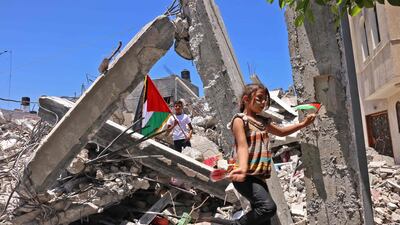
One month after a ceasefire ended the 11-day conflict between Israel and militants in Gaza that devastated the Palestinian enclave, reconstruction has not even started and tensions remain high.
More than 2,000 homes were destroyed and thousands more damaged in the fighting, which claimed the lives of 256 Palestinians and 13 Israelis, and tens of thousands of people have been left uprooted, according to Gaza’s Ministry of Public Works.
-

Palestinian workers clear the rubble and debris in Gaza City's al-Rimal neighbourhood, which was targeted by Israeli strikes during the recent confrontation between Hamas and Israel, on June 8, 2021. AFP -

A Palestinian man rides his camel after sunset on the shores of the Mediterranean Sea, at the beach in Gaza City, Sunday, June 6, 2021. AP -
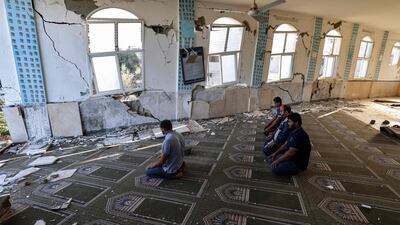
Palestinians pray at a mosque heavily damaged during the May 2021 conflict between Hamas and Israel. AFP -

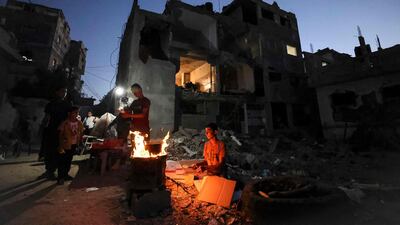
A Palestinian youth prepares to cook corn near buildings destroyed during the May 2021 conflict between Hamas and Israel. AFP -
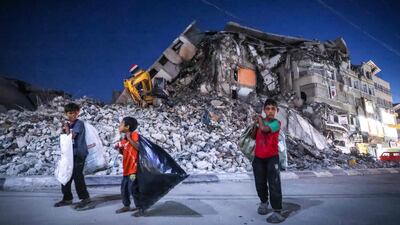
Palestinian boys walk past the destroyed Al Shuruq tower in Gaza City's Al Rimal neighbourhood. AFP -
Palestinians gather near buildings that were heavily damaged during the May conflict in Beit Hanun in the northern Gaza Strip. AFP -
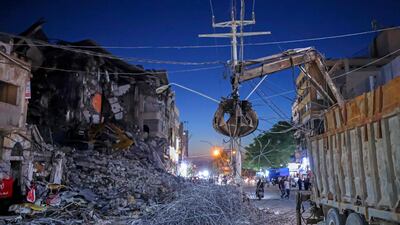
An excavator clears the rubble and debris in Gaza City's Al Rimal neighbourhood which was targeted by Israeli strikes. AFP -
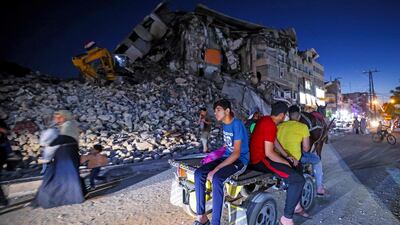
Palestinians pass by the destroyed Al Shuruq tower in Gaza City's Al Rimal neighbourhood. AFP -
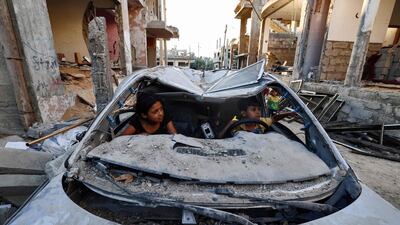
Palestinian children play inside a car destroyed during the May 2021 conflict between Hamas and Israel. AFP -
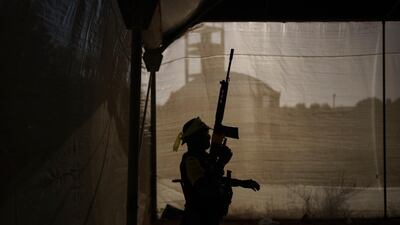
A Fatah militant hold his rifle during a rally in Khan Younis, southern Gaza Strip. AP -
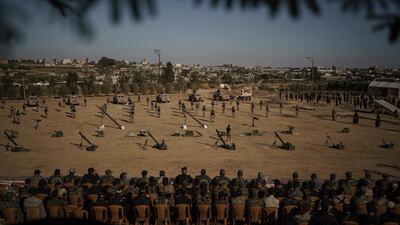
Fatah militants display their weapons during a rally in Khan Younis, southern Gaza Strip. AP -

Fatah militants stand in formation with their weapons during a rally in Khan Younis. AP -

Members of the Ezzedine Al Qassam Brigades, the armed wing of the Palestinian Hamas movement, parade in Gaza City. AFP


Gazans have returned to their daily routines but many of their homes will lie devastated for months, maybe years to come, while the threat of further attacks hangs over their heads.
Last week, Palestinians in Gaza sent helium-filled incendiary balloons over the border, causing several fires in Israel. Israel responded with renewed air strikes throughout the strip, targeting Hamas military camps.
On Sunday, new Israeli Prime minister Naftali Bennett told a memorial ceremony for soldiers killed in the 2014 Gaza war that “our patience has run out”. Days earlier, Israeli army chief Aviv Kochavi told troops to prepare for the possibility of new fighting.
Hamas, the Islamic group that controls Gaza, has likewise warned that more strikes on Israel’s cities remains an option. “Our decision is already made that it is possible the war will return,” senior official Moussa Abu Marzouk said as tensions rose again last week over a flag march by Jewish ultranationalists in occupied East Jerusalem.
While agreements and cessations of violence between Israel and Hamas have been brokered in the past, analysts say that last month’s fighting ended differently.
“This war ended with a ceasefire, while previous ones ended with a truce and an agreement,” political analyst and university lecturer Abeer Thabet explained.
“This time, conditions in Gaza haven’t improved. Trade borders remain largely closed and Israel hasn’t yet approved the transfer of funds from Qatar.”
Such conditions could stir further conflict, she said.
Gaza receives monthly funding from Qatar, but the transfer of millions of dollars has been held up since the latest fighting, with Israel insisting that Hamas first release the bodies of two Israeli soldiers killed in previous conflicts, and two imprisoned civilians.
On Sunday, Israel partially eased the border restrictions to allow the export of agricultural and textile products from Gaza, but maintained tight control over goods entering the Palestinian enclave.
The import of hundreds of products needed for reconstruction, including pipes, steel bars and cement, remains banned because Israel considers them "dual-use" – materials that could be used for military purposes.
"If the restrictions aren't eased and the money isn't transferred, it could lead to further escalations," Ms Thabet told The National.
Reconstruction teams sent by Egypt, which brokered the ceasefire, arrived in Gaza on June 5, but their work has barely started. A few bulldozers decorated with Palestinian and Egyptian flags scramble to clean up the rubble from destroyed buildings.

Gazans who lost their homes believe it will take years for them to be rebuilt.
Kheldia Nassir, 51, a mother of six who lost her husband in the 2008 war, said survival took priority over rebuilding her house in Beit Hanoun which was almost completely destroyed.
Inside the hallway, banners reading "Ramadan Kareem" still hang from the wall – put up before the Eid Al Fitr celebration at the end of the holy month. But there were no celebrations for Ms Nassir's family. After fighting broke out on May 10, the family spent the holiday sheltering inside from Israeli strikes. Several days later, their house was hit. Miraculously, the back room where they were sheltering did not collapse and all of them survived.
“I don’t know when we will receive funds or help to rebuild,” Ms Nassir said, sitting in what is left of her son’s bedroom.
Kheldia Nassir, widow
“We can barely find the money to buy food, so rebuilding with our own funds is not an option.”
Since the missiles hit their neighbourhood, the family has been renting a small apartment nearby, returning to the ruins of their house each day.
“When the planes came back a few days ago and the rockets started, I was shaken by cold fear,” Ms Nassir said. Most nights, drones circle above the enclave, their constant humming unmistakeable.
In East Jerusalem and the West Bank, Palestinians continue to stage protests, many of them relating to Israeli settlements and land annexations in occupied territory that are considered illegal under international law.
But although Gaza is suffering, the conflict has given Palestinians here a new confidence.
“Nobody clearly won,” said Usama Antar, an independent political analyst, “but the resistance feels like a victory. For Palestinians, it has restored some dignity.”
Just how easily the situation can deteriorate was clear last week, when explosions from air strikes once again lit up Gaza’s sky as Israel retaliated to the incendiary balloons.
“The ceasefire is not as strong as a truce. The situation is unstable and it could escalate any time,” Ms Thabet said. "I’d say we’re still at conflict right now.”

