



Follow the latest news from the Sudan crisis here
Perhaps alone among the hundreds of Sudanese at the Karkar bus terminal in southern Egypt who fled the fighting in their homeland, Khartoum resident Ahmed Abdel Aziz is heading home.
Mr Abdel Aziz and his wife flew to Cairo with their two-month-old son on April 14, the day before fighting broke out between the army and the paramilitary Rapid Support Forces, to seek urgent medical care for the infant.
“I waited this long in Cairo in the hope that I could leave after my little child is operated on, but the doctors kept delaying the surgery until he weighs 3 kilograms,” he told The National on Saturday at the bus terminal in Karkar village, about 10 kilometres from the city of Aswan.
“I left my wife with him in Cairo and now I must return to my children in Khartoum. There are five of them, with the oldest only 12, being looked after by my elderly mother,” said Mr Abdel Aziz, who lives in the Khartoum district of Abu Adam.
“I am not afraid. I am very brave and I must return,” he said as he walked away, both armed raised in the air, a black gym bag slung over his left shoulder.
Elsewhere in the bus terminal, hundreds of Sudanese, looking fatigued and sleep deprived, disembarked from the buses that brought them from Sudan, mostly Khartoum and its suburbs.
________________________________
Sudan evacuees land in Abu Dhabi - in pictures
-

People who fled the conflict in Sudan by air are met by UAE officials in Abu Dhabi on Saturday. AFP -
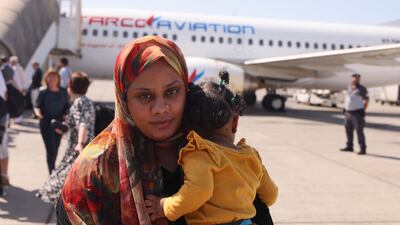
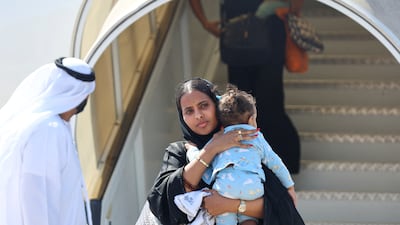
Many of those who left Sudan behind were women and children, who have been trying to escape fighting that broke out about three weeks ago. AFP -
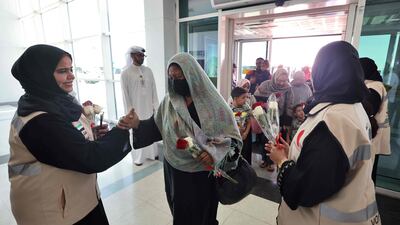
Emirates Red Crescent officials hand out gifts of flowers as the travellers from Sudan arrive in the UAE. AFP -
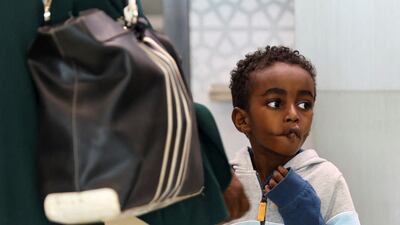
The UN says that millions of families trapped in Sudan face an uncertain future. Reuters -
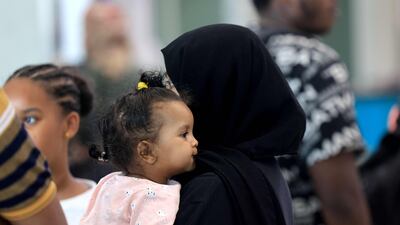
Some children clung tightly to their parents on the journey from Sudan to Abu Dhabi. AFP -
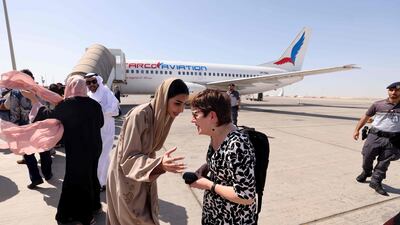
Emirati officials were on the tarmac in Abu Dhabi as passengers from the UAE and more than a dozen other nations arrived from Sudan. AFP -
Accommodation was provided for the people who fled Sudan. The outlook for them is uncertain until warring factions talk peace. Reuters


________________________________
Mr Abdel Aziz’s story was one of many The National heard in Karkar about lives devastated by the fighting and of the hardships endured as entire families made the long journey to Egypt.
They spoke of horror and fear, frustration and disbelief as they lived through the deadly urban warfare on the streets of Sudan's capital.
The fighting entered its third week on Saturday, with both sides paying no heed to a 72-hour ceasefire renewed the previous day.
At least 512 people have been killed and nearly 4,200 wounded, according to the Sudanese Health Ministry, although the UN believes the actual death toll may be much higher.
The fighting derailed a political process that was nearing fruition, with plans to form a civilian-led government to steer the country for 24 months until elections and for the military to quit politics and the RSF to be assimilated into the armed forces.
The fighting, while centred in Khartoum, has spread to other parts of the country, especially Darfur, where it has rekindled a two-decade-old conflict that cost 300,000 lives and displaced another 2.5 million in the 2000s.
It has also caused fuel, food, water and power shortages.

As the case has been with previous ceasefires, the army and the RSF blamed each other for Saturday’s breaches.
“The shells and bullets were hitting our home on daily basis,” said Ammar Ahmed, a 53-year-old Khartoum native from the airport district as he waited in the passenger seat of a microbus taking him, his sister and aunt to Aswan.
“It took us two hours to manoeuvre our way out of Khartoum to avoid being caught in crossfire. It was another 14 hours to the Egyptian border, two days spent there before we were processed, and here we are.”
Mr Ahmed, who works for a local non-government organisation that does social development in Sudan, spoke of widespread looting, burglaries and motorway robberies by armed gangs in the capital.

At Karkar bus terminal, a chaotic and ramshackle affair in the middle of the desert, the Sudanese refugees are met by stench from mounds of rubbish, mixed with the suffocating fumes of bus engines.
Families huddle in the little shade available, their suitcases piled up next to them. Some had no choice but to squat next to the piles of rubbish.
Food, cigarettes, tea, coffee and engine oil are on sale, as are sacks of rice and wheat-flour. Kiosks of Egyptian-based telecom companies do brisk sales of mobile phone lines as long queues form outside in the merciless noon heat.
Animated arguments between passengers and bus drivers headed to Aswan or Cairo, roughly 1,000 kilometres to the north, fill the air. The migrants pay up out of black plastic bags in which they keep wads of dollars or Egyptian pounds.
Hotel room charges and rents for flats in Aswan are also negotiated at the terminal.
“There isn’t a single bed available in Aswan now,” said an elderly man in a neatly pressed white robe as he negotiated with a Sudanese family.
As is often the case during times of war and migration, prices of everything have shot up, including bus fares.
“I will be honest with you, a seat on a bus from Khartoum to the Egyptian border used to go for $25 before the fighting. Now, it’s $250 or more, depending on how bad the fighting is at the pickup point,” said Bakry Omar, a Sudanese bus driver from the neighbourhood of Wad Nebawy in Khartoum’s twin city of Omdurman.
Wad Nebawy is a stronghold of the large Umma party and its Ansars, descendants of the men who fought with the Imam Al Mahdi during the second half of the 19th century against Turkish-Egyptian rule before they were defeated in 1899 at the hands of a British-led Anglo-Egyptian expedition.
“I don’t care who is in power in Sudan as long as I am able to feed, clothe and educate my children,” said Mr Omar, who professes support for the army against the RSF.
“They [RSF fighters] are lawless and heavy-handed. They loot and steal people’s possessions at their checkpoints,” said Mr Omar, 40, before he walked to a vendor to buy flour and rice for his family in Omdurman.

