


Egypt’s Supreme Constitutional Court has rejected appeals to overturn a 2014 law, which stripped the right of Egyptians to take legal action against privatisation.
The move has raised concerns that selling off important industrial and agricultural companies will remove any public input from the process.
The appeals were submitted in 2014 by the Egyptian Centre for Economic and Social Rights. The organisation sought to overturn amendments introduced by Adly Mansour, Egypt’s acting president for one year between the rule of ousted president Mohamed Morsi and current president Abdel Fattah El Sisi, who came to power in 2014.
Mr Mansour’s amendments mandated that the only private individuals who could contest privatisation deals undertaken by the state were those with “personal or in-kind rights over the money subject to the contract”, according to statements made by Mahmoud Ghanim, the supreme court’s vice president, to Al Shorouk, a local daily.
-

A street market in Attaba Square in central Cairo. AFP -

A worker at the Marie Louis textile factory in the 10th of Ramadan City north of Cairo. AFP -

A tailor at the factory. AFP -

A worker threads a sewing machine. AFP -
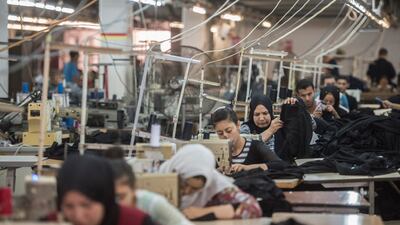
Tailors at work. AFP -

A Cairo vegetable market. EPA -

An Egyptian baker in Cairo. EPA -

Examining a fresh batch of bread. EPA -

A brick factory in Al Badrashin district, Giza. EPA


Formerly, under the rule of former president Hosni Mubarak, citizens could take legal action against privatisation deals they did not agree with.
Mr Ghanim said the amendments had been carried out to stabilise the country’s economy and ensure it met its international contractual obligations at a time of political instability.
“Mansour’s amendments were implemented at a time when the country was going through extraordinary circumstances to stabilise the economy,” Negad Borai, a rights lawyer, told The National. “But there are many examples of parliaments or governments revising such decisions and nullifying previous contracts or refusing to pay back loans they feel were founded on corruption, for example.”
Mr Mansour’s amendments were later approved into the constitution by Egypt’s parliament, which reconvened in 2016 for the first time since being dissolved after the 2011 Arab Spring protests.
The ECESR’s appeal had been submitted as part of a class-action suit on behalf of employees at the Nubaria Seed Production Company (Nubasid – formerly a fully state-owned company since 1976) who vehemently opposed an earlier deal to privatise 100 per cent of the company’s assets.
The supreme court’s ruling, issued on Saturday, comes at a time when Egypt’s government is embarking on its controversial “State Property Policy” through which it is aiming to bring in private investments to compensate for a glaring financing gap of about $17 billion until the end of the 2025/26 financial year, according to a recent IMF report on Egypt.
The IMF predicted that the gap would probably be filled through the sale of state assets, particularly to GCC countries, a number of whom have already acquired Egyptian state holdings in several companies.
The policy seeks to increase the private sector’s role in the country’s economy, Prime Minister Moustafa Madbouly said in May, whose government hopes to raise private sector involvement from 30 per cent of the country’s economy to 65 per cent.
The ruling has been met with concern from rights groups and labour unions in Egypt, who fear it will reduce accountability during privatisation deals. It has also raised concerns about the sale of Egyptian sovereign holdings to foreign entities.
“From a legal standpoint, the court’s decision makes sense, it would be disorganised to allow anyone off the street to interfere with a government privatisation contract,” Mr Borai continued.
“However, there is also a political side to this ruling and therein lies the problem. The decision has highlighted the failures of parliament and the judiciary, both of which are basically non-functional, to protect civilian interests.”
Although parliament is technically functioning and had approved Mr Mansour's amendments, Mr Borai raised concerns shared by other rights lawyers that the house is packed with pro-government MPs.
Mr Borai explains that in the absence of such democratic channels, rights lawyers have repeatedly found themselves in a role meant to be played by parliament, explaining that there should be more direct means through which Egyptians can contest the sale of state assets to foreign entities, and labour unions can fight the sale of large portions of industries to private sector players.
He said that this absence of parliament's role is why the supreme court took eight years to issue a ruling on the Mansour amendments.
“The fact that a rights lawyer had to take on a lawsuit on behalf of a trade union means that our democratic channels are not functioning properly,” he said. “Had our parliament played its necessary role in deals between the state and private companies, it would have ensured that the people’s interests were represented every time.”
Mr Borai concluded that there most likely won’t be an immediate effect from Saturday’s ruling, but that he hoped it would highlight the dire need for more democratic representation for Egyptians.

