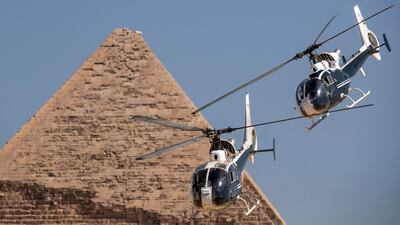
Egyptian-South Korean aerobatics display takes place at Giza pyramids


Kamal Tabikha
  • English
  • Arabic

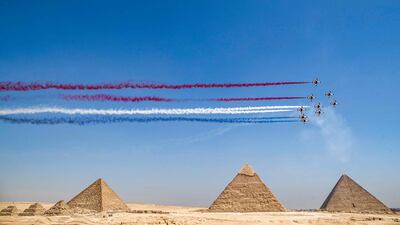
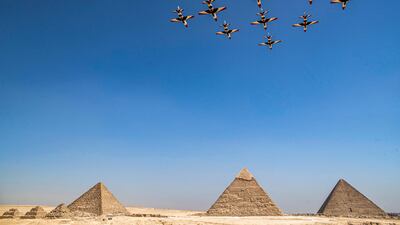
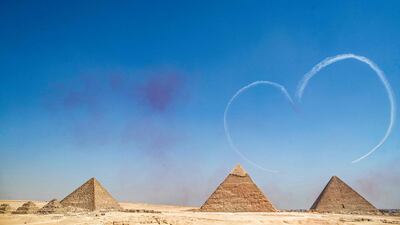
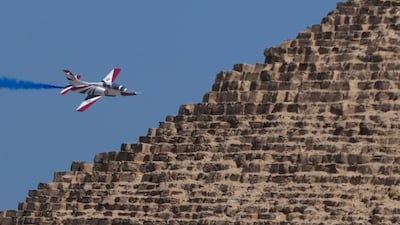
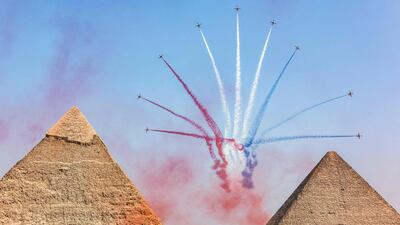
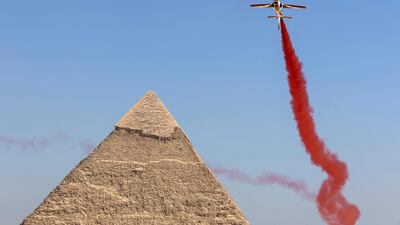
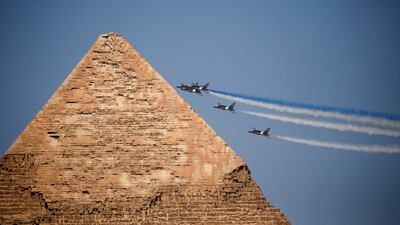
The Egyptian air force’s Silver Stars aerobatics team joined South Korea's Black Eagles to perform an air show at the Giza pyramids.

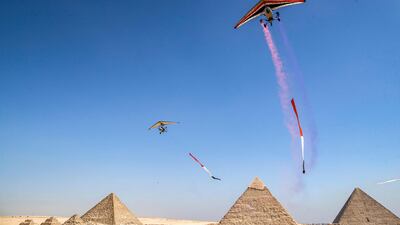
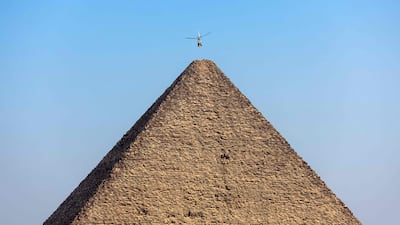
Egypt's tourism ministry said the show, which the Egyptian military’s Horus helicopter team also took part in, was organised by the country’s defence ministry and attended by the ministers of tourism, youth and civil aviation, along with the commander of Egypt’s air force and South Korea's ambassador to Egypt.

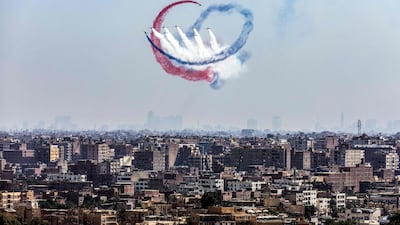
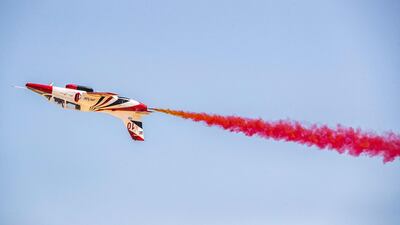
For almost two hours, various plane formations flew over the Giza pyramids on Wednesday, leaving long trails in the colours of both countries’ flags in the sky. The planes performed flips and other tricky manoeuvres to the delighted cheers of those watching.

A portion of the show also included parachuters jumping out of planes and forming complex formations in the sky as they descended.

On the sidelines of the event, the Egyptian tourism minister said the show would promote Egypt's archaeological attractions, as he revealed plans to hold similar aerobatic displays at some of Egypt’s other heritage sites, either with planes or parachutists.

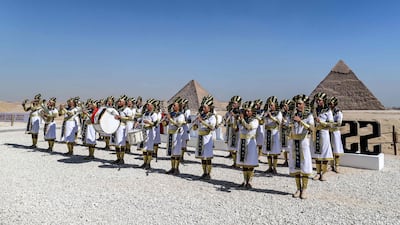
The air show also included a patriotic performance by the Egyptian military marching band.

According to a statement from the defence ministry, the South Korean aerobatics team arrived in Cairo on Monday night and spent Tuesday practising the complex show.

Following a 2016 visit to Seoul by Egyptian President Abdel Fattah El Sisi, when he signed a co-operation agreement with his former South Korean counterpart Park Geun-hye, bilateral relations between both countries have developed in a number of sectors, including energy, transportation and education.

In January, Mr El Sisi hosted the country's current president Moon Jae-in for the first visit to Egypt by a South Korean president in 16 years to discuss further bilateral relations.


WIDE%20VIEW
%3Cp%3EThe%20benefits%20of%20HoloLens%202%2C%20according%20to%20Microsoft%3A%3C%2Fp%3E%0A%3Cp%3E%3Cstrong%3EManufacturing%3A%3C%2Fstrong%3E%20Reduces%20downtime%20and%20speeds%20up%20onboarding%20and%20upskilling%3C%2Fp%3E%0A%3Cp%3E%3Cstrong%3EEngineering%20and%20construction%3A%3C%2Fstrong%3E%20Accelerates%20the%20pace%20of%20construction%20and%20mitigates%20risks%20earlier%20in%20the%20construction%20cycle%3C%2Fp%3E%0A%3Cp%3E%3Cstrong%3EHealth%20care%3A%3C%2Fstrong%3E%20Enhances%20the%20delivery%20of%20patient%20treatment%20at%20the%20point%20of%20care%3C%2Fp%3E%0A%3Cp%3E%3Cstrong%3EEducation%3A%3C%2Fstrong%3E%20Improves%20student%20outcomes%20and%20teaches%20from%20anywhere%20with%20experiential%20learning%3C%2Fp%3E%0A

Graduated from the American University of Sharjah

She is the eldest of three brothers and two sisters

Has helped solve 15 cases of electric shocks

Enjoys travelling, reading and horse riding


Mercer, the investment consulting arm of US services company Marsh & McLennan, expects its wealth division to at least double its assets under management (AUM) in the Middle East as wealth in the region continues to grow despite economic headwinds, a company official said.

Mercer Wealth, which globally has $160 billion in AUM, plans to boost its AUM in the region to $2-$3bn in the next 2-3 years from the present $1bn, said Yasir AbuShaban, a Dubai-based principal with Mercer Wealth.

Within the next two to three years, we are looking at reaching $2 to $3 billion as a conservative estimate and we do see an opportunity to do so,” said Mr AbuShaban.

Mercer does not directly make investments, but allocates clients’ money they have discretion to, to professional asset managers. They also provide advice to clients.

“We have buying power. We can negotiate on their (client’s) behalf with asset managers to provide them lower fees than they otherwise would have to get on their own,” he added.

Mercer Wealth’s clients include sovereign wealth funds, family offices, and insurance companies among others.

From its office in Dubai, Mercer also looks after Africa, India and Turkey, where they also see opportunity for growth.

Wealth creation in Middle East and Africa (MEA) grew 8.5 per cent to $8.1 trillion last year from $7.5tn in 2015, higher than last year’s global average of 6 per cent and the second-highest growth in a region after Asia-Pacific which grew 9.9 per cent, according to consultancy Boston Consulting Group (BCG). In the region, where wealth grew just 1.9 per cent in 2015 compared with 2014, a pickup in oil prices has helped in wealth generation.

BCG is forecasting MEA wealth will rise to $12tn by 2021, growing at an annual average of 8 per cent.

Drivers of wealth generation in the region will be split evenly between new wealth creation and growth of performance of existing assets, according to BCG.

Another general trend in the region is clients’ looking for a comprehensive approach to investing, according to Mr AbuShaban.

“Institutional investors or some of the families are seeing a slowdown in the available capital they have to invest and in that sense they are looking at optimizing the way they manage their portfolios and making sure they are not investing haphazardly and different parts of their investment are working together,” said Mr AbuShaban.

Some clients also have a higher appetite for risk, given the low interest-rate environment that does not provide enough yield for some institutional investors. These clients are keen to invest in illiquid assets, such as private equity and infrastructure.

“What we have seen is a desire for higher returns in what has been a low-return environment specifically in various fixed income or bonds,” he said.

“In this environment, we have seen a de facto increase in the risk that clients are taking in things like illiquid investments, private equity investments, infrastructure and private debt, those kind of investments were higher illiquidity results in incrementally higher returns.”

The Abu Dhabi Investment Authority, one of the largest sovereign wealth funds, said in its 2016 report that has gradually increased its exposure in direct private equity and private credit transactions, mainly in Asian markets and especially in China and India. The authority’s private equity department focused on structured equities owing to “their defensive characteristics.”

Look%20Both%20Ways
%3Cp%3EDirector%3A%20Wanuri%20Kahiu%3Cbr%3EStars%3A%20Lili%20Reinhart%2C%20Danny%20Ramirez%2C%20David%20Corenswet%2C%20Luke%20Wilson%2C%20Nia%20Long%3Cbr%3ERating%3A%203%2F5%3Cbr%3E%3C%2Fp%3E%0A
Expert advice

“Join in with a group like Cycle Safe Dubai or TrainYAS, where you’ll meet like-minded people and always have support on hand.”

Stewart Howison, co-founder of Cycle Safe Dubai and owner of Revolution Cycles

“When you sweat a lot, you lose a lot of salt and other electrolytes from your body. If your electrolytes drop enough, you will be at risk of cramping. To prevent salt deficiency, simply add an electrolyte mix to your water.”

Cornelia Gloor, head of RAK Hospital’s Rehabilitation and Physiotherapy Centre 

“Don’t make the mistake of thinking you can ride as fast or as far during the summer as you do in cooler weather. The heat will make you expend more energy to maintain a speed that might normally be comfortable, so pace yourself when riding during the hotter parts of the day.”

Chandrashekar Nandi, physiotherapist at Burjeel Hospital in Dubai
 

Bullet%20Train
%3Cp%3E%3Cstrong%3EDirector%3A%3C%2Fstrong%3E%20David%20Leitch%3Cbr%3E%3Cstrong%3EStars%3A%3C%2Fstrong%3E%20Brad%20Pitt%2C%20Aaron%20Taylor-Johnson%2C%20Brian%20Tyree%20Henry%2C%20Sandra%20Bullock%3Cbr%3E%3Cstrong%3ERating%3A%3C%2Fstrong%3E%203%2F5%3C%2Fp%3E%0A
Updated: August 04, 2022, 1:01 PM