Ethiopians below a banner referring to the Grand Ethiopian Renaissance Dam. AP

Ethiopia open to resuming dam talks with Egypt and Sudan


  • English
  • Arabic

Ethiopia is open to resuming talks with Egypt and Sudan on the controversial Blue Nile dam that will be Africa’s largest hydroelectric power plant.

Sileshi Bekele, Ethiopia’s former negotiator on the dam and the country’s ambassador to the US, communicated the interest during a meeting with the new US special envoy to the Horn of Africa, Mike Hammer, AP reported.

A statement by Ethiopia’s foreign ministry on Friday cited the ambassador as highlighting “Ethiopia’s interest to resume the African Union-led trilateral negotiation over the GERD,” or Grand Ethiopian Renaissance Dam.

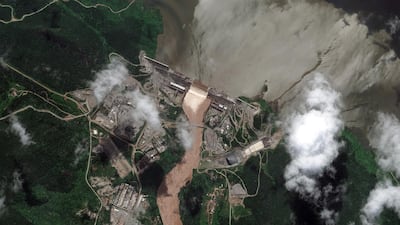
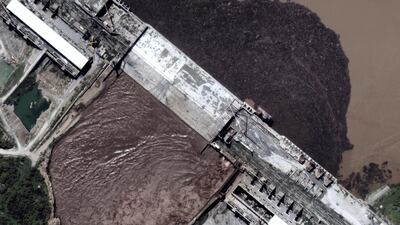
  • A satellite image shows the Grand Ethiopian Renaissance Dam on the Blue Nile river in July, 2020. Maxar Technologies via AP
    A satellite image shows the Grand Ethiopian Renaissance Dam on the Blue Nile river in July, 2020. Maxar Technologies via AP
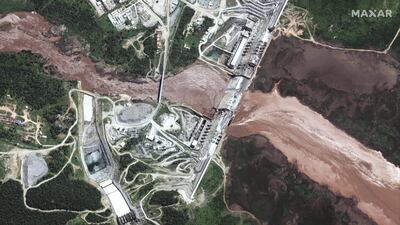
  • The project - which began in 2011 - has become a flashpoint between Ethiopia and several of its neighbours. Maxar Technologies via Reuters
    The project - which began in 2011 - has become a flashpoint between Ethiopia and several of its neighbours. Maxar Technologies via Reuters
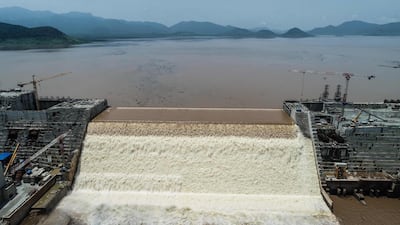
  • For Ethiopia, the dam will make a huge difference to power generation, doubling annual output and connecting millions of Ethiopian families to the grid. AFP
    For Ethiopia, the dam will make a huge difference to power generation, doubling annual output and connecting millions of Ethiopian families to the grid. AFP
  • Egypt maintains that the dam on the Blue Nile, the River Nile's main tributary, will jeopardise its water supply. AFP
    Egypt maintains that the dam on the Blue Nile, the River Nile's main tributary, will jeopardise its water supply. AFP
  • The $4 billion is about 90 per cent completed. Maxar Technologies via Reuters
    The $4 billion is about 90 per cent completed. Maxar Technologies via Reuters
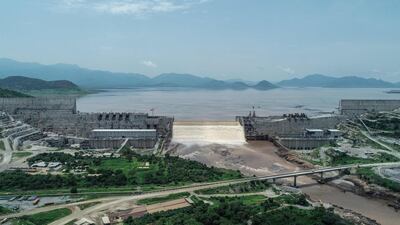
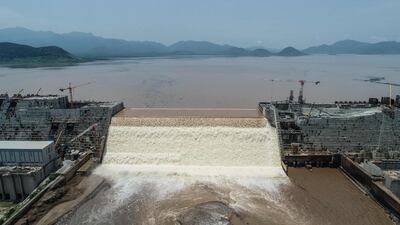
  • An aerial view Grand Ethiopian Renaissance Dam on the Blue Nile River in Guba, northwest Ethiopia, on the 20th July. AFP
    An aerial view Grand Ethiopian Renaissance Dam on the Blue Nile River in Guba, northwest Ethiopia, on the 20th July. AFP

The multi-billion-dollar project is expected to bring electricity to millions of off-grid Ethiopians, but Sudan and Egypt fear it will reduce the amount of water they receive from the Nile River.

Several past rounds of negotiations among Ethiopia, Egypt and Sudan have failed. Egypt fears a quick filling of the dam will reduce its share of Nile waters and seeks a binding legal agreement in case of a dispute.

In February, Ethiopia said it had begun producing power from one unit of the dam.

Earlier on Friday, foreign ministry spokesman Dina Mufti told reporters the third filling of the dam is on schedule this year.

“We have been saying since the start of the dam’s construction that tripartite talks will continue,” he said.


Mercer, the investment consulting arm of US services company Marsh & McLennan, expects its wealth division to at least double its assets under management (AUM) in the Middle East as wealth in the region continues to grow despite economic headwinds, a company official said.

Mercer Wealth, which globally has $160 billion in AUM, plans to boost its AUM in the region to $2-$3bn in the next 2-3 years from the present $1bn, said Yasir AbuShaban, a Dubai-based principal with Mercer Wealth.

Within the next two to three years, we are looking at reaching $2 to $3 billion as a conservative estimate and we do see an opportunity to do so,” said Mr AbuShaban.

Mercer does not directly make investments, but allocates clients’ money they have discretion to, to professional asset managers. They also provide advice to clients.

“We have buying power. We can negotiate on their (client’s) behalf with asset managers to provide them lower fees than they otherwise would have to get on their own,” he added.

Mercer Wealth’s clients include sovereign wealth funds, family offices, and insurance companies among others.

From its office in Dubai, Mercer also looks after Africa, India and Turkey, where they also see opportunity for growth.

Wealth creation in Middle East and Africa (MEA) grew 8.5 per cent to $8.1 trillion last year from $7.5tn in 2015, higher than last year’s global average of 6 per cent and the second-highest growth in a region after Asia-Pacific which grew 9.9 per cent, according to consultancy Boston Consulting Group (BCG). In the region, where wealth grew just 1.9 per cent in 2015 compared with 2014, a pickup in oil prices has helped in wealth generation.

BCG is forecasting MEA wealth will rise to $12tn by 2021, growing at an annual average of 8 per cent.

Drivers of wealth generation in the region will be split evenly between new wealth creation and growth of performance of existing assets, according to BCG.

Another general trend in the region is clients’ looking for a comprehensive approach to investing, according to Mr AbuShaban.

“Institutional investors or some of the families are seeing a slowdown in the available capital they have to invest and in that sense they are looking at optimizing the way they manage their portfolios and making sure they are not investing haphazardly and different parts of their investment are working together,” said Mr AbuShaban.

Some clients also have a higher appetite for risk, given the low interest-rate environment that does not provide enough yield for some institutional investors. These clients are keen to invest in illiquid assets, such as private equity and infrastructure.

“What we have seen is a desire for higher returns in what has been a low-return environment specifically in various fixed income or bonds,” he said.

“In this environment, we have seen a de facto increase in the risk that clients are taking in things like illiquid investments, private equity investments, infrastructure and private debt, those kind of investments were higher illiquidity results in incrementally higher returns.”

The Abu Dhabi Investment Authority, one of the largest sovereign wealth funds, said in its 2016 report that has gradually increased its exposure in direct private equity and private credit transactions, mainly in Asian markets and especially in China and India. The authority’s private equity department focused on structured equities owing to “their defensive characteristics.”

How Alia's experiment will help humans get to Mars

Alia’s winning experiment examined how genes might change under the stresses caused by being in space, such as cosmic radiation and microgravity.

Her samples were placed in a machine on board the International Space Station. called a miniPCR thermal cycler, which can copy DNA multiple times.

After the samples were examined on return to Earth, scientists were able to successfully detect changes caused by being in space in the way DNA transmits instructions through proteins and other molecules in living organisms.

Although Alia’s samples were taken from nematode worms, the results have much bigger long term applications, especially for human space flight and long term missions, such as to Mars.

It also means that the first DNA experiments using human genomes can now be carried out on the ISS.


SPECS
%3Cp%3E%3Cstrong%3EEngine%3A%3C%2Fstrong%3E%20Dual%20electric%20motors%20with%20102kW%20battery%20pack%3C%2Fp%3E%0A%3Cp%3E%3Cstrong%3EPower%3A%20%3C%2Fstrong%3E570hp%3C%2Fp%3E%0A%3Cp%3E%3Cstrong%3ETorque%3A%3C%2Fstrong%3E%20890Nm%3C%2Fp%3E%0A%3Cp%3E%3Cstrong%3ERange%3A%3C%2Fstrong%3E%20Up%20to%20428km%3C%2Fp%3E%0A%3Cp%3E%3Cstrong%3EOn%20sale%3A%3C%2Fstrong%3E%20Now%3C%2Fp%3E%0A%3Cp%3E%3Cstrong%3EPrice%3A%20%3C%2Fstrong%3EFrom%20Dh1%2C700%2C000%3C%2Fp%3E%0A
Updated: June 11, 2022, 12:05 PM