



Exactly a year ago, on March 23, one of the largest container ships ever built, Ever Given, ran aground in one of the world’s busiest shipping routes.
The vessel blocked Egypt’s Suez Canal for six days, in an incident that made headlines across the world.
Though the blockage was quickly resolved, it remains an important event for some people, whose lives were immeasurably changed.
For Abdullah Abdel Gawad, 30, the driver of a now-famous excavator captured in one of the most-shared pictures from the incident, it was a chance to have his mundane yet demanding job seen and appreciated.
Dozens of social media accounts were set up in tribute, with one called Guy With The Digger At Suez Canal earning 55,000 followers.
“I was called to the site because I was the closest technician to the ship, so it was only by chance,” said Mr Abdel Gawad.
“The work itself wasn’t much different from other assignments I had done on the digger, in fact, some other jobs were more physically taxing for me. What was unique about it was that people cared so much. I honestly didn’t know how much was riding on the task at the time.”
He remembers working round the clock. During the little time he had to rest, he would catch up on sleep, so he was not aware of how famous his excavator had become until the ship was refloated.

“Someone like me, someone who comes from where I come from, is used to back-breaking labour. But what I was not used to was having that labour seen and appreciated,” said Mr Abdel Gawad.
“Having so many people understand how difficult it is and celebrate my efforts fills me with pride to this day. If I leave nothing else to my children, I will at least leave them that.”
After helping to free the Ever Given, Mr Abdel Gawad is now part of a team working on widening the section of the canal where the ship became stuck, as part of an expansion plan announced by authorities after the incident.
While Mr Abdel Gawad was part of the rescue operations on land, there were dozens of other workers on marine units that were working on tugging the 400-metre vessel out of its stuck position.
For Ahmed El Zoz, whose image also became a top trend on Egyptian social media channels in March last year, the Ever Given incident transformed his workplace and its operations.
“An incident of that size had never taken place in the canal. It wasn’t just a small ship that got stuck either, no one can really imagine the sheer size of the Ever Given,” Mr El Zoz told The National.
“The part of our training that pertains to ships running aground was mostly theoretical until last year when we got a chance to test it out. What we learnt was that a lot has to change.”

He said in addition to fine-tuning a long list of rescue procedures, teams are now being stationed at different, more strategic points on the canal. Better signalling systems are being used and communications have become much more effective than they used to be.
Mr El Zoz was born and raised in Ismailia and educated from his early teens at the canal authority’s training centre.
Mr Abdel Gawad, on the other hand, is employed by a private company commissioned by the SCA to carry out repairs on the waterway.

Mr El Zoz says that for him and his fellow SCA co-workers, the Ever Given incident was a test of their unity as a team and how much humans can accomplish when they co-operate to such a degree.
“There is a saying in Ismailia, that the whole city is a one-bedroom apartment,” said Mr El Zoz, “Down here most people work for the canal authority. It's a great career that many would kill for.”
He said he is personally connected, away from work, with all of his colleagues. He said this communal harmony is the reason it took the rescue teams only six days to refloat the Ever Given, a fact that is still celebrated by many Egyptians today.
-
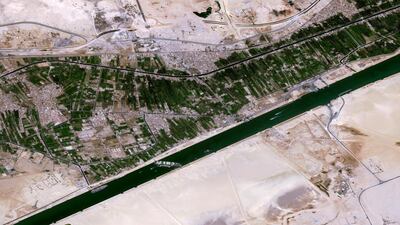
Satellite image shows the Suez Canal, a global trade way, blocked by the Ever Given vessel. Airbus Space -
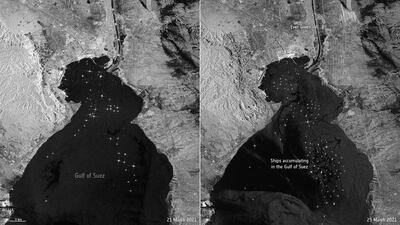
The image on the right shows regular traffic flow on the Suez Canal and the left one shows cargo pile up after Ever Given ran aground. European Space Agency -
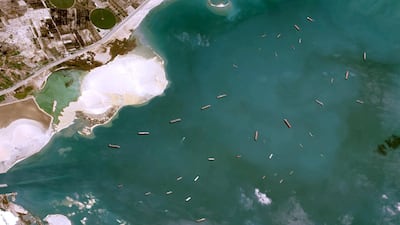
Satellite imagery shows the Suez Canal blocked after the Ever Given vessel ran aground. Airbus Space -
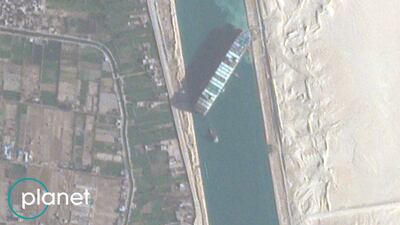
Around 10 per cent of global trade goes through the canal. Planet Labs -
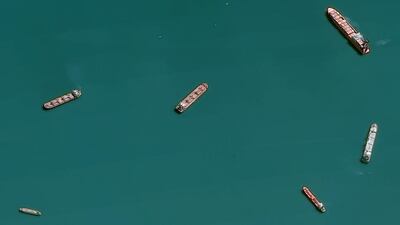
Cargo ships queued up in the canal while it was blocked. Airbus Space -
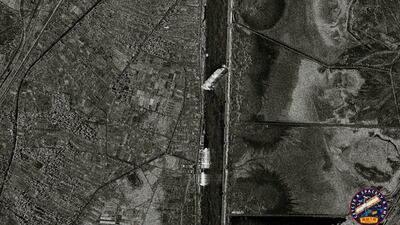
A massive effort eventually refloated the stricken vessel. Research Institute of China Electronics Technology Group Corporation -
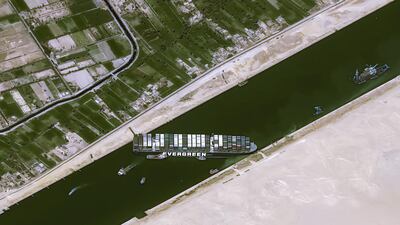
Satellite imagery capture the traffic jam at the Suez Canal caused by the 'Ever Given' container running aground. Airbus Space


“How else can you explain the fact that it took us under a week and it’s taking American rescue workers longer to refloat its sister vessel?” said Mr El Zoz emphatically.
But despite being proud of their involvement in the rescue, both men told The National that their day-to-day lives are largely the same now as they were before the incident. Others involved in the affair witnessed more drastic changes.

As she reflects back on the past year, Egypt’s first female ship captain Marwa El Selehdar remembers being shocked by the misogyny of the maritime sector in Egypt when the Ever Given ran aground.
“When I heard news of the incident, it was at the same time that I became aware of a rumour that I was captaining the ship and so was somehow responsible for what happened,” said Ms El Selehdar, who was in Alexandria on board a commercial vessel at the time. She had just been promoted to first mate and had been subjected to sexism from men in her field.
Doctored images of Ms El Selehdar created by a popular Arab news website were spread online, alleging that she was the captain on board the Ever Given at the time it ran aground.
Ms El Selehdar had faced adversity all her life because of her desire to follow a career in the maritime sector, a notoriously male-dominated field, so she brushed off the negative comments she received at the time. She has even joked that the attention made her more famous.
She has since moved to Dubai, where she works as a marine operations manager for shipping giant Hapag-Lloyd.
She said the Ever Given incident gave a lot of Egyptians a chance to see how important the Suez Canal is to global trade. It made many of them proud that their country could have such an impact on the global landscape.
"I think the most important thing to take away from the Ever Given is that when people co-operate to solve crisis, it is a beautiful thing," she said.

