


Live updates: follow the latest news on Russia-Ukraine
Egypt faces a complex task of protecting its economic and military interests with Moscow, after voting for a UN resolution condemning Russia’s invasion of Ukraine, analysts tell The National.
The effort, say analysts, will likely be hampered by continuing Western pressure on Egypt to be an active contributor to a US-led drive to damage Russia’s economic interests.
A country of 100 million people in the middle of an ambitious programme to modernise its economy and large military, Egypt can ill-afford to sacrifice its interests with Moscow and will strive to benefit from both camps, said the analysts.
“Egypt is having to deal with fallout on a number of fronts, including worries about crucial wheat imports, further blows to an already hard-hit tourism sector, foreign exchange reserve depletions, and an uncomfortable juggling of relations between Russia and the West,” wrote Mirette Mabrouk of the Middle East Institute on Friday.
-
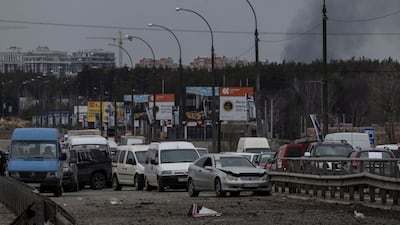
Cars are left abandoned on a road as residents flee the town of Irpin, Ukraine after days of heavy shelling. Reuters -
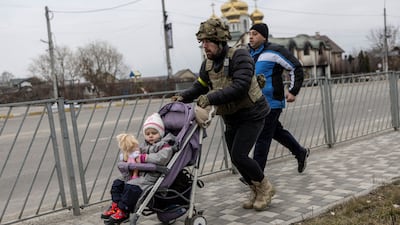
A Ukrainian soldier helps a family fleeing from Irpin. Reuters -
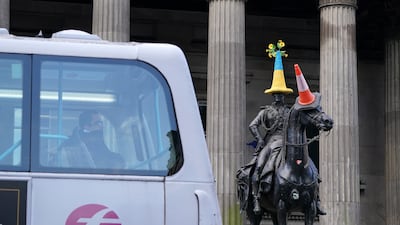
A bus passes the Duke of Wellington statue, which has a traffic cone in the colours of the flag of Ukraine placed on top of it, in Glasgow, Scotland. AP -
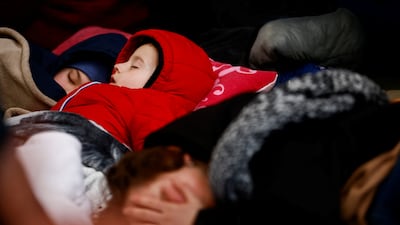
Ukrainian children sleep at the reception point at the train station in Przemysl, Poland. Reuters -
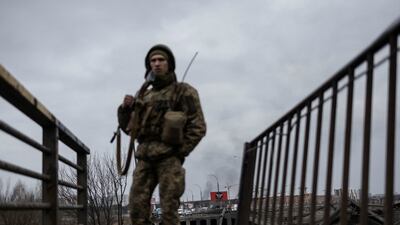
Smoke rises as a Ukrainian soldier stands by the only escape route used by locals to flee from the town of Irpin. Reuters -
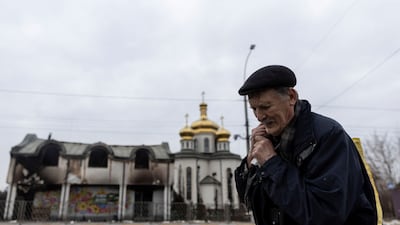
A man flees from Irpin. Reuters -
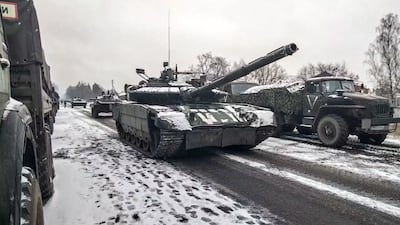
A screengrab from footage released by the Russian Defence Ministry shows a purported Russian tank unit advancement in the Kyiv region. AFP -
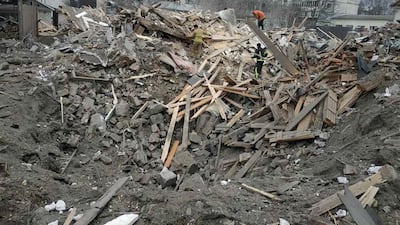
People walk on debris of residential buildings damaged by shelling in the Zhytomyr region. Reuters -

A damaged residential building after Russian multiple rocket launchers shelled the area in the southern city of Mykolaiv. AFP -
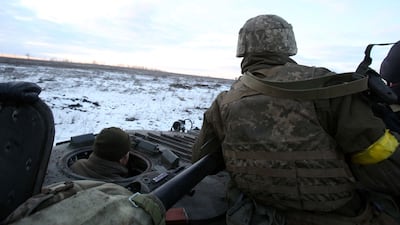
Ukrainian soldiers sit in their armoured vehicle after fighting against Russian troops and Russia-backed separatists near Zolote village, Luhansk region. AFP -
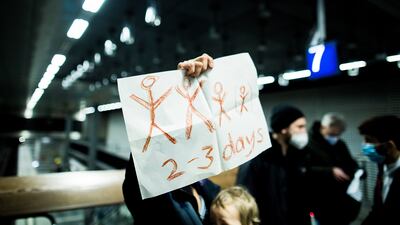
A woman offers accommodation for people fleeing Ukraine at the main railway station in Berlin, Germany. Getty Images -
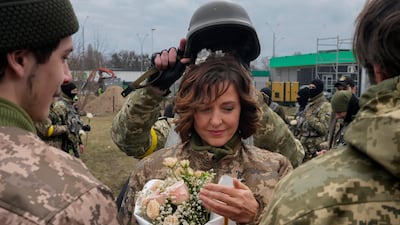
A soldier holds a helmet as a wedding crown during the ceremony for members of the Ukrainian Territorial Defence Forces Lesia Ivashchenko and Valerii Fylymonov, at a checkpoint in Kyiv. AP -
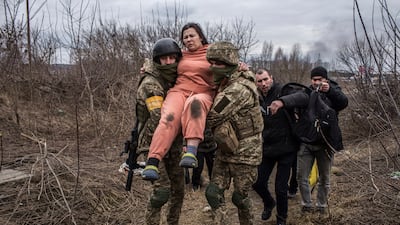
Ukrainian soldiers carry a woman fleeing the town of Irpin. AP -
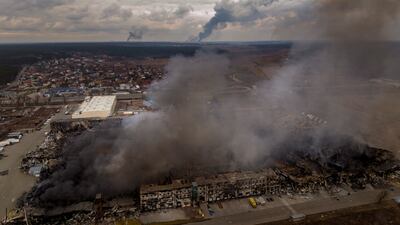
A factory and warehouse burn after being bombarded in Irpin. AP -
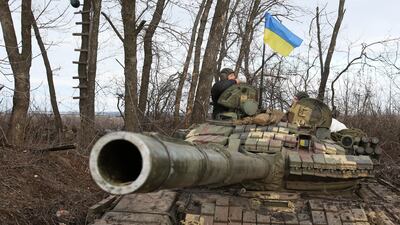
Ukrainian soldiers near Zolote. AFP -
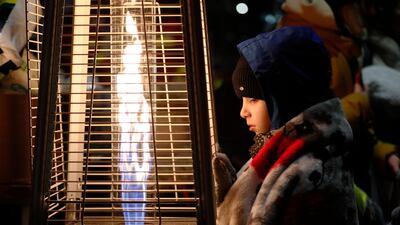
A Ukrainian refugee boy, wearing a blanket on his shoulders, warms his hands with a gas heater shortly after crossing the Siret border into northern Romania. EPA -

People demonstrate against the Russian military operation in Ukraine in Buenos Aires, Argentina. EPA -
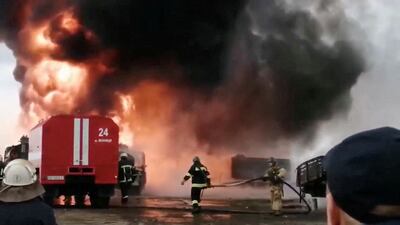
First responders work at the scene after a missile hit a building at Havryshivka Vinnytsia International Airport in Vinnytsia, Ukraine. Reuters -
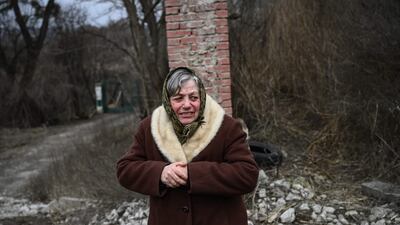
A woman at a checkpoint on the road to Kyiv after her evacuation from a nearby town. AFP -
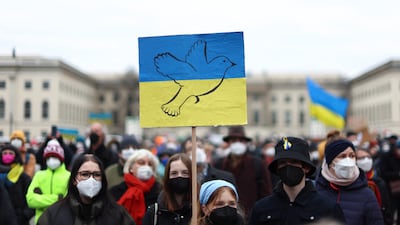
A placard in the Ukrainian colours is held up at an anti-war demonstration the Bebelplatz square in Berlin, Germany. Reuters -
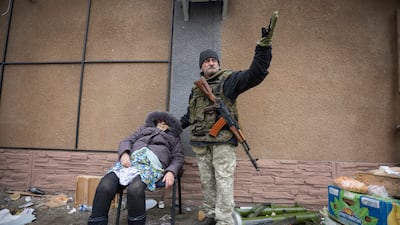
A Ukrainian serviceman helps an elderly woman in Irpin, 20 kilometres north-west of the capital Kyiv. AP Photo -
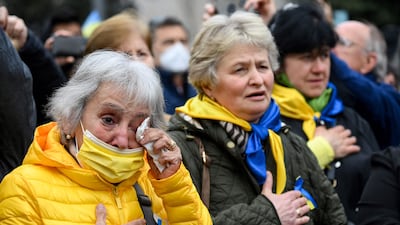
Protesters cry during a demonstration in support of Ukraine at the Plaza Catalunya square in Barcelona. AFP -
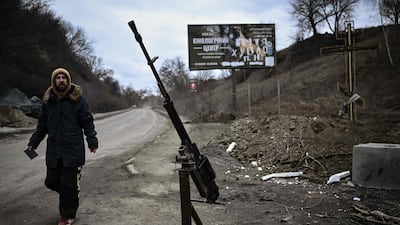
A man walks past a machine gun at a checkpoint next to the last bridge on the road that connects the town of Stoyanka to the outskirts of Ukraine's capital Kyiv. AFP -
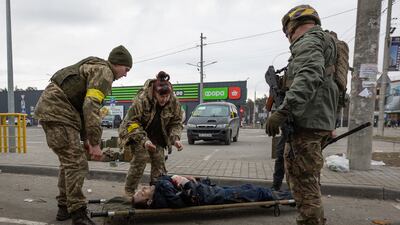
Ukrainian servicemen put a wounded man on a stretcher in Irpin. AP Photo -

People board a train to return to Ukraine after getting supplies in Zahony, Hungary. AP Photo -
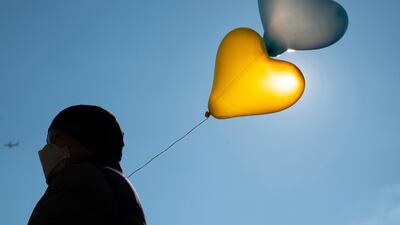
Balloons in the colors of Ukraine during a demonstration against the Russian attack on Ukraine, in Mainz, Germany. AP -
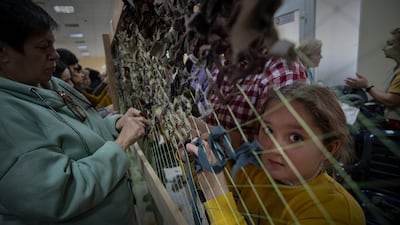
A Ukrainian girl helps to weave a camouflage net for the Ukrainian army, in Odesa. EPA -

Molotov cocktails prepared by a group of volunteers in Odesa. Hundreds are made every day. EPA -

Ukrainian servicemen assist people fleeing the town of Irpin after crossing the Irpin River on an improvised path under a bridge that was destroyed by a Russian air strike. AP Photo -
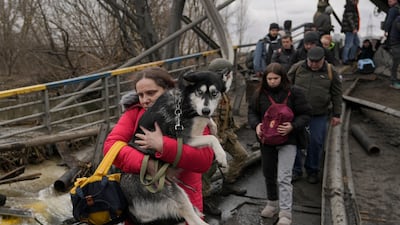
A woman holds a dog while crossing the Irpin River on an improvised path under a bridge that was destroyed by a Russian airstrike, while assisting people fleeing the town of Irpin, Ukraine. AP Photo -
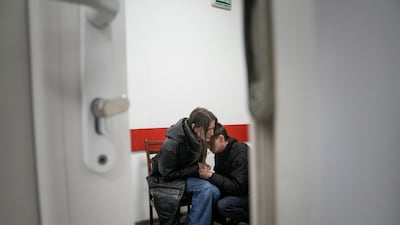
Marina Yatsko and her boyfriend Fedor comfort each other at a hospital in Mariupol after her 18-month-old son Kirill was killed by shelling. AP Photo -

Ukrainian civilians receive weapons training in a cinema in Lviv, western Ukraine. AP Photo -
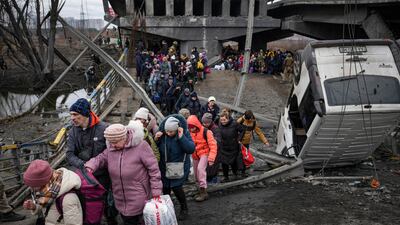
Residents flee the town of Irpin, near Kyiv, Ukraine. AP Photo -
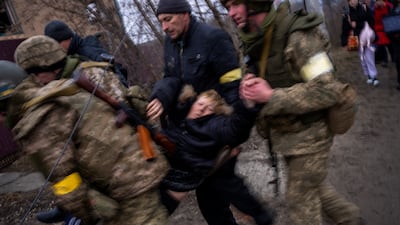
Ukrainian soldiers carry a sick woman as civilians flee Irpin, on the outskirts of Kyiv, after Russian attacks. AP Photo -

Captured Russian soldiers at a press conference in the Interfax news agency in Kyiv, Ukraine. AP Photo -
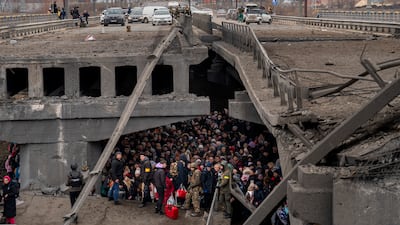
Ukrainians beneath a destroyed bridge in Irpin. AP Photo -

A woman fleeing Ukraine on a bus near the border crossing in Korczowa, Poland. AP Photo -
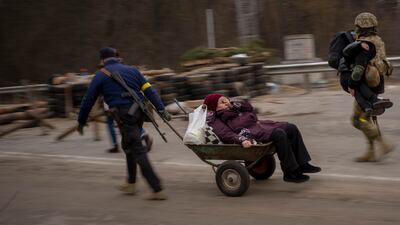
A Ukrainian soldier and a militia man help a fleeing family on the outskirts of Kyiv, Ukraine, on March 5, 2022. AP Photo -
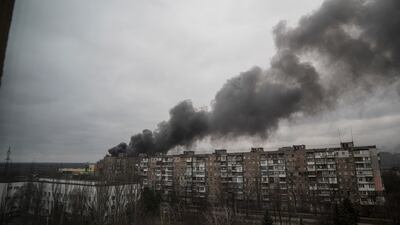
Smoke rises after shelling by Russian forces in Mariupol. AP Photo -
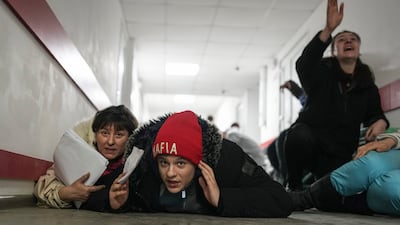
People at a hospital during shelling by Russian forces in Mariupol. AP Photo -
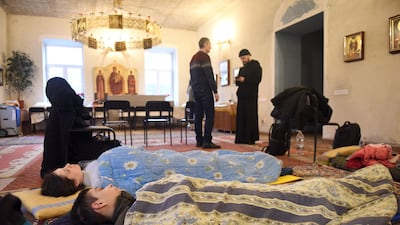
Displaced Ukrainians at the Resurrection New Athos Monastery in the western Ukrainian city of Lviv. AFP


“Egypt has extensive and convoluted ties with both Russia and the West and it would be counter-productive to step to one side or another.”
Egypt is no stranger to being caught in the middle of Russian-American rivalry, having spent most of the second half of the last century seeking, albeit with limited success, to walk a middle course between East and West during the Cold War.
But the task may prove to be much more difficult this time round, say the analysts.
A US ally since the 1970s, Egypt has in recent years inched closer to Russia, which has sold Cairo cutting-edge weapons and agreed to build its first nuclear power station.
Modern-day relations date back to the 1950s, when the Soviet Union sold Egypt its first shipment of weapons after army officers seized power in 1952 and replaced the monarchy with a left-leaning regime.
The two countries remained close allies until 1972, when then president Anwar Sadat threw out thousands of Russian military advisers and later took Egypt to the US camp, cutting off virtually all ties with the Kremlin. Relations with the Kremlin shifted between being fraught with tension and lukewarm for years, until President Abdel Fattah El Sisi took office in 2014.

The world’s largest wheat importer, Egypt, relies on Russia for 50 per cent of its imports of the grain, which last year stood at about 13 million tonnes.
The two countries have also been co-ordinating policy on Libya, Egypt’s war-torn neighbour.
They are also bound by the 2018 comprehensive partnership and strategic co-operation agreement which, among other things, entails regular talks between the two countries’ defence and foreign ministers.
Egypt is also a popular destination for Russian tourists. Hundreds of thousands of Russians visited each year, before a plane flying to St Petersburg crashed in the Sinai Peninsula in 2015, killing all 224 people on board in a suspected terror attack.
“These interactions [with Russia] will likely continue, albeit there may be some regression of tourism, which is still recovering from the impact of the coronavirus pandemic,” said Mohamed Anis Salem, a retired career diplomat who sits on the Egyptian Council for Foreign Affairs.
“There may be some difficulties resulting from the Western sanctions on Russia but we can assume that there will be solutions that ensure continuity.”
Sanctions controversy
On account of the potential risk to these interests, Egypt followed its UN General Assembly vote on Wednesday with a statement designed to reassure the Russians.
Read at the General Assembly by its permanent representative, the statement emphasised the need to find a political solution to the Ukraine conflict and admonished the West for adopting economic sanctions against Moscow outside the umbrella of the UN.
“Egypt opposes the method of employment of economic sanctions outside international mechanisms… past experiences [of sanctions] have had extremely negative effects” on ordinary people, said the statement.
The vote followed days of deliberations at the highest level in Cairo, said officials who closely monitored the process, with Egypt initially inclined to abstain. Cairo shifted to vote in favour when it became clear that the resolution would be overwhelmingly supported, they said.
Moreover, Egypt’s foreign policy, they explained, has a long and proven track record of firmly siding with international law and against military actions not sanctioned by the UN. There was also intense pressure from the US and its European allies on Egypt in the days leading to the vote.
“Egypt was very exposed because it did not want to simply follow the US line. It likes to have this diversified approach to policy and the US has been willing to tolerate that,” said Michael Hanna, the New York-based US programme director in the International Crisis Group.
“For Egypt to abstain would have been taken as effectively siding with Russia; and as much as Egypt wanted to hedge it, that would have proven problematic for Cairo. It would have raised fundamental questions about our relationship,” he said.
“But Egypt can find a safe haven from possible admonishment or reproach by Russia in the sheer large number of nations [141] that voted in favour of the resolution.”
The Egyptians have long complained that Washington has consistently denied them some of the cutting-edge weapons they need, prompting them to shop elsewhere, including deals to buy Russia’s SU-35 fighter jets, despite Washington’s opposition. Egypt’s large imports of Russian wheat have also been justified on account of their low prices compared to what's on offer from the US.
Egypt, meanwhile, receives $1.3 billion annually in US military aid and the two countries maintain a high level of security co-operation and intelligence-sharing, since they drew closer after Egypt signed a peace treaty with Israel in 1979.
However, Cairo’s relations with Washington have frequently been bumpy, mostly over US criticism of Cairo’s human rights record.
Significantly, President El Sisi has yet to be invited to Presidsent Joe Biden’s White House, although relations between the two leaders have thawed after Egypt helped mediate a cease-fire between Hamas and Israel last May.
The US recently suspended $130 million in military aid to Egypt, again citing Cairo’s rights record. It marked the second time the US has taken such action in less than a decade.
“It took some time and a lot of work to get past the relationship’s fraught stage. It is not an easy relationship and it took a lot of work to get it where it is now,” said Mr Hanna, adding that considerable tension would have been placed on relations had Egypt abstained on Wednesday.

