

In Cairo's City of the Dead, the signs of imminent destruction are literally written on the walls of family cemeteries. Markings in black spray paint, coupled with informal notice from the area's gravediggers, mean families are in a state of devastation and confusion as to whether their burial grounds will be collateral damage in a roads expansion project.
More than 2,000 tombs will be bulldozed if a plan to build a motorway through the southern section of the vast historic necropolis comes to fruition.
It is unclear what will be spared in the area that measures 12 kilometres from north to south and is a part of Historic Cairo registered as a Unesco world heritage site in 1979.
A surveying team from the Cairo governorate has made frequent visits over the past few weeks to determine which graveyards should be considered heritage sites and which will be demolished.
member of campaign for the safeguard of Historic Cairo's cemeteries
But conservationists say the entire area, which dates back to the Muslim conquest of Egypt in the 7th Century, must be preserved because of its historical and architectural significance. It includes elaborate mausoleums of many of the country’s rulers and elite families, as well as the graves of prominent writers, cultural figures and scholars, among the common population.
“Losing this is losing a part of history,” says Dr Mostafa El Sadek, a member of a group of architects, urban planners and activists who started a petition and Facebook site calling for the safeguard of Historic Cairo’s cemeteries.
“People think that the arafa [cemetery] is an ugly place – no, it’s a place of beauty,” says Dr El Sadek, a professor of obstetrics and gynaecology at Cairo University. He became fascinated with learning about the area and now visits at least once a week to take photographs and talk to members of the community.
-

More than 2,000 tombs will be bulldozed if a plan to build a highway through the southern cemetery of Cairo’s vast historic necropolis comes to fruition. Nada El Sawy / The National -

The Zulfiqar family cemetery, where Queen Farida, the first wife of King Farouk, is buried. Nada El Sawy / The National -

The family cemetery of Ismail Sedky, a former prime minister of Egypt in the first half of the 20th century. Nada El Sawy / The National -

Dr Mostafa El Sadek, a professor of obstetrics and gynaecology at Cairo University, is part of a campaign to save the city’s historic cemeteries. Nada El Sawy / The National -
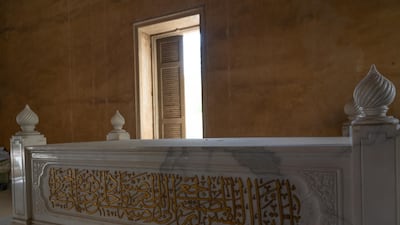
Intricate Islamic calligraphy is inscribed on a tomb above ground in the City of the Dead. Mahmoud Nasr / The National -
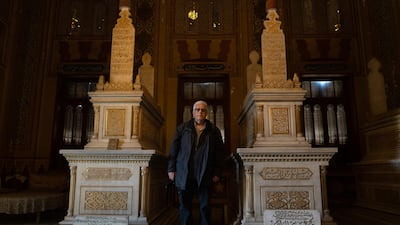
Dr El Sadek in the family mausoleum of Ismail Sedky. Mahmoud Nasr / The National -

Markings in black spray paint indicating plans for demolition have left families devastated. Nada El Sawy / The National -

Medhat Khalaf, the caretaker of the Ismail Sedky family cemetery, points to a black marking indicating the street will be expanded by 32 metres. Nada El Sawy / The National -

Families have emptied their relatives’ graves based on black markings and informal notices that they would soon be demolished. Nada El Sawy / The National -

A decision issued by Prime Minister Mostafa Madbouly stated the owners of cemeteries affected by the highway project will be compensated. Nada El Sawy / The National -

Architect Galila El Kadi and Islamic antiquities professor Hossam Ismail were among the speakers at an event at the Greater Cairo Public Library on Saturday. Nada El Sawy / The National -
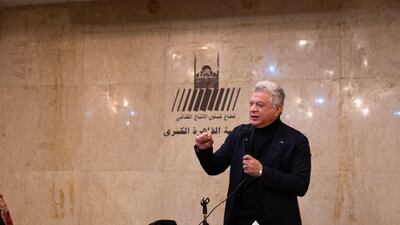
Hany Eissa Al Fekky, the planner of road expansions in City of the Dead, defended the projects as beneficial for the public good. Mahmoud Nasr / The National -
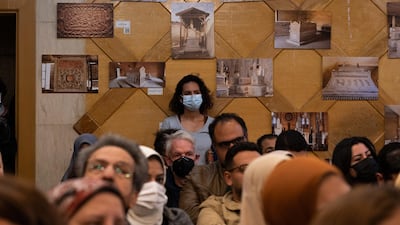
More than 200 people attended a photography exhibit and talk at the Greater Cairo Public Library in Zamalek on Saturday about saving the city’s historic cemeteries. Mahmoud Nasr / The National


The balance between easing traffic congestion in Cairo, a city of more than 20 million people, and protecting the gems of its past has been the subject of intense debate since President Abdel Fattah El Sisi took office in 2014. He has made a nationwide infrastructure overhaul and construction boom a defining feature of his presidency, but some say it has come at too high a price.
In rare cases, the debate has inspired change; a planned flyover in the suburb of Heliopolis that would have passed in front of the 100-plus-year-old Basilica church was put on hold last year after a public outcry.
The destruction of tombs in the City of the Dead has the added weight of severing emotional and social ties and displacing the living who inhabit the area.
But there are indications that the government is adamant in its mission, arguing that is for the sake of the public good and includes upgrading slums. Parts of the northern cemetery section were already destroyed in the summer of 2020 for an expressway called Al Fardous (Paradise), now renamed Jehan Al Sadat.
“It was something so terrible. It was like a bomb falling on the place,” says Galila El Kadi, a Paris-based emeritus professor of urban planning and architecture and founder of the group that launched the current petition campaign.
Ms El Kadi, author of the 2007 book Architecture for the Dead: Cairo's Medieval Necropolis, says a Cairo 2050 masterplan from the Ministry of Housing calls for the eventual transfer of tombs to the city’s outskirts.
Unesco said in a statement to The National: “Our experts are in permanent contact with the Egyptian authorities to reconcile these urban development projects with the necessary World Heritage Protection, in accordance with the international commitments of Egypt."
Hany Al Fekky, the planner behind the Jehan Al Sadat expressway and the current project, told The National, “We have not gone close to any graves that are considered heritage sites or have distinguished architecture.”
Egypt’s 1983 Antiquities Protection Law states that an antiquity is every immovable or movable property that has archaeological or historical value, from the prehistoric area up until 100 years ago, but allows for exceptions to the time limit by decision from the prime minister.
A 2006 law prohibits the demolition of buildings that have a distinguished architectural style and historical significance.
The petition against the current project, signed by more than 3,300 people and addressed to Mr El Sisi, says that demands of the public interest “should not come at the expense of the nation’s cultural heritage”.
On December 14, Prime Minister Mostafa Madbouly issued a decision in the official gazette to the effect that expansion of the major arterial road Salah Salem Street will start from the National Museum of Egyptian Civilisation in Fustat to the Jehan Al Sadat axis and is considered “one of the projects of public interest”.
The project’s path is interspersed with cemeteries, as well as some properties in Al Khalifa neighbourhood, the statement said. The relevant authorities will survey the cemeteries that fall within the project’s scope and “compensate the cemeteries’ beneficiaries”.
Families have not received official government notification, but some have been told they will be compensated with 30-metre plots in 15th of May City, about 30 kilometres south of their current location.
On a recent visit to the project’s targeted area in the City of the Dead, The National found several common graves on Al Khelaa street that had been emptied already, perhaps to avoid being caught unaware by demolition.

Others hold out hope that their cemeteries will be exempt. One of them is Seif Zulfiqar, the grandson of the brother of Queen Farida. She is the first wife of Egypt's last monarch, King Farouk, who was deposed 70 years ago.
Mr Zulfiqar says he received notice in October through the cemetery caretakers that the new motorway would pass over the 4,200-square-metre courtyard where Queen Farida and many other family members are buried.
He took to social media and sent letters to several government entities, such as the Council of Ministers, the Cairo governorate and the Ministry of Tourism and Antiquities. But aside from rumours that the Zulfiqar burial ground will not be affected, he has received no official word.
“They said they will demolish. Then they said they will not demolish. Then they said they will demolish,” says Mr Zulfiqar, 32. “No one knows what will happen.”
When The National visited, the surveying team from the Cairo governorate gave informal assurances that such heritage sites would not be included and said they would be submitting an official report.
Separating the layers of a place that mixes old and new, traditional and modern, ancient Egyptian and Islamic and Mamluk influences, may not be so simple.
The group of activists behind the petition and Facebook page documented and photographed the sites under threat and held an event on Saturday at the Greater Cairo Public Library attended by more than 200 people.
Ms El Kadi, Dr El Sadek and others spoke of the historical, spiritual, architectural, symbolic and cultural values at stake.
Tariq Al Murri, a consultant in architectural conservation, presented alternative solutions, such as building a tunnel below ground from the Citadel that would avoid the area and relocating a microbus station that he said causes most of the traffic congestion.
planner of road expansion projects in City of the Dead
Sitting in the front row of the audience was Mr Al Fekky, the architectural consultant for the Ministry of Housing and Ministry of Defence.
At the end of the talk, he stepped up to the microphone to defend the projects, saying that they were for the public good. The crowd was unconvinced, heckling him with comments such as “that’s not true”.
Attendees followed him out the door, asking desperately whether their cemeteries would be among those affected. “I don’t want to have to bury my father twice,” one woman told him.
“Everything that is ordinary that we have to remove will be removed,” he said.
He told The National the drawings have been approved, new yellow markings will soon follow, and official notice will be given in the next month.

