

Littered with stables that house hundreds of horses, the district of Saqqara, about 30 kilometres south of central Cairo, has long been a favourite for Egypt's equestrian enthusiasts.
Perhaps that is why Omar Abu Karama, the founder and head coach of Talaat Kheil, a nascent free-riding school, chose the area as his operation’s headquarters.
“I began riding when I was 3 years old. I grew up in the district of Haram, an area famous for its love of horses, so it wasn’t such a stretch that I became so fascinated with them and with the freedom that one feels when one is on horseback,” Abu Karama tells The National.
It certainly isn’t a new idea to set up a horse-riding business so close to the pyramids of Giza, where the activity has become a tourism staple over the decades. The nearby neighbourhood of Nazlet El Semman, — a few kilometres closer to the Giza plateau than Saqqara — is known as the Egyptian capital’s quintessential equestrian hotspot.
But Abu Karama, wanting to rectify some of the problems that, he felt, were preventing visitors of the Giza plateau from truly enjoying riding horses through the empty Sahara, brought his own spin to the experience.
After getting swindled by greedy tour operators who overcharge unsuspecting tourists and not being taught how to properly deal with a horse, many people who ride horses by the pharaonic sites in the area have a terrible experience, and often they never want to associate with horses again, he said.
“My main goal was to introduce people to free-riding and how transformative it can be,” he says. “Nobody really thinks of it as a sport, I think that should change.”
Unlike other equestrian sports, which are more disciplined and rife with rules, free-riding is about letting go, explains Abu Karama. It is a totally recreational and cathartic experience, he adds.
Essentially, free-riding is having enough know-how about horse-riding that you feel comfortable enough to let your horse gallop at full speed through open terrain. The horse enjoys the release as much as the rider, says Abu Karama.
-

Omar Abu Karama, 27, and his horse Shaheen at El Gammal Stables in Saqqara. He founded a horse-riding school and tour operator called Talaat Kheil which specialises in free-riding. Photo: Mahmoud Nasr -

Free-riding enthusiast Omar rides his horse through the Sahara desert. In the background, the step pyramids of Abusir can be seen. Photo: Mahmoud Nasr -
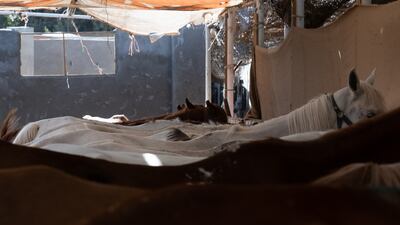
Horses resting at El Gammal Stables in Saqqara, which is about 30km south of central Cairo. Some of these horses are for riding, and some pull carts. Photo: Mahmoud Nasr -
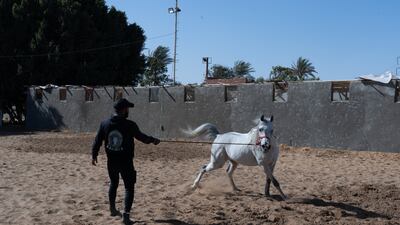
Omar warms up his horse before a free-ride in the desert. Photo: Saqqara by Mahmoud Nasr -
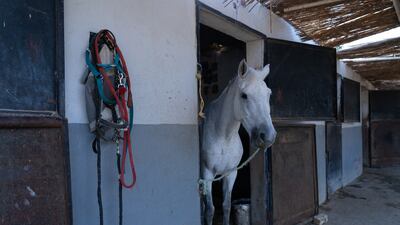
A horse in its stable at El Gammal Stables. Sitting on the edge of the Sahara desert, the area houses some of Cairo's largest and most prominent horse stables. Photo: Mahmoud Nasr -
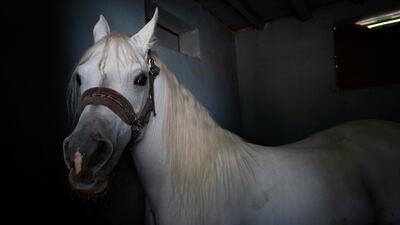
Omar's Arab horse, Shaheen. He is a small-sized 5-year-old. Photo: Saqqara by Mahmoud Nasr -

Omar gives Shaheen a break after a long ride through the desert. Photo: Mahmoud Nasr -

Omar rides Shaheen on a hilltop in Saqqara. Photo: Mahmoud Nasr -
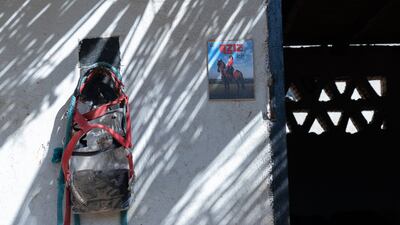
A horse-riding poster on the wall of at a stables in Saqqara. The area is popular with the country's equestrians. Photo: Saqqara by Mahmoud Nasr -
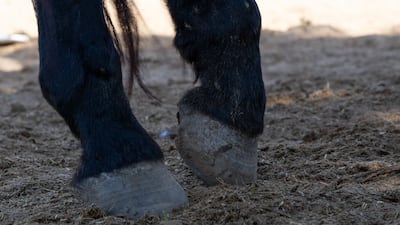
The hooves of a horse in the district of Saqqara. Photo: Mahmoud Nasr -

Omar and his horse Shaheen atop a sand dune in the Abu Sir necropolis. The necropolis houses some of the oldest graves from ancient Egypt. Photo: Mahmoud Nasr -
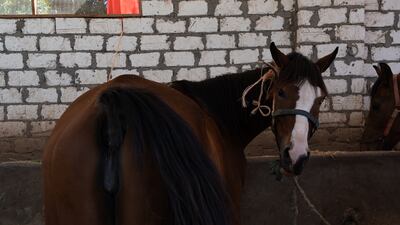
A horse at a stable just outside the Egyptian capital. The neighbouring districts of Saqqara and Nazlet El Semman house the country's best stables. Photo: Mahmoud Nasr


“It’s not like other sports where people do it just to compete for some big medal at the end,” he explains. “The gold medal in free-riding is the transcendental euphoria you feel as your horse races through the sand and the wind rages around you.”
Abu Karama says he found sports like showjumping rather uptight, and was drawn to free-riding because anyone could do it, no matter their background.
“But like anything, even enjoyment can be better accomplished with some rules,” explains Abu Karama.
With a love of free-riding as its credo, Talaat Kheil is halfway between a riding school and a tour operator.
“I set up Talaat Kheil more as a school where our riders get an immersive introduction into how to deal with the animal first before we go out into the desert and have some fun.”
Administered by the six guides currently working alongside Abu Karama, Talaat Kheil’s tours begin with a one-hour crash course on how to interact with the horse, how not to scare it, but above all, visitors are taught the importance of assertiveness when dealing with their horses.

“The key to an enjoyable free-ride is unsurprisingly the rider’s relationship with his horse,” says Mr Abu Karama, “Which is why I teach people how to deal with the animal in all of its moods before they mount it. This gives them more agency during the ride and allows them to trust themselves enough to let go and be in the moment.”
Once man and beast have been acquainted and both are comfortable, Abu Karama leads a group of 25 out into Saqqara’s sand dunes, where conveniently some of the oldest pharaonic monuments in existence are located.
“The monuments create a truly striking backdrop to the rides,” says Abu Karama, looking over his shoulder and motioning to one of the pyramids inside the Abusir necropolis, an area known for housing Old Kingdom relics.
He also leads more advanced tour groups on longer, more difficult horse safaris in districts outside Cairo, including Fayoum, about 100km south-west of Cairo, the Nile Delta province of Damietta, which sits on the Nile Delta's right arm and Dahab, a beach town in South Sinai.
On these longer trips, riders are expected to be out on horse-back for around nine hours, he said.
In three years, Abu Karama has managed to amass tens of thousands of online followers, many of whom visit on a weekly basis, he says.
For one tour, which typically takes three hours, including the introductory course, Egyptian visitors are charged 200 Egyptian pounds ($12.72). Foreigners are charged EGP250 ($15.91).

