Egyptian President Abdel Fattah El Sisi, centre, meets with Libyan military strongman Khalifa Haftar, second right, and Libyan Parliament speaker Aguila Saleh, second left, in Cairo. AFP

El Sisi meets Libyan officials to push for elections


  • English
  • Arabic

President Abdel Fattah El Sisi received on Tuesday speaker Aguila Saleh and Khalifa Haftar, commander of the Libyan Arab Armed Forces, in Cairo, the Egyptian leader’s office said.

Mr El Sisi pushed for the holding of elections as scheduled in December and said his government would continue its efforts “with all Libyan brothers … to hold the significant presidential and parliamentary vote by the end of this year”.

He also reiterated calls for foreign forces and mercenaries to be pulled out of the oil-rich country.

The UN has estimated there have been 20,000 foreign forces and mercenaries, mostly Syrian, Turkish, Russian and Sudanese, in the North African nation. The presence of foreign fighters and mercenaries is a major hurdle to holding the planned vote.

Mr Saleh and Gen Hafter, whose forces run most of Libya’s eastern and southern regions and oil facilities, are close allies to Egypt.

In recent months, Mr El Sisi’s government has also reached out to officials in western Libya.

UN-sponsored peace talks brought about a ceasefire last October and installed an interim government that is expected to lead the country into December elections.

The ceasefire deal also required the withdrawal of foreign fighters and mercenaries within three months, a deadline that was never met.

  • Vehicles of the "Tripoli Brigade", a militia loyal to the UN-recognised Government of National Accord (GNA), parade through the Martyrs' Square at the centre of the GNA-held Libyan capital Tripoli on July 10, 2020. AFP
    Vehicles of the "Tripoli Brigade", a militia loyal to the UN-recognised Government of National Accord (GNA), parade through the Martyrs' Square at the centre of the GNA-held Libyan capital Tripoli on July 10, 2020. AFP
  • Vehicles of the "Tripoli Brigade", a militia loyal to the UN-recognised Government of National Accord (GNA), parade through the Martyrs' Square at the centre of the GNA-held Libyan capital Tripoli on July 10, 2020. AFP
    Vehicles of the "Tripoli Brigade", a militia loyal to the UN-recognised Government of National Accord (GNA), parade through the Martyrs' Square at the centre of the GNA-held Libyan capital Tripoli on July 10, 2020. AFP
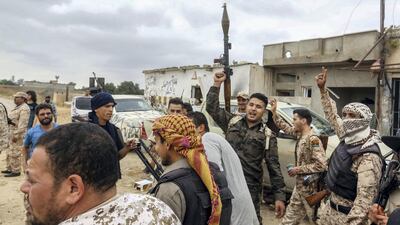
  • Fighters loyal to the Libyan internationally-recognised Government of National Accord (GNA) are pictured near the frontline during clashes against forces loyal to Khalifa Haftar, on June 1, 2019, in al-Sawani area, south of the Libyan capital Tripoli. AFP
    Fighters loyal to the Libyan internationally-recognised Government of National Accord (GNA) are pictured near the frontline during clashes against forces loyal to Khalifa Haftar, on June 1, 2019, in al-Sawani area, south of the Libyan capital Tripoli. AFP
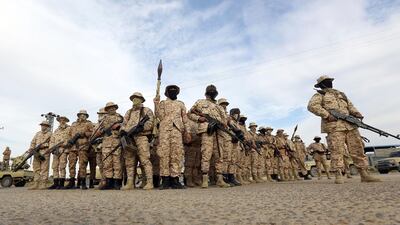
  • Members of the Tripoli Protection Force, an alliance of militias from the capital city, patrol an area south of the Libyan capital on January 18, 2019, during clashes with the Seventh Brigade group from the town of Tarhuna. Two days of clashes between rival militias near Libya's capital Tripoli have left 10 people dead and 41 wounded, the health ministry said on January 17. Fighting between armed groups erupted Wednesday despite a truce deal four months ago that had halted deadly battles in the city. AFP
    Members of the Tripoli Protection Force, an alliance of militias from the capital city, patrol an area south of the Libyan capital on January 18, 2019, during clashes with the Seventh Brigade group from the town of Tarhuna. Two days of clashes between rival militias near Libya's capital Tripoli have left 10 people dead and 41 wounded, the health ministry said on January 17. Fighting between armed groups erupted Wednesday despite a truce deal four months ago that had halted deadly battles in the city. AFP
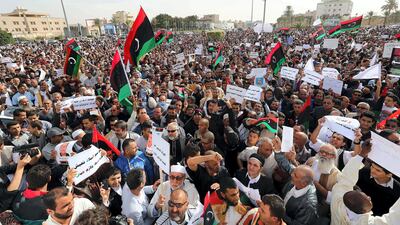
  • Libyans demonstrate in a street in the capital Tripoli to demand the withdrawal of all armed militias from the capital on November 22, 2013. Residents of Libya's capital were turning out Friday to press militias remaining in the city to follow others and withdraw, aiming to keep up the momentum following deadly clashes last weekend. Many of the groups have long rejected government calls to lay down their arms or integrate into the armed forces, triggering the frustration of Libyans who once hailed them as heroes for toppling Kadhafi. AFP
    Libyans demonstrate in a street in the capital Tripoli to demand the withdrawal of all armed militias from the capital on November 22, 2013. Residents of Libya's capital were turning out Friday to press militias remaining in the city to follow others and withdraw, aiming to keep up the momentum following deadly clashes last weekend. Many of the groups have long rejected government calls to lay down their arms or integrate into the armed forces, triggering the frustration of Libyans who once hailed them as heroes for toppling Kadhafi. AFP

Libyan lawmakers have failed to finalise a legal framework for voting to take place, throwing the election schedule into doubt.

With mounting international pressure, the parliament earlier this month adopted a controversial presidential electoral law and said it is in the process of finalising it for parliamentary elections, according to the UN's envoy to Libya.

However, the High Council of State, an executive institution that among other duties proposes electoral laws, complained the law was adopted without consulting its members, which could derail the road map.

US special envoy to Libya Richard Norland urged the country’s leaders to compromise to meet the people’s expectations and hold elections at the end of the year.

Libya has been wracked by chaos since a Nato-backed uprising toppled longtime dictator Muammar Qaddafi in 2011 and split the oil-rich country between rival governments, each backed by armed groups and foreign governments.


The story of Edge

Sheikh Mohamed bin Zayed, Crown Prince of Abu Dhabi and Deputy Supreme Commander of the Armed Forces, established Edge in 2019.

It brought together 25 state-owned and independent companies specialising in weapons systems, cyber protection and electronic warfare.

Edge has an annual revenue of $5 billion and employs more than 12,000 people.

Some of the companies include Nimr, a maker of armoured vehicles, Caracal, which manufactures guns and ammunitions company, Lahab


How Apple's credit card works

The Apple Card looks different from a traditional credit card — there's no number on the front and the users' name is etched in metal. The card expands the company's digital Apple Pay services, marrying the physical card to a virtual one and integrating both with the iPhone. Its attributes include quick sign-up, elimination of most fees, strong security protections and cash back.

What does it cost?

Apple says there are no fees associated with the card. That means no late fee, no annual fee, no international fee and no over-the-limit fees. It also said it aims to have among the lowest interest rates in the industry. Users must have an iPhone to use the card, which comes at a cost. But they will earn cash back on their purchases — 3 per cent on Apple purchases, 2 per cent on those with the virtual card and 1 per cent with the physical card. Apple says it is the only card to provide those rewards in real time, so that cash earned can be used immediately.

What will the interest rate be?

The card doesn't come out until summer but Apple has said that as of March, the variable annual percentage rate on the card could be anywhere from 13.24 per cent to 24.24 per cent based on creditworthiness. That's in line with the rest of the market, according to analysts

What about security? 

The physical card has no numbers so purchases are made with the embedded chip and the digital version lives in your Apple Wallet on your phone, where it's protected by fingerprints or facial recognition. That means that even if someone steals your phone, they won't be able to use the card to buy things.

Is it easy to use?

Apple says users will be able to sign up for the card in the Wallet app on their iPhone and begin using it almost immediately. It also tracks spending on the phone in a more user-friendly format, eliminating some of the gibberish that fills a traditional credit card statement. Plus it includes some budgeting tools, such as tracking spending and providing estimates of how much interest could be charged on a purchase to help people make an informed decision. 

* Associated Press 

Small Victories: The True Story of Faith No More by Adrian Harte
Jawbone Press

French business

France has organised a delegation of leading businesses to travel to Syria. The group was led by French shipping giant CMA CGM, which struck a 30-year contract in May with the Syrian government to develop and run Latakia port. Also present were water and waste management company Suez, defence multinational Thales, and Ellipse Group, which is currently looking into rehabilitating Syrian hospitals.

How to watch Ireland v Pakistan in UAE

When: The one-off Test starts on Friday, May 11
What time: Each day’s play is scheduled to start at 2pm UAE time.
TV: The match will be broadcast on OSN Sports Cricket HD. Subscribers to the channel can also stream the action live on OSN Play.

Updated: September 15, 2021, 6:28 AM