
Morocco has said it will soon begin producing China's Sinopharm Covid-19 vaccine while Egypt intends to make all its coronavirus vaccines locally.
MAP, Morocco's state news agency, on Monday reported that pharmaceutical company Sothema would soon begin making up to five million doses of the Sinopharm vaccine every month.
The agency said Morocco and Sinopharm signed an agreement at a ceremony attended by King Mohammed VI.
The project will involve an investment of about $500 million, MAP reported, but did not say when production would begin.
At the same event, the Moroccan government also signed a deal with Sweden’s Recipharm to set up a plant in the North African country to produce other vaccines.
About 9.1 million of Morocco's 36 million people have received two doses of a Covid vaccine since its inoculation drive started in January. Morocco has already vaccinated more people against the coronavirus than other African countries.
Morocco is using the Sinopharm and AstraZeneca shots, and had administered 19.2 million doses of both vaccines as of Monday.
The country has received 20.4 million doses so far and plans to inoculate everyone over the age of 17.
So far, Morocco has registered 534,797 Covid-19 infections and 9,329 deaths.
Meanwhile, Egyptian prime minister Mostafa Madbouly on Monday said Egypt intends to become self-sufficient by producing all its coronavirus vaccines locally.
“We seek to achieve self-sufficiency in the vaccine industry and make Egypt a regional centre for the production of medicines,” he said on Egyptian TV.
Mr Madbouly indicated that Egypt would be able to produce about three million doses a day of various vaccines.
-
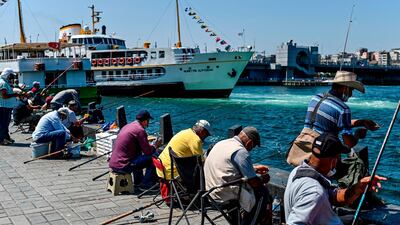
People fish next to the Bosphorus strait, at Eminonu district in Istanbul. AFP -
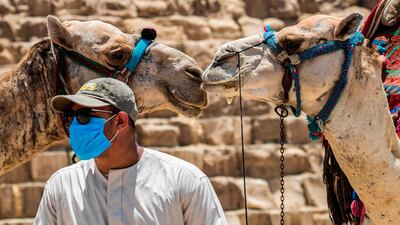
A guide stands before camels at the Giza Pyramids necropolis, Egypt. AFP -

A cleaning worker at the Egyptian Museum in central Cairo. AP Photo -

French citizens of Algerian origin wait at the departure hall of Houari Boumediene International airport in Algiers. AP Photo -

Plush toy pandas are placed at tables with a card reading "Leave this place empty for your health" in a restaurant in the Sogutozu district in Ankara. AFP -

An Iraqi barber, wears a protective suit as he sterilises his work equipment before giving his client a haircut in Najaf, Iraq. Reuters -
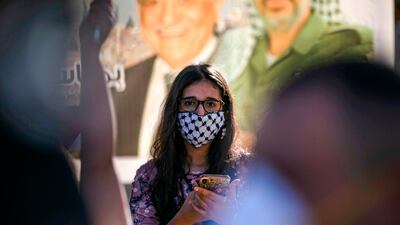
A protester attends a demonstration against Israel's plan to annex parts of the occupied West Bank in Ramallah. AFP -

Groom Okan Barut and bride Oya Kulaksiz wear face masks as they take part in their wedding ceremony at the Kadikoy Municipality marriage office in Istanbul, Turkey. Getty Images -

A man sits in the vicinity of the Erbil Citadel in the capital of the northern Iraqi Kurdish autonomous region. AFP -
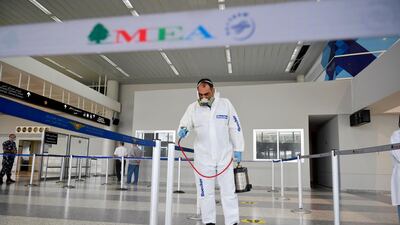
A worker wearing a protective suit sprays disinfectant as a precaution against the spread of the coronavirus at Rafik Hariri international airport during its re-opening in Beirut, Lebanon. EPA -

A Kuwaiti member of staff uses a walkie-talkie at the re-opened 360 Mall in the capital Kuwait City. AFP -

Kuwaitis wearing protective masks shop at the re-opened 360 Mall. AFP -

A man walks in front of a closed Al Hamra Cinema in Manama, Bahrain. Reuters


In May, Egypt received raw material for the production of two million Sinovac doses after signing an agreement to produce the vaccine locally and distribute it at home and in other African countries.
The first vials were due to be produced on June 15 and up to six weeks will be needed for checks before they are put to use in vaccination centres, Health Minister Hala Zayed said at the time.
Cairo also expects to sign an agreement with an international company to produce a European vaccine in Egypt, Ms Zayed said.
The Cabinet said previously that Egypt wants to produce the AstraZeneca vaccine locally.
Egypt, which has received several million AstraZeneca and Sinopharm vaccine doses, has said it aims to inoculate 40 per cent of its population of more than 100 million people by the end of this year.
It registered a 14.9 per cent increase in deaths in the first half of 2021 compared with the same period last year, the country's statistics agency Capmas said on Monday, without specifying any underlying causes of death.
The Health Ministry has so far reported 282,257 cases of coronavirus, including 16,284 deaths, since the Covid-19 pandemic began.
However, officials and experts claim the real number of infections is much higher and say this is not reflected in government figures because of low coronavirus testing rates and the exclusion of private test results.
Capmas said 49,818 more people died in the first six months of 2021, signifying a “large increase in the rate".

