Israel paid Russia $1.2 million to provide the Syrian government with Covid-19 vaccines as part of a deal that secured the release of an Israeli woman held captive in Damascus, according to Israeli media reports on Sunday.
The terms of the clandestine trade-off orchestrated by Moscow between the two nations remained murky. But the fact Israel is providing vaccines to Syria – an enemy country hosting hostile Iranian forces – drew criticism at home, and stands in contrast to Israel’s refusal to provide significant quantities of vaccines to Palestinians in the West Bank and Gaza Strip.
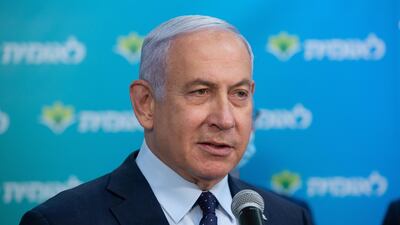
Israeli Prime Minister Benjamin Netanyahu said Saturday “not one Israeli vaccine” was involved in the deal. He didn’t address whether Israel paid for Russian vaccines, and said Russia insisted details of the swap remain secret.
Mr Netanyahu’s office declined to comment, and many details of the agreement remained censored.
Labor Party leader Merav Michaeli called on the Knesset’s foreign affairs and defence committee to discuss the deal and Mr Netanyahu’s “political, inappropriate use of censorship.”
“Why do Israeli citizens consistently need to learn about things from foreign media that their prime minister is hiding from them?” she said on Israel’s Kan radio Sunday.
Vaccine diplomacy
Israel announced on Friday it had reached a Russian-mediated deal to bring home a young woman who had crossed into neighbouring Syria earlier this month. In exchange, Israel said it released two Syrian shepherds who had entered Israeli territory.
Mr Netanyahu boasted that his warm ties with Russian President Vladimir Putin helped clinch the deal. His office made no mention of any agreement to pay for vaccines for Syria.
The Israeli reports said Israel paid for an undisclosed number of doses of the Sputnik V vaccine. The Russian Direct Investment Fund, which financed development of Sputnik V, said in November it will cost less than $10 per dose internationally.
-
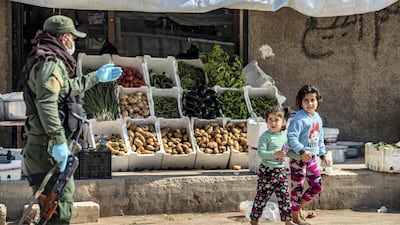
A member of the Kurdish Internal Security Forces of Asayesh urges children to return home, in Syria's northeastern city of Hasakeh on April 30, 2020, following measures taken by the Kurdish-led local authorities there, to limit the spread of the novel coronavirus. AFP -
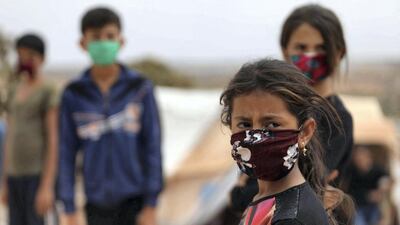
Children wear face masks sewed by displaced Syrian women at a camp for the internally displaced people near the town of Maaret Misrin in Syria's northwestern Idlib province on July 27, 2020 amid the COVID-19 pandemic crisis. AFP -

Members of Syrian Civil Defence, also known as the White Helmets, transport the body of a man who died from the Covid-19 coronavirus for burial in Syria's rebel-held northwestern city of Idlib on November 19, 2020. AFP -
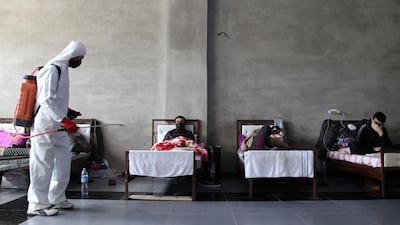
A man sanitises the room as Syrians who returned from Turkey rest at a quarantine facility in the countryside of the town of Jisr al-Shughur, west of the mostly rebel-held Syrian province of Idlib, on April 27, 2020 during the coronavirus COVID-19 pandemic. AFP -
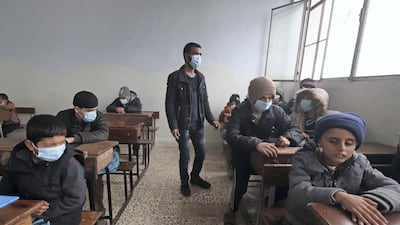
A blind Syrian teacher leads visually impaired pupils during a lesson, respecting social distancing amid the spread of the coronavirus disease, at a school for the blind in the rebel-held northwestern city of Idlib on December 20, 2020. AFP -
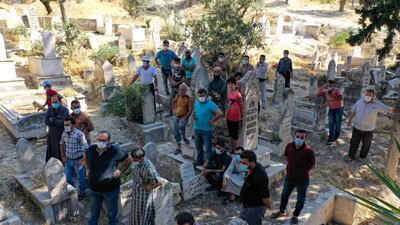
People wearing face masks, attned the funeral of a 62-year-old displaced Syrian man who died of the covid-19 disease, in the town of Salqin, in the northwestern Syrian Idlib province on September 17, 2020. AFP -
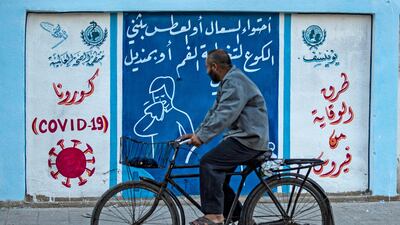
A Syrian man rides a bicycle past a mural painted as part of an awareness campaign by UNICEF and WHO initiative, bearing instructions on protection from COVID-19 in the Kurdish-majority city of Qamishli of Syria's northeastern Hasakeh province on August 16, 2020, after a spike in infections in the area. AFP


The Syrian state news agency denied the deal exists.
The released 25-year-old Israeli woman returned to Israel via Moscow and was questioned by Israel’s internal security agency. She is from the predominantly ultra-Orthodox West Bank settlement of Modiin Illit and previously attempted to cross Israel’s borders with the Gaza Strip and Jordan, according to Israeli media.
The woman reportedly crossed into Syrian territory from the Golan Heights, which Israel captured in the 1967 Mideast war and annexed in 1981, a move not widely recognised internationally. Her identity and motivation for crossing into Syria were not released by Israeli officials.
Gideon Saar, a former Netanyahu ally who is running to unseat him in the coming Israeli elections, said Sunday the government’s “censorship of something that Damascus and Moscow know about, and Israeli citizens don’t, is incomprehensible.”
Israel and Syria remain in an official state of war and Israeli citizens are officially prohibited from visiting Syria.
Israel’s archenemy Iran has sent troops to support Syrian President Bashar Assad against rebel groups. Israel considers Iranian entrenchment on its northern frontier to be a red line and has carried out hundreds of air strikes on Iranian-linked facilities and suspected weapons convoys destined for the Iranian-backed Hezbollah militant group.
Israel has provided some humanitarian aid to groups unaffiliated with Assad and provided medical treatment to thousands of Syrians who reached the Golan Heights frontier.
Palestinian vaccines
Mr Netanyahu’s reported agreement to pay for vaccines to an enemy country contrasts with his refusal to provide large quantities of vaccines to Palestinians in the West Bank and Gaza, which has drawn outcry from human rights organisations.
The disparities between Israel’s successful vaccination push with its own population and the Palestinians have drawn criticism from UN officials and rights groups and have shined a light on the inequities between rich and poor countries getting access to vaccines.
These groups contend that Israel is responsible for vaccinating the Palestinians. Israel has argued that it is not responsible for vaccinating them and that under interim peace agreements reached in the 1990s, the internationally supported Palestinian Authority must see to vaccinating its own population. Israel’s vaccination campaign has included its own Arab population.
The Palestinian Authority has not publicly asked for Israeli assistance, saying it is procuring vaccines on its own and through a World Health Organisation for poorer nations. But earlier this month, Israel agreed to share 2,000 vaccines with the Palestinians to inoculate medical workers in the West Bank.
Ahmad Tibi, a lawmaker with the Joint List of Arab parties in Israel’s Knesset, wrote on Twitter on Friday: “Must we wait for a Jewish person to cross the border with Gaza for them to deserve vaccines?”

