It has become an obsession in 'undoubtedly xenophobic, divided times' for Mohamad Hafez to use his mix of street art, sculpture and activism as a response to thorny issues such as the atrocities of the conflict in Syria or the dehumanisation of refugees. Photo: Fabrica
It has become an obsession in 'undoubtedly xenophobic, divided times' for Mohamad Hafez to use his mix of street art, sculpture and activism as a response to thorny issues such as the atrocities of th

Man of parts: architect Mohamad Hafez captures Syria in miniature


Jacqueline Fuller
  • English
  • Arabic

The sound of a muezzin exhorting Muslim worshippers to hurry to salvation is not one that could often have been heard within the former Regency church of Holy Trinity in the seaside resort of Brighton.

Right on cue, though, the distinctive chant echoes out, filling every nook and cranny of the 200-year-old building, from the galleries to the arched stained-glass windows and timber-clad chancel at either end.

It comes as Mohamad Hafez is recounting the day he fell under the spell of his birthplace, Damascus, having returned to it as a teenager after a 14-year absence.

“Walking down the old city streets looking at mosques right next to churches, and synagogues next to secular galleries and nude sculptures … I went there from a very conservative culture in Saudi Arabia,” Hafez, 37, tells The National.

“Seeing the bustling city life, with merchants and calls to prayer,” he says, pausing to smile at the perfectly timed adhan issuing out of a loudspeaker hidden in one of his artworks, “and bells ringing together with children playing and the car horns, it was very hard not to fall in love with this collective celebration of diversity.”

The recording of the busy streetscape issuing forth from 'Framed Nostalgia #3', above, is audible even over the hustle and hammering of the team assembling Hafez’s exhibition in the historic Brighton residence of the visual arts organisation Fabrica. Photo: Tom Thistlethwaite / Fabrica

The recording of the busy streetscape is clearly audible even over the hustle and hammering of the team assembling Hafez’s 'Journeys from an Absent Present to a Lost Past' exhibition in the historic residence of the visual arts organisation Fabrica.

Art handlers wearing blue surgical gloves have already carefully opened the dozen or so timber shipping crates to decant the series of miniature dioramas of his native Syria now hanging on the walls.

Each box was stencilled with FRAGILE in black lettering but the romantic snippets of memories and sounds of a bygone era contained within Framed Nostalgia #3 might arguably have warranted a more strongly worded warning.

It occupies an extra special place in the heart of Hafez — and that of his new wife, Luisa. “That’s the only piece I don’t own,” he says. “It’s owned by her, and I told the guys that if they damage it, they ruin my marriage. Anything else is fair game.”

His immersive process involves the study of photographs of Damascus from before and during the civil war, dimming the lights, brewing Arabic coffee, burning bakhour and incense, and putting on acoustic Middle Eastern music.

What emerges from the induced sentimental state as if, as Hafez puts it, he were a 3D printer are scenes of urban fabric that draw on his training as a corporate architect but come with a political charge.

“I really don’t remember much of the detail, how it comes together,” he says. “It’s a weird feeling. What I enjoy most is that I am discovering this detail as though I am a spectator seeing it for the first time, and that’s very, very fulfilling.”

Frustrated at prevailing narratives, Hafez took a sabbatical from architecture three years ago to focus fully on using his mix of street art, sculpture and activism to respond to thorny issues such as the atrocities in the ongoing conflict or dehumanisation of refugees.

“It is my foot in the door,” he says. “The more the sabbatical continues, the more I’m realising the urgency of the message and sense of agency because there are thousands of architects who can build skyscrapers, thousands.

By night, Hafez was modelling the destruction of Syria in works such as 'Collateral Damage', above, as a sanity-saving outlet to be able to get up and build glistening skyscrapers in his day job. Photo: Cole Wilson

“But how many of them are Syrian, Arab, Middle Eastern, practising Muslims, raised in Saudi Arabia, educated in the Midwest of the United States, and can talk the talk that will build bridges between people?”

Hafez says the crisis in his homeland has caused a spiritual awakening within him. Which may explain what he was doing on a three-week retreat in Malaysia when he heard news of a concert being held nearby in the capital by the ensemble Al Firdaus that he often listens to in his art studio while working.

Particularly captivated by the cellist Luisa Gutierrez, it wasn't long before Hafez engineered a visit by Al Firdaus to Yale University, in New Haven, Connecticut, where he is a Silliman College Fellow.

He hosted the ensemble for dinner and invited them to his studio crammed full of paraphernalia, shelves and bins overflowing with scaled-down furniture and toys, dried plants and jewellery, Christmas ornaments and shells, electrical appliance innards and paints.

There, Hafez engaged all the musicians in conversation except for Luisa, who, overwhelmed by the atmosphere, was sitting on a chair staring at the artist’s latest labour of love — Framed Nostalgia #3 — and listening to the evocative audio with tears in her eyes.

“I think what happened is that she clicked into the street scene,” he says. “It’s common for people to come out crying from my exhibitions. Well, fast forward and that became her dowry for our wedding last year.”

Though Hafez was born in Syria, his own tale deviated early on when the family moved to a military compound in Al-Kharj in central Saudi Arabia, where he spent many happy hours supervising the construction of buildings out of whatever he and his playmates could lay their hands on.

The young Mohamad grew up on a military compound in Al Kharj in central Saudi Arabia, where he spent many happy hours supervising the construction of buildings out of whatever he and his playmates could lay their hands on. Photo: Mohamad Hafez

Other than the lengthy commute to the elite Najd National School by bus 100 kilometres away in Riyadh, Mohamad never ventured outside the base where his father was head surgeon in the attached hospital.

“There was no need. It was a protected bubble in all respects, and really gave me a true childhood like building forts using found objects. I would boss my friends around, saying ‘No, no, this way, let’s put a window here, you see?’ Twenty years later, I’m going ‘You idiot, you’ve been doing architecture since you were 6 years old.'”

Hafez returned to his birthplace intermittently for holidays that were mostly whiled away in swimming pools, and only properly at the age of 15 when his father took early retirement.

Presided over by his sociable mother, the household became a “cultural salon” that inspired his latest architectural endeavour, Pistachio Cafe, below his studio on the northern shore of Long Island Sound.

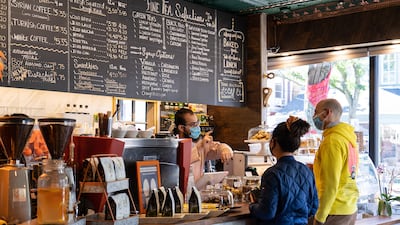
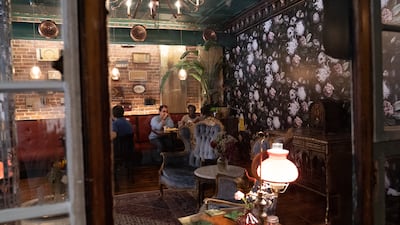
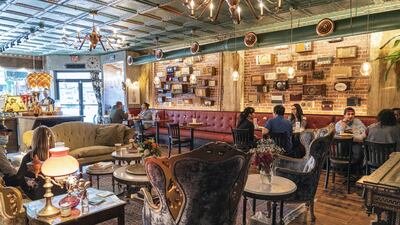
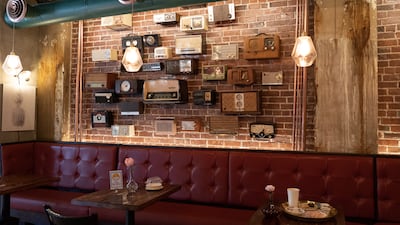
It offers the experience of being hosted in what his domicile might have been like, transporting customers with mosaic tables and vintage radios, and bounty made by refugee chefs and cooks such as “the lady who makes shawarma for me from her kitchen at home”.

  • Pistachio Cafe in New Haven, Connecticut, which was inspired by the 'cultural salon' that Hafez's mother presided over in their home on the outskirts of Damascus. Sophie Tremblay / The National
    Pistachio Cafe in New Haven, Connecticut, which was inspired by the 'cultural salon' that Hafez's mother presided over in their home on the outskirts of Damascus. Sophie Tremblay / The National
  • Pistachio cafe offers the experience of being hosted in what his domicile might have been like, transporting customers with mosaic tables and vintage radios, and bounty made by refugee chefs and cooks. Sophie Tremblay / The National
    Pistachio cafe offers the experience of being hosted in what his domicile might have been like, transporting customers with mosaic tables and vintage radios, and bounty made by refugee chefs and cooks. Sophie Tremblay / The National
  • Customers enjoy coffee and Middle Eastern-inspired food at Pistachio. Sophie Tremblay / The National
    Customers enjoy coffee and Middle Eastern-inspired food at Pistachio. Sophie Tremblay / The National
  • Mohamad Hafez speaks with a customer at Pistachio. Sophie Tremblay / The National
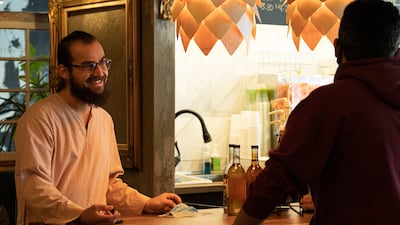
    Mohamad Hafez speaks with a customer at Pistachio. Sophie Tremblay / The National
  • Hafez, who is also an architect, designed Pistachio to be full of unique details you cannot find in a corporate coffee shop. Sophie Tremblay / The National
    Hafez, who is also an architect, designed Pistachio to be full of unique details you cannot find in a corporate coffee shop. Sophie Tremblay / The National
  • The wall of antique radios are a popular topic of conversation among Pistachio’s customers. Sophie Tremblay / The National
    The wall of antique radios are a popular topic of conversation among Pistachio’s customers. Sophie Tremblay / The National
  • The signature rose latte at Pistachio. Sophie Tremblay / The National
    The signature rose latte at Pistachio. Sophie Tremblay / The National
  • A hand-carved Syrian table and antique radio in Pistachio’s majlis-style dining room. Sophie Tremblay / The National
    A hand-carved Syrian table and antique radio in Pistachio’s majlis-style dining room. Sophie Tremblay / The National

He is as entranced now with the world’s oldest continuously inhabited city as he was back then when his teenage self would wander its souqs and alleyways with sketch book in hand at any available opportunity.

But for a pupil hitherto accustomed to rubbing shoulders with the upper echelons of Saudi Arabian society, the move to a public school with military uniform and regular training exercises was shocking.

Consequently, Hafez has a deep connection to the words he has spray painted across a vast swathe of black plastic sheeting stretched around several pillars in his exhibition for the Brighton Festival.

This section of "Journeys" replicates the sense of exile felt by those in the refugee and migrant encampment known as the Calais Jungle. Above an evocative stanza borrowed from the Nairobi-born, Somali-British poet Warsan Shire — “No one leaves home unless home is the mouth of a shark” — he has put: I AM JUST A NUMBER.

A childhood sketch by Mohamad Hafez, who was so entranced by the world’s oldest continuously inhabited city as a teenager that he would wander its souqs and alleyways with pencil and paper in hand at any available opportunity. Photo: Mohamad Hafez

“I think the whole experience at that school was so traumatic,” he recalls. “I had lost myself. No one cared about ‘What do you want to be?’ I think it’s a big part of me, who I am and why I like working with a lot of universities and high school kids, just to push that fire inside them and make them believe in their intuition.”

The result was that he undertook a course in electrical engineering at Damascus University before following his older siblings to study in the United States when it finally dawned that “every inch of my body was meant to be an architect”.

Hafez would go on to celebrate his first skyscraper at the precocious age of 30, becoming project head designer on an ambitious 48-storey glass and steel office tower in downtown Houston, Texas.

But throughout his studies, a single-entry visa precluded him from visiting Syria because of a travel ban imposed on the citizens of 27 countries after the 9/11 attacks, and later came the Arab uprisings.

Surrounded by the cornfields of Iowa, a homesick Hafez lapsed into depression and was wrought by anxiety. His way of dealing with it, as he explains in A Broken House, the Jimmy Goldblum documentary about his life shortlisted for this year’s Oscars, was deciding that if he couldn’t go home then why not make home?

Hafez celebrated his first skyscraper at the precocious age of 30, becoming project head designer of 609 Main, above, an ambitious 48-storey glass and steel office tower in downtown Houston, Texas. Photo: Hines

By night, for a long time, he modelled the destruction of Syria as a sanity-saving outlet to be able to get up and build glistening edifices in his day job with colleagues complaining about the coffee being cold. “‘This is your dilemma right now?’,” Hafez remembers thinking.

It is little wonder that he quotes with conviction the observation of Cesar Cruz, Dean of the Secondary Schools Programme at Harvard, that art should comfort the disturbed and disturb the comfortable.

“With skyscrapers, we design every last detail until the cows come home years before the building sees the light of day. With these,” he gestures around the gallery, “I can break free in my artistic expression. I don’t plan. I work on six or seven pieces at a time so as not to commit too much memory to any one piece, jumping from one to another.”

His store of memories of home is precious and finite. There is no portrait of the four siblings and parents together since 1999, the last time they were all under the same roof. He has been back to Damascus only once, just before the war began in earnest in 2011, when his architectural firm sent Hafez to pitch a project in neighbouring Lebanon.

There has been no other chance to experience the everyday occurrences or family occasions — the funeral of his beloved grandmother, the marriage of a sister, the births that made him an uncle — he has had to miss or risk enforced military service.

Mohamad Hafez's studio in New Haven is his refuge, its shelves and bins overflowing with scaled-down furniture and toys, dried plants and jewellery, Christmas ornaments and shells, electrical appliance innards and paints. Photo: Fabrica

Yet, sustained by an inner peace, Hafez conveys hope in person and through the use of verses from the Quran in his art that are intended to counsel patience and raise spirits in dark times.

When asked to translate a particular bit of Arabic script he has incorporated into a scene, he looks gleeful. “Happiness Bakery this way 200 metres,” he explains, laughing. “People have no qualms whatsoever spray painting on a 2,000-year-old wall, putting the advertisement for their shop on a Roman column!”

The humour abounds with graffiti elsewhere saying “I love you”, “Where’s Dad?” and then there’s one in English. Again, it sets Hafez off. “It’s supposed to be ‘No parking’ but with the Arabic accent I’m making fun of our people with ‘No barking please’.”

Accents offer an endless source of amusement to him. One of the consequences of his childhood in the military compound in Saudi Arabia was picking up a multitude of Arabic dialects that Hafez employs on his travels.

“I engage people with their own native dialect, and they go, ‘Whoa, whoa, who are you?’ I love messing with Arabs because nobody can tell that I am Arab. I'm this weird object … I have this curly artist’s moustache, I have a beard, and a little [pony]tail. Then I wear a fancy shirt or a Malaysian garment, and they're like, ‘Is he Italian? Pakistani? Bosnian? No, he's Iranian.’”

As a master of misdirection, he concedes that he likes to sneak up on people in the same way that crises do. Audiences are lured in by the beauty of his work, such as Tower of Dreams that features intricate mosaics and floats above a tapestried rug, until the “hot moment when they realise that it looks like an RPG shooting people’s lives and memories into an abyss”.

Perhaps it is the habit of a lifelong outsider but he is also, be warned, a consummate eavesdropper, honing the skill during that side trip to Damascus from Lebanon 12 years ago.

Like a sponge, Hafez took to the streets once again, using his phone to record taxi journeys, calls to prayer, the chattering of locals in cafes that would eventually end up as the multimedia embedded in his works.

“My favourite, favourite, favourite part in everything I do is when I'm a fly on the wall,” he says. “If nobody recognises me around my exhibits, I can just eavesdrop to see how people are reacting. Or you'll find me in Pistachio Cafe mopping floors, sweeping, putting myself at the service of people, and I observe them enjoying my product, my architectural creation.”

He ends the interview with a short guided tour of his dioramas, pointing out a pleasing crackle or patina here or some rust that has developed there, then stopping at a surveillance camera poking out of one of the facades.

“That’s Big Daddy watching always,” Hafez notes, without the slightest hint of recognition that it would be fair to say much the same of him.

'Journeys from an Absent Present to a Lost Past' by Mohamad Hafez is at Fabrica, Brighton, until May 29


Players Selected for La Liga Trials

U18 Age Group
Name: Ahmed Salam (Malaga)
Position: Right Wing
Nationality: Jordanian

Name: Yahia Iraqi (Malaga)
Position: Left Wing
Nationality: Morocco

Name: Mohammed Bouherrafa (Almeria)
Position: Centre-Midfield
Nationality: French

Name: Mohammed Rajeh (Cadiz)
Position: Striker
Nationality: Jordanian

U16 Age Group
Name: Mehdi Elkhamlichi (Malaga)
Position: Lead Striker
Nationality: Morocco

Tamkeen's offering
  • Option 1: 70% in year 1, 50% in year 2, 30% in year 3
  • Option 2: 50% across three years
  • Option 3: 30% across five years 
ALRAWABI%20SCHOOL%20FOR%20GIRLS
%3Cp%3ECreator%3A%20Tima%20Shomali%3C%2Fp%3E%0A%3Cp%3EStarring%3A%C2%A0Tara%20Abboud%2C%C2%A0Kira%20Yaghnam%2C%20Tara%20Atalla%3C%2Fp%3E%0A%3Cp%3ERating%3A%204%2F5%3C%2Fp%3E%0A

Results:

First Test: New Zealand 30 British & Irish Lions 15

Second Test: New Zealand 21 British & Irish Lions 24

Third Test: New Zealand 15 British & Irish Lions 15

THE TWIN BIO

Their favourite city: Dubai

Their favourite food: Khaleeji

Their favourite past-time : walking on the beach

Their favorite quote: ‘we rise by lifting others’ by Robert Ingersoll

Business Insights
  • Canada and Mexico are significant energy suppliers to the US, providing the majority of oil and natural gas imports
  • The introduction of tariffs could hinder the US's clean energy initiatives by raising input costs for materials like nickel
  • US domestic suppliers might benefit from higher prices, but overall oil consumption is expected to decrease due to elevated costs

The Disaster Artist

Director: James Franco

Starring: James Franco, Dave Franco, Seth Rogan

Four stars

UAE%20Warriors%20fight%20card
%3Cp%3EMain%20Event%0D%3A%20Catchweight%20165lb%0D%3Cbr%3EMartun%20Mezhulmyan%20(ARM)%20v%20Acoidan%20Duque%20(ESP)%0D%3Cbr%3ECo-Main%20Event%0D%3A%20Bantamweight%0D%3Cbr%3EFelipe%20Pereira%20(BRA)%20v%20Azamat%20Kerefov%20(RUS)%0D%3Cbr%3EMiddleweight%0D%3Cbr%3EMohamad%20Osseili%20(LEB)%20v%20Amir%20Fazli%20(IRN)%0D%3Cbr%3ECatchweight%20161%20lb%0D%3Cbr%3EZhu%20Rong%20(CHI)%20vs.%20Felipe%20Maia%20(BRA)%0D%3Cbr%3ECatchweight%20176%20lb%0D%3Cbr%3EHandesson%20Ferreira%20(BRA)%20vs.%20Ion%20Surdu%20(MDA)%0D%3Cbr%3ECatchweight%20168%20lb%0D%3Cbr%3EArtur%20Zaynukov%20(RUS)%20v%20Sargis%20Vardanyan%20(ARM)%0D%3Cbr%3EFeatherweight%0D%3Cbr%3EIlkhom%20Nazimov%20(UZB)%20v%20Khazar%20Rustamov%20(AZE)%0D%3Cbr%3EBantamweight%0D%3Cbr%3EJalal%20Al%20Daaja%20(JOR)%20v%20Mark%20Alcoba%20(PHI)%0D%3Cbr%3ELightweight%0D%3Cbr%3EJakhongir%20Jumaev%20(UZB)%20v%20Dylan%20Salvador%20(FRA)%0D%3Cbr%3ECatchweight%20143%20lb%0D%3Cbr%3EHikaru%20Yoshino%20(JPN)%20v%20Djamal%20Rustem%20(TUR)%0D%3Cbr%3EFeatherweight%0D%3Cbr%3EJavohir%20Imamov%20(UZB)%20v%20Ulan%20Tamgabaev%20(KAZ)%0D%3Cbr%3ECatchweight%20120%20lb%0D%3Cbr%3ELarissa%20Carvalho%20(BRA)%20v%20Elin%20Oberg%20(SWE)%0D%3Cbr%3ELightweight%0D%3Cbr%3EHussein%20Salem%20(IRQ)%20v%20Arlan%20Faurillo%20(PHI)%3C%2Fp%3E%0A
Who's who in Yemen conflict

Houthis: Iran-backed rebels who occupy Sanaa and run unrecognised government

Yemeni government: Exiled government in Aden led by eight-member Presidential Leadership Council

Southern Transitional Council: Faction in Yemeni government that seeks autonomy for the south

Habrish 'rebels': Tribal-backed forces feuding with STC over control of oil in government territory

While you're here
Company%20profile
%3Cp%3EName%3A%20Tabby%3Cbr%3EFounded%3A%20August%202019%3B%20platform%20went%20live%20in%20February%202020%3Cbr%3EFounder%2FCEO%3A%20Hosam%20Arab%2C%20co-founder%3A%20Daniil%20Barkalov%3Cbr%3EBased%3A%20Dubai%2C%20UAE%3Cbr%3ESector%3A%20Payments%3Cbr%3ESize%3A%2040-50%20employees%3Cbr%3EStage%3A%20Series%20A%3Cbr%3EInvestors%3A%20Arbor%20Ventures%2C%20Mubadala%20Capital%2C%20Wamda%20Capital%2C%20STV%2C%20Raed%20Ventures%2C%20Global%20Founders%20Capital%2C%20JIMCO%2C%20Global%20Ventures%2C%20Venture%20Souq%2C%20Outliers%20VC%2C%20MSA%20Capital%2C%20HOF%20and%20AB%20Accelerator.%3Cbr%3E%3C%2Fp%3E%0A
Key findings of Jenkins report
  • Founder of the Muslim Brotherhood, Hassan al Banna, "accepted the political utility of violence"
  • Views of key Muslim Brotherhood ideologue, Sayyid Qutb, have “consistently been understood” as permitting “the use of extreme violence in the pursuit of the perfect Islamic society” and “never been institutionally disowned” by the movement.
  • Muslim Brotherhood at all levels has repeatedly defended Hamas attacks against Israel, including the use of suicide bombers and the killing of civilians.
  • Laying out the report in the House of Commons, David Cameron told MPs: "The main findings of the review support the conclusion that membership of, association with, or influence by the Muslim Brotherhood should be considered as a possible indicator of extremism."

Mercer, the investment consulting arm of US services company Marsh & McLennan, expects its wealth division to at least double its assets under management (AUM) in the Middle East as wealth in the region continues to grow despite economic headwinds, a company official said.

Mercer Wealth, which globally has $160 billion in AUM, plans to boost its AUM in the region to $2-$3bn in the next 2-3 years from the present $1bn, said Yasir AbuShaban, a Dubai-based principal with Mercer Wealth.

Within the next two to three years, we are looking at reaching $2 to $3 billion as a conservative estimate and we do see an opportunity to do so,” said Mr AbuShaban.

Mercer does not directly make investments, but allocates clients’ money they have discretion to, to professional asset managers. They also provide advice to clients.

“We have buying power. We can negotiate on their (client’s) behalf with asset managers to provide them lower fees than they otherwise would have to get on their own,” he added.

Mercer Wealth’s clients include sovereign wealth funds, family offices, and insurance companies among others.

From its office in Dubai, Mercer also looks after Africa, India and Turkey, where they also see opportunity for growth.

Wealth creation in Middle East and Africa (MEA) grew 8.5 per cent to $8.1 trillion last year from $7.5tn in 2015, higher than last year’s global average of 6 per cent and the second-highest growth in a region after Asia-Pacific which grew 9.9 per cent, according to consultancy Boston Consulting Group (BCG). In the region, where wealth grew just 1.9 per cent in 2015 compared with 2014, a pickup in oil prices has helped in wealth generation.

BCG is forecasting MEA wealth will rise to $12tn by 2021, growing at an annual average of 8 per cent.

Drivers of wealth generation in the region will be split evenly between new wealth creation and growth of performance of existing assets, according to BCG.

Another general trend in the region is clients’ looking for a comprehensive approach to investing, according to Mr AbuShaban.

“Institutional investors or some of the families are seeing a slowdown in the available capital they have to invest and in that sense they are looking at optimizing the way they manage their portfolios and making sure they are not investing haphazardly and different parts of their investment are working together,” said Mr AbuShaban.

Some clients also have a higher appetite for risk, given the low interest-rate environment that does not provide enough yield for some institutional investors. These clients are keen to invest in illiquid assets, such as private equity and infrastructure.

“What we have seen is a desire for higher returns in what has been a low-return environment specifically in various fixed income or bonds,” he said.

“In this environment, we have seen a de facto increase in the risk that clients are taking in things like illiquid investments, private equity investments, infrastructure and private debt, those kind of investments were higher illiquidity results in incrementally higher returns.”

The Abu Dhabi Investment Authority, one of the largest sovereign wealth funds, said in its 2016 report that has gradually increased its exposure in direct private equity and private credit transactions, mainly in Asian markets and especially in China and India. The authority’s private equity department focused on structured equities owing to “their defensive characteristics.”

Desert Warrior

Starring: Anthony Mackie, Aiysha Hart, Ben Kingsley

Director: Rupert Wyatt

Rating: 3/5

What can victims do?

Always use only regulated platforms

Stop all transactions and communication on suspicion

Save all evidence (screenshots, chat logs, transaction IDs)

Report to local authorities

Warn others to prevent further harm

Courtesy: Crystal Intelligence

How%20to%20avoid%20getting%20scammed
%3Cul%3E%0A%3Cli%3ENever%20click%20on%20links%20provided%20via%20app%20or%20SMS%2C%20even%20if%20they%20seem%20to%20come%20from%20authorised%20senders%20at%20first%20glance%3C%2Fli%3E%0A%3Cli%3EAlways%20double-check%20the%20authenticity%20of%20websites%3C%2Fli%3E%0A%3Cli%3EEnable%20Two-Factor%20Authentication%20(2FA)%20for%20all%20your%20working%20and%20personal%20services%3C%2Fli%3E%0A%3Cli%3EOnly%20use%20official%20links%20published%20by%20the%20respective%20entity%3C%2Fli%3E%0A%3Cli%3EDouble-check%20the%20web%20addresses%20to%20reduce%20exposure%20to%20fake%20sites%20created%20with%20domain%20names%20containing%20spelling%20errors%3C%2Fli%3E%0A%3C%2Ful%3E%0A
THE CLOWN OF GAZA

Director: Abdulrahman Sabbah 

Starring: Alaa Meqdad

Rating: 4/5

TOP%2010%20MOST%20POLLUTED%20CITIES
%3Cp%3E1.%20Bhiwadi%2C%20India%0D%3Cbr%3E2.%20Ghaziabad%2C%20India%0D%3Cbr%3E3.%20Hotan%2C%20China%0D%3Cbr%3E4.%20Delhi%2C%20India%0D%3Cbr%3E5.%20Jaunpur%2C%20India%0D%3Cbr%3E6.%20Faisalabad%2C%20Pakistan%0D%3Cbr%3E7.%20Noida%2C%20India%0D%3Cbr%3E8.%20Bahawalpur%2C%20Pakistan%0D%3Cbr%3E9.%20Peshawar%2C%20Pakistan%0D%3Cbr%3E10.%20Bagpat%2C%20India%3C%2Fp%3E%0A%3Cp%3E%3Cem%3ESource%3A%20IQAir%3C%2Fem%3E%3C%2Fp%3E%0A
PRO BASH

Thursday’s fixtures

6pm: Hyderabad Nawabs v Pakhtoon Warriors

10pm: Lahore Sikandars v Pakhtoon Blasters

Teams

Chennai Knights, Lahore Sikandars, Pakhtoon Blasters, Abu Dhabi Stars, Abu Dhabi Dragons, Pakhtoon Warriors and Hyderabad Nawabs.

Squad rules

All teams consist of 15-player squads that include those contracted in the diamond (3), platinum (2) and gold (2) categories, plus eight free to sign team members.

Tournament rules

The matches are of 25 over-a-side with an 8-over power play in which only two fielders allowed outside the 30-yard circle. Teams play in a single round robin league followed by the semi-finals and final. The league toppers will feature in the semi-final eliminator.

Titanium Escrow profile

Started: December 2016
Founder: Ibrahim Kamalmaz
Based: UAE
Sector: Finance / legal
Size: 3 employees, pre-revenue  
Stage: Early stage
Investors: Founder's friends and Family

THE CARD

2pm: Maiden Dh 60,000 (Dirt) 1,400m

2.30pm: Handicap Dh 76,000 (D) 1,400m

3pm: Handicap Dh 64,000 (D) 1,200m

3.30pm: Shadwell Farm Conditions Dh 100,000 (D) 1,000m

4pm: Maiden Dh 60,000 (D) 1,000m

4.30pm: Handicap 64,000 (D) 1,950m

UAE currency: the story behind the money in your pockets
The specs
  • Engine: 3.9-litre twin-turbo V8
  • Power: 640hp
  • Torque: 760nm
  • On sale: 2026
  • Price: Not announced yet
Gran Gala del Calcio 2019 winners

Best Player: Cristiano Ronaldo (Juventus)
Best Coach: Gian Piero Gasperini (Atalanta)
Best Referee: Gianluca Rocchi
Best Goal: Fabio Quagliarella (Sampdoria vs Napoli)
Best Team: Atalanta​​​​​​​
Best XI: Samir Handanovic (Inter); Aleksandar Kolarov (Roma), Giorgio Chiellini (Juventus), Kalidou Koulibaly (Napoli), Joao Cancelo (Juventus*); Miralem Pjanic (Juventus), Josip Ilicic (Atalanta), Nicolo Barella (Cagliari*); Fabio Quagliarella (Sampdoria), Cristiano Ronaldo (Juventus), Duvan Zapata (Atalanta)
Serie B Best Young Player: Sandro Tonali (Brescia)
Best Women’s Goal: Thaisa (Milan vs Juventus)
Best Women’s Player: Manuela Giugliano (Milan)
Best Women’s XI: Laura Giuliani (Milan); Alia Guagni (Fiorentina), Sara Gama (Juventus), Cecilia Salvai (Juventus), Elisa Bartoli (Roma); Aurora Galli (Juventus), Manuela Giugliano (Roma), Valentina Cernoia (Juventus); Valentina Giacinti (Milan), Ilaria Mauro (Fiorentina), Barbara Bonansea (Juventus)

Freezer tips

  • Always make sure food is completely cool before freezing.
  • If you’re cooking in large batches, divide into either family-sized or individual portions to freeze.
  • Ensure the food is well wrapped in foil or cling film. Even better, store in fully sealable, labelled containers or zip-lock freezer bags.
  • The easiest and safest way to defrost items such as the stews and sauces mentioned is to do so in the fridge for several hours or overnight.
Updated: August 11, 2022, 8:13 AM