


Algerian legislative elections on Saturday are unlikely to attract a large turn-out but analysts said they could still result in a lower house that is traditionally closely aligned to the presidency falling into new hands.
The elections were initially scheduled for 2022 but with mass protests, known as the hirak, returning to the streets in February, as well as the dual threats of a stuttering economy and the coronavirus, President Abdelmadjid Tebboune brought the poll forward to June and suspended parliament.
Nevertheless, with many prominent figures among the hirak calling for a boycott of the vote, as well as the traditionally low turn-out for Algeria's legislative vote, hopes that Saturday will secure the new parliament an overwhelming mandate are guarded.
In a break from the past, Saturday's vote looks designed to draw in candidates from outside the country's traditional political fold.
In March, Mr Tebboune signed a decree designed to encourage the country's young, Algeria's dominant demographic, to "join the process of building new, credible and trustworthy institutions".
That call appears to have been answered, at least in part, with 1,500 candidates putting themselves forward.
Across all governorates, lists of independents featuring civil society activists, academics and professionals emerged, offering varying alternatives to the status quo.
Squeezed by the Islamist parties on one hand, and an increasing crackdown by the security services against the protests on the other, some of the hirak's hardcore supporters are also likely to ignore calls to boycott the vote.
Algeria protests – in pictures
-
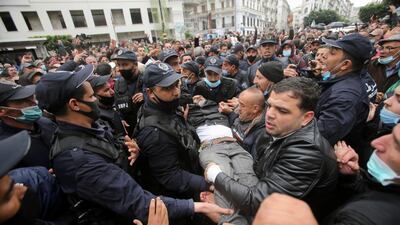
A man is carried by police and protesters during a rally marking two years since the start of a mass protest movement demanding political change, in the Algerian capital, Algiers. Reuters -

Algerians gesture during a demonstration in the capital Algiers, marking the second anniversary of the rise of the country’s anti-government Hirak protest movement. Police were in force on the streets of the city, and helicopters hovered overhead as checkpoints created traffic jams. AFP -
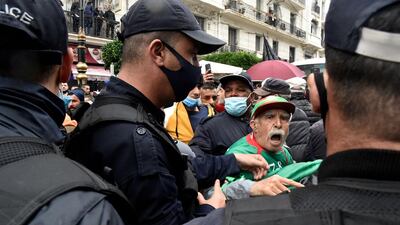
An elderly man confronts police officers during a demonstration in the Algerian capital Algiers, marking the second anniversary of the country’s anti-government Hirak protest movement. AFP -
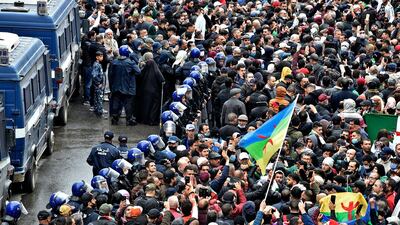
Algerians rally in the capital Algiers, marking the second anniversary of the country’s anti-government Hirak protest movement. AFP -
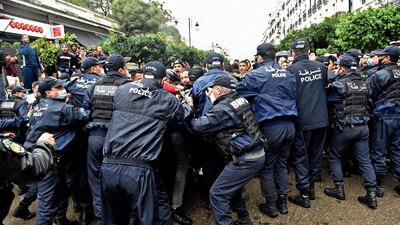
Algerian policemen block protesters from advancing during a demonstration in the capital Algiers, marking the second anniversary of the country’s anti-government Hirak protest movement. AFP -
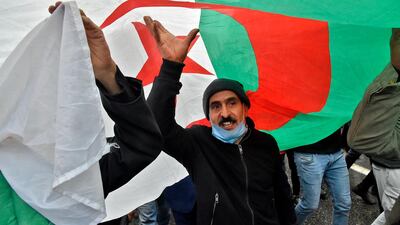
Algerians march with a national flag during a demonstration in the capital Algiers. AFP -
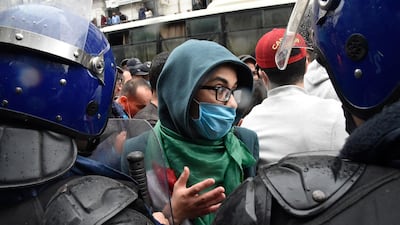
Protesters gather in the Algerian capital Algiers to mark the second anniversary of the country’s Hirak anti-government protest movement. AFP -
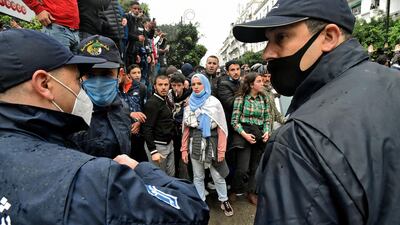
Protesters gather in the Algerian capital Algiers to mark the second anniversary of the country’s Hirak anti-government protest movement. AFP -

Protesters chant slogans during a demonstration in the Algerian capital Algiers. AFP


"Why not?" said Abdelkader Abderrahmane, a senior researcher with Enact and the Institute for Security Studies.
"Every vote now could be a step away from the ‘pouvoir'. They vote for an independent parliament now. Next time, they could vote for a new presidency,” he said.
The pouvoir, or power, is a term used to denote the small oligarchy of top political, business and security officials that have traditionally controlled much of the government.
The largest party in the country, the Front de Liberation Nationale (FLN) is in contention again as are other mainstream parties such as the National Rally for Democracy, the Rally for Hope for Algeria, and the Algerian Popular Movement.
However, as with the FLN, all are expected to suffer through their close associations with presidents of the past.
In contrast, the Muslim Brotherhood-affiliated Movement de la Societe pour la Paix, currently the third-largest party in parliament, is hoping to pick up the votes of those excluded from the closed circles of influence.
Moreover, for many in Algeria, the notion of a political party that combines politics with the themes of their religion holds a clear attraction.
"Politically, the Islamists lost the argument in the 1990s. However, culturally, they've been winning," Mr Abderrahmane said.
"Over the last 20 or 30 years, Algerian society has grown increasingly religious," he said, pointing to the footholds that Islamists have established in mosques, universities and on social networks, as movements such as Dawa Salafiya, while avowedly apolitical, have fostered political discussion within a religious framework.
Algerians hope the elections will lead to the formation of a new government that can arrest the downward trajectory of Algeria's spluttering economy.
Despite years of calls to diversify its model and halt the country's reliance on oil and gas exports, the economy is almost entirely unreformed. Exacerbating Algeria's problems is the state subsidy system, one of the highest within Opec and paid for by hydrocarbon exports.
But with energy prices maintaining the flat line they have held since 2014, foreign reserves, and time, are fast running out.
Irrespective of the results of Saturday's vote, Algeria's challenges are significant.
What role a newly renewed parliament may play in helping the country overcome them remains to be seen.

