

Israel's Supreme Court ruled on Monday against a significant part of the government's polarising legal reform, which challenged the powers of the judiciary and sparked mass protests.
Eight of 15 justices on the country's top court ruled against an amendment passed by the parliament in July which scraps the “reasonableness” clause, used by the court to overturn government decisions which are deemed unconstitutional.
“This is due to the severe and unprecedented damage to the basic characteristics of the state of Israel as a democratic state,” the statement said.
Prime Minister Benjamin Netanyahu had argued the sweeping judicial reform package presented a year ago was necessary to rebalance powers between judges and politicians.
But his detractors warn the multipronged package paved the way for authoritarian rule and could be used by Mr Netanyahu to quash possible convictions against him, an accusation the Prime Minister denies.
Tens of thousands of demonstrators had rallied weekly against the government reforms, with protests only ending due to the outbreak of the Israel-Gaza war in October.
Israelis protest against judicial overhaul – in pictures
-

Mass protests continue across Israel against the government's justice system reform plan. EPA -

Anti-government protesters march towards the Israeli Knesset in Jerusalem. EPA -

Protesters blocked roads across Israel, hours after parliament adopted a key clause of the government's judicial overhaul package, which opponents say threatens democracy. AFP -

A demonstrator in a dinosaur suit marches at Ben Gurion Airport near Lod. AFP -
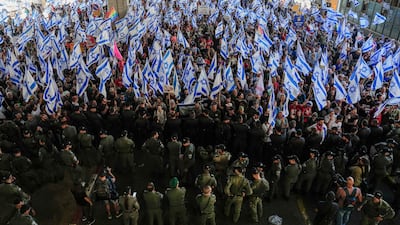
Israelis wave flags during a protest against plans by Prime Minister Benjamin Netanyahu's government to overhaul the judicial system. AP -

Israelis have taken to the streets en masse to protest against the government’s plans to weaken the power of judges. Bloomberg -

Mass protests continue across the country against the government's justice system reform plan. EPA -
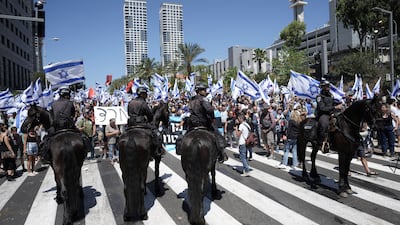
Mounted police in Tel Aviv, Israel, control protesters demonstrating against plans to overhaul the judicial system. AP -

Police and protesters clash on the 'Day of Disruption' opposing the judicial overhaul, in Tel Aviv. Reuters -

Israeli demonstrators wave flags as they block Highway 443 between Jerusalem and Tel Aviv, near Modiin. AFP -
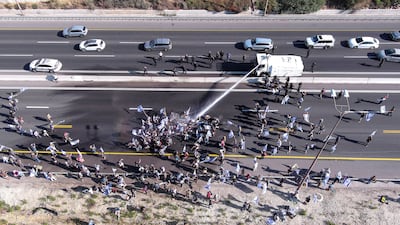
Israeli police use a water cannon against demonstrators at the Ein Hemed junction towards Jerusalem. Reuters -
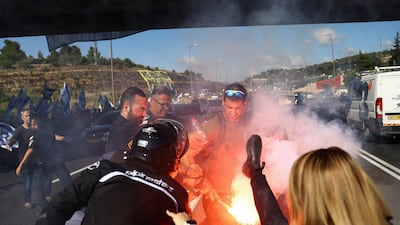
Protesters set off a flare near Jerusalem as they oppose a bill to curb the Israeli Supreme Court's power to void government decisions. Reuters -

A confrontation in Tel Aviv, Israel, during protests against the move by Prime Minister Benjamin Netanyahu's coalition. Reuters -
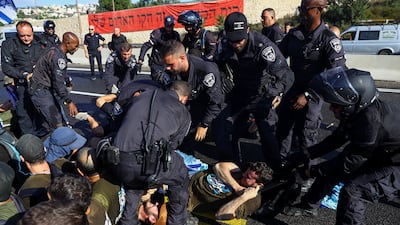
Members of the Israeli security forces remove demonstrators blocking a highway to Jerusalem. Reuters -
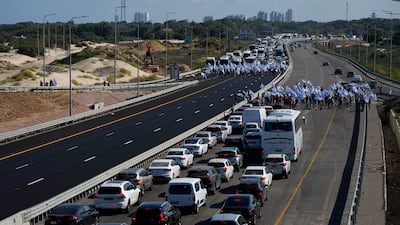
Israeli protesters block the Tel Aviv to Haifa highway near Beit Yanai, Israel. AP -
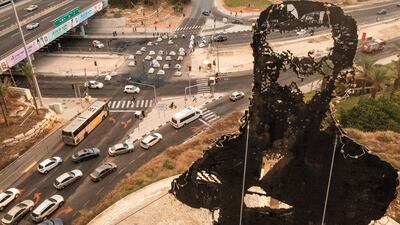
Demonstrators block a road with tents at the entrance to Herzliya, north of Tel Aviv, Israel. Reuters -
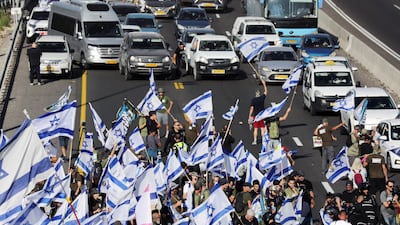
Israeli anti-government protesters block the entrance to Jerusalem, where some demonstrators entered the Knesset building. EPA


The “reasonableness” amendment, the only major part of the legal reform package to become law, was also one of its most contentious steps as it sought to curb judicial oversight of the government.
When Mr Netanyahu's allies voted to scrap the reasonableness clause in July, opposition politicians stormed out of the chamber, shouting “shame”.
The law has been cited in only a handful of court decisions, including a high-profile ruling last year which barred an ally of Mr Netanyahu from serving in the cabinet because of a previous tax evasion conviction.

