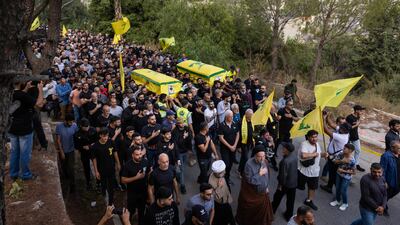
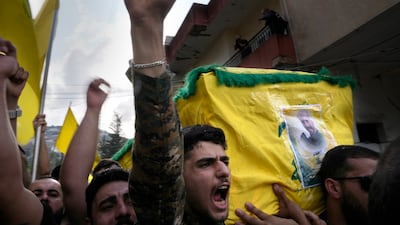
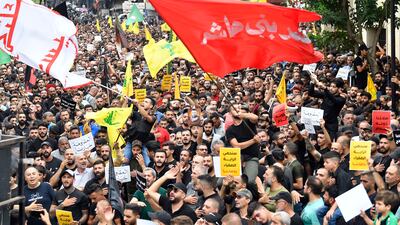
A man waves the Palestinian flag during the funeral of three Hezbollah members killed in intensifying border skirmishes on the Lebanese-Israeli border, in Lebanon's southern city of Nabatieh on October 27, 2023. AFP
A man waves the Palestinian flag during the funeral of three Hezbollah members killed in intensifying border skirmishes on the Lebanese-Israeli border, in Lebanon's southern city of Nabatieh on Octobe

Escalation between Hezbollah and Israel puts Lebanon at risk of regional war


Nada Homsi
  • English
  • Arabic

Live updates: Follow the latest news on Israel-Gaza

As Israel expands its ground assault into Gaza, the scale and intensity of activity on the Lebanon front has also increased, reflecting Hezbollah’s willingness to support Hamas even at the risk of igniting a broader regional conflict.

“The rules of engagement, which have been so far relatively respected, are being increasingly tested day after day, so no one can dismiss the risk of a wider escalation,” said Karim Bitar, professor of international relations at Saint Joseph University in Beirut.

Hezbollah said on Tuesday it had “killed and wounded” the crew of a Merkava tank near northern Israel's Pranit barracks. It was not immediately known how many soldiers were killed in the attack, as the Israeli military does not immediately acknowledge fatalities.

Overnight, Israeli forces struck the outskirts of several southern Lebanese towns – Ramia, Aita Al Shaab and Labouneh – with white phosphorous and artillery.

The Israeli military said the attack had been aimed at Hezbollah military positions, including a weapons cache.

The use of white phosphorous by Israel in its attacks on south Lebanon has been documented on several occasions by rights group Amnesty International. Its use is banned under international law.

Although Israel and Hezbollah have exchanged fire almost daily since the conflict began, the cross-border bombardment has significantly intensified since last week, after Israel announced the “second stage” of its war on Hamas.

Yemen’s Houthi rebels also claimed to have launched “a large batch of ballistic and cruise missiles and a significant number of drones” towards Israel’s southern city of Eilat on Tuesday – the third such operation claimed by the rebel group.

An Israeli tank advances on a road in northern Israel near the border with Lebanon on October 28, 2023, amid intensifying cross-border skirmishes. AFP

Gaza invasion a 'red line' in 'unity of fronts' strategy

“We have seen a widening of the geographic area in which the military operations are happening,” Mohanad Hage Ali, a senior fellow at the Carnegie Middle East Centre in Beirut, told The National.

Since 2021, Hezbollah and its allies have employed a strategy commonly referred to as the “unity of fronts”, in which the respective groups would pool resources, tactics and weapons, Mr Ali explained.

The strategy saw them form a “a Nato of non-state actors, if you will, in which they would all join in if attacked by Israel and that would deter Israel from launching attacks against these organisations”.

“So what we're seeing now in south Lebanon has been in the works for years,” he explained.

“Hezbollah has to step in to try and draw a red line around the invasion of the Gaza Strip and destruction of Hamas.”

The unity of fronts strategy has also been enacted in Yemen, where the Iran-backed Houthis have launched attacks on Israel over the past three weeks, and in Iraq, where Iran-backed groups have attacked US military instalments.

Israeli army tracked medical vehicles move along a road near the northern town of Kiryat Shmona close to the border with Lebanon on October 31, 2023. AFP

How has the Israel-Lebanon front evolved?

The gradually escalating conflict has been more or less continuous since hostilities began on October 8, punctuated by brief lulls in the bombardment.

Three weeks ago, when the conflict first erupted between Israel and armed militant groups in Lebanon led by Hezbollah, the Iran-backed party primarily launched attacks on Israeli military instalments – intelligence watchtowers, surveillance infrastructure and tanks. The vast majority of casualties were soldiers.

Hezbollah has also allowed Palestinian groups such as Islamic Jihad and Hamas to cross into Israel for limited operations.

The exchange of fire was largely tit for tat: whenever Israeli shelling killed civilians, Hezbollah or its allies would also attack civilians. If an especially high death toll was announced in Gaza following intense aerial bombardment by Israel, groups in south Lebanon would, in turn, intensify their own attacks.

But the tactics have since evolved.

Hezbollah and its allies intensified attacks on Israel following the latter’s high-intensity bombardment of Gaza last week, which was accompanied by a ground operation conducted under the cover of a total communications blackout.

Israel, in turn, has responded by striking up to 20km into Lebanon in areas such as Jezzine, no longer limiting itself to the border – a significant boost in hostilities.

A house damaged in a rocket attack in the northern region of Kiryat Shmona near the border with Lebanon on October 30, 2023. AFP

Hezbollah's aims

Hezbollah aims to prevent a military invasion of the Gaza Strip, or at least keep Israel too occupied to focus its full attention on the enclave.

The group is sending the message that “it will step if will step in and will be part of this conflict if Israel continues its ground invasion in Gaza”, Mr Ali explained.

“And secondly, it's also an attempt to engage as many Israeli soldiers in the north to divert some of the resources away from the Gaza Strip,” he continued.

“Hezbollah will keep phasing its escalation to try an avoid a war, as it tries to send the message to Israel that it needs to limit its operation in the Gaza Strip, or this will get out of hand.”

To date, at least 50 people have been killed in Lebanon since the conflict with Israel erupted – mostly Hezbollah fighters and some fighters from allied groups. There have been four civilian casualties, including Reuters journalist Issam Abdallah.

Most of Hezbollah’s fighters have been killed in Israeli drone strikes, leading the powerful group to unveil its surface-to-air missile capability for the first time on Sunday when it downed an Israeli drone.

Eight Israelis have been killed in attacks coming from Lebanon, the vast majority of them soldiers.

Thousands of people have evacuated or been displaced on both sides of the border.

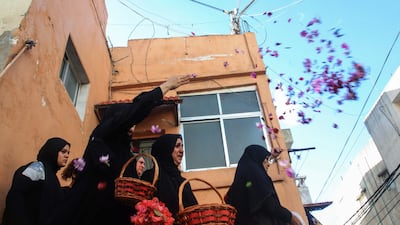
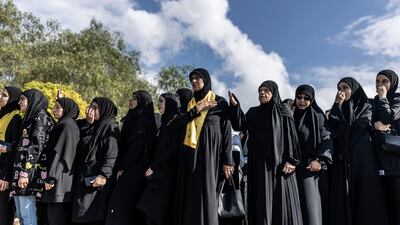
  • Women attend the funeral of a Hezbollah militant killed during clashes against Israeli forces in the southern border of Lebanon. Getty Images
    Women attend the funeral of a Hezbollah militant killed during clashes against Israeli forces in the southern border of Lebanon. Getty Images
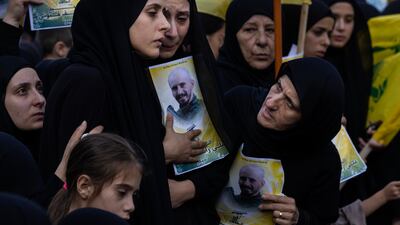
  • Women at the funeral of Hezbollah fighter Kamal Al Masri in Burj Al Shemali, southern Lebanon. AFP
    Women at the funeral of Hezbollah fighter Kamal Al Masri in Burj Al Shemali, southern Lebanon. AFP
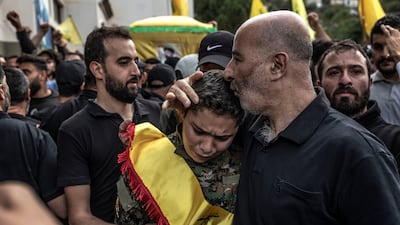
  • A man comforts the son of a Hezbollah militant killed during clashes against Israeli forces in the southern border of Lebanon. Getty Images
    A man comforts the son of a Hezbollah militant killed during clashes against Israeli forces in the southern border of Lebanon. Getty Images
  • Hezbollah supporters attend the funeral of a Hezbollah militant killed in Lebanon. Getty Images
    Hezbollah supporters attend the funeral of a Hezbollah militant killed in Lebanon. Getty Images
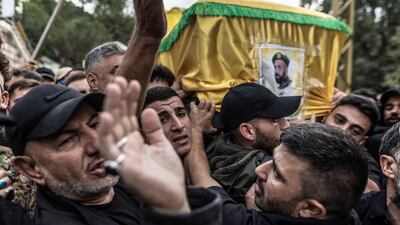
  • Hezbollah supporters carry the coffin of a Hezbollah militant. Getty Images
    Hezbollah supporters carry the coffin of a Hezbollah militant. Getty Images
  • Men carrying the coffins at a funeral for two Hezbollah soldiers killed in south Lebanon. Getty Images
    Men carrying the coffins at a funeral for two Hezbollah soldiers killed in south Lebanon. Getty Images
  • Members and supporters of Hezbollah take part in the funeral of Kamal Al Masri, one of the group's fighters, in southern Lebanon. AFP
    Members and supporters of Hezbollah take part in the funeral of Kamal Al Masri, one of the group's fighters, in southern Lebanon. AFP
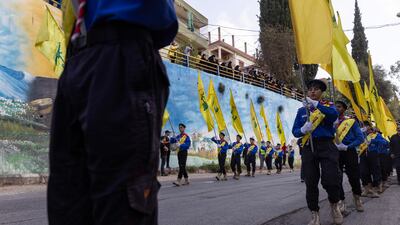
  • Scouts carry Hezbollah flags at a funeral for two Hezbollah soldiers killed in South Lebanon. Getty Images
    Scouts carry Hezbollah flags at a funeral for two Hezbollah soldiers killed in South Lebanon. Getty Images
  • Hezbollah fighters attend the funeral procession of two comrades in Kherbet Selem, south Lebanon. AP Photo
    Hezbollah fighters attend the funeral procession of two comrades in Kherbet Selem, south Lebanon. AP Photo
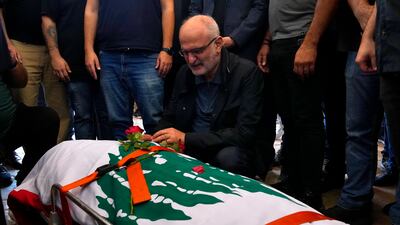
  • Member of Lebanese parliament Ali Hassan Khalil mourns the body of Reuters videographer Issam Abdallah, who was killed by Israeli shelling, during his funeral in Khiam, southern Lebanon. AP Photo
    Member of Lebanese parliament Ali Hassan Khalil mourns the body of Reuters videographer Issam Abdallah, who was killed by Israeli shelling, during his funeral in Khiam, southern Lebanon. AP Photo
  • Women at a funeral for two Hezbollah soldiers killed in south Lebanon. Getty Images
    Women at a funeral for two Hezbollah soldiers killed in south Lebanon. Getty Images
  • A Hezbollah fighter carries the coffin of his comrade who was killed by Israeli shelling in Kherbet Selem, south Lebanon. AP Photo
    A Hezbollah fighter carries the coffin of his comrade who was killed by Israeli shelling in Kherbet Selem, south Lebanon. AP Photo
  • Hezbollah fighters at the funeral of their two comrades in Kherbet Selem. AP Photo
    Hezbollah fighters at the funeral of their two comrades in Kherbet Selem. AP Photo
  • Hezbollah supporters shout religious slogans during the funeral of Hezbollah fighter Ahmed Qassas in a southern suburb of Beirut. EPA
    Hezbollah supporters shout religious slogans during the funeral of Hezbollah fighter Ahmed Qassas in a southern suburb of Beirut. EPA
Ten tax points to be aware of in 2026

1. Domestic VAT refund amendments: request your refund within five years

If a business does not apply for the refund on time, they lose their credit.

2. E-invoicing in the UAE

Businesses should continue preparing for the implementation of e-invoicing in the UAE, with 2026 a preparation and transition period ahead of phased mandatory adoption. 

3. More tax audits

Tax authorities are increasingly using data already available across multiple filings to identify audit risks. 

4. More beneficial VAT and excise tax penalty regime

Tax disputes are expected to become more frequent and more structured, with clearer administrative objection and appeal processes. The UAE has adopted a new penalty regime for VAT and excise disputes, which now mirrors the penalty regime for corporate tax.

5. Greater emphasis on statutory audit

There is a greater need for the accuracy of financial statements. The International Financial Reporting Standards standards need to be strictly adhered to and, as a result, the quality of the audits will need to increase.

6. Further transfer pricing enforcement

Transfer pricing enforcement, which refers to the practice of establishing prices for internal transactions between related entities, is expected to broaden in scope. The UAE will shortly open the possibility to negotiate advance pricing agreements, or essentially rulings for transfer pricing purposes. 

7. Limited time periods for audits

Recent amendments also introduce a default five-year limitation period for tax audits and assessments, subject to specific statutory exceptions. While the standard audit and assessment period is five years, this may be extended to up to 15 years in cases involving fraud or tax evasion. 

8. Pillar 2 implementation 

Many multinational groups will begin to feel the practical effect of the Domestic Minimum Top-Up Tax (DMTT), the UAE's implementation of the OECD’s global minimum tax under Pillar 2. While the rules apply for financial years starting on or after January 1, 2025, it is 2026 that marks the transition to an operational phase.

9. Reduced compliance obligations for imported goods and services

Businesses that apply the reverse-charge mechanism for VAT purposes in the UAE may benefit from reduced compliance obligations. 

10. Substance and CbC reporting focus

Tax authorities are expected to continue strengthening the enforcement of economic substance and Country-by-Country (CbC) reporting frameworks. In the UAE, these regimes are increasingly being used as risk-assessment tools, providing tax authorities with a comprehensive view of multinational groups’ global footprints and enabling them to assess whether profits are aligned with real economic activity. 

Contributed by Thomas Vanhee and Hend Rashwan, Aurifer

The specs: Audi e-tron

Price, base: From Dh325,000 (estimate)

Engine: Twin electric motors and 95kWh battery pack

Transmission: Single-speed auto

Power: 408hp

Torque: 664Nm

Range: 400 kilometres

RESULTS

Lightweight (female)
Sara El Bakkali bt Anisha Kadka
Bantamweight
Mohammed Adil Al Debi bt Moaz Abdelgawad
Welterweight
Amir Boureslan bt Mahmoud Zanouny
Featherweight
Mohammed Al Katheeri bt Abrorbek Madaminbekov
Super featherweight
Ibrahem Bilal bt Emad Arafa
Middleweight
Ahmed Abdolaziz bt Imad Essassi
Bantamweight (female)
Ilham Bourakkadi bt Milena Martinou
Welterweight
Mohamed Mardi bt Noureddine El Agouti
Middleweight
Nabil Ouach bt Ymad Atrous
Welterweight
Nouredine Samir bt Marlon Ribeiro
Super welterweight
Brad Stanton bt Mohamed El Boukhari

Draw

Quarter-finals

Real Madrid (ESP) or Manchester City (ENG) v Juventus (ITA) or Lyon (FRA)

RB Leipzig (GER) v Atletico Madrid (ESP)

Barcelona (ESP) or Napoli (ITA) v Bayern Munich (GER) or Chelsea (ENG)

Atalanta (ITA) v Paris Saint-Germain (FRA)

Ties to be played August 12-15 in Lisbon

Updated: October 31, 2023, 5:16 PM