


When Indian expat Boby Sebastian, 33, from Kerala, met and fell in love with Hala Abuzaid, 26, a softly spoken Sudanese woman who was working at the same restaurant in Khartoum, the couple knew their marriage would come with challenges.
But dodging bullets while fleeing a war zone with passports from two different countries, fighting a street mob and scrambling for a seat on an Indian repatriation flight out of Sudan, all while expecting their first child, were not scenarios the young couple ever envisioned.
With Sudan’s sudden descent into a civil conflict on April 15, the young couple's lives changed in an instant.
Ms Abuzaid, two months pregnant, went from the joy of impending motherhood to the fear of being caught in the crossfire of a power struggle that has displaced millions.
Amid the continuing violence and the exodus of thousands from Sudan, The National pieced together the couple's daring escape, through the violence-torn streets of Khartoum, their journey to Port Sudan and eventually to a small town in Kottayam in Kerala, India.

April 15: The day war broke out
In their small apartment on Al Obaid Street, nestled within the bustling neighbourhood of Al Riyad in Khartoum, the pair began their day like any other.
Mr Sebastian, a restaurant manager, slept peacefully, knowing his shift at Luxury Pastries and Restaurant would start later in the afternoon. Meanwhile, his partner, also employed in the restaurant's pastry section, was busy preparing breakfast before heading to work.
Suddenly, there was a jarring noise from outside.
“First I thought it was another strike or public protest, a common occurrence in Sudan. But then there was a volley of gunfire and I knew something was wrong,” Ms Abuzaid told The National.
She woke up her husband who said it was clear there was a “big fight” unfolding in the distance.
Their world was engulfed in chaos as, outside, the rivalry between two of Sudan's army chiefs escalated into a fully fledged urban war.
April 16: Screams and gunfire
The couple said they spent the night in their house, hoping that things would improve the next day.
“I wanted to go out and check what is the status with our restaurant, which is just a 10-minute walk from our apartment, but it was too dangerous to step out,” said Mr Sebastian.
“We could fear gunfights just outside our apartment. They were firing from both sides of the building.”

As they spent another day hunkered down watching TV and scrolling through social media, they realised Sudan was slipping into chaos.
“I started to get really worried about Hala as she was in the early stages of her pregnancy,” said Mr Sebastian.
“We had just finished a medical examination and the doctor had advised rest, but the fear and panic was taking its toll on her.
"I thought I will never see another day.”
April 17: Death toll mounts
Sudan was in the grip of one of its worst civil conflicts. More than 160 people were reported dead in the first two days.
The couple were trying desperately to get in touch with friends and relatives of Hala to find a way to escape.
“Everyone advised us to stay indoors. Hundreds of people were fleeing Khartoum to safer regions and neighbouring countries. But it was too risky to travel with Hala. So, we decided to stay where we are,” said Mr Sebastian.
For several days, the couple said they locked themselves up, with windows closed and lights switched off.

April 18: Plotting escape route
Mr Sebastian said he was closely following updates from Indian embassy in Sudan as there was talk about the possibility of the Indian government launching evacuation flights for its citizens.
The advisory put out by the embassy asked citizens to stay calm and keep essentials such as medicine, water, food, money, a passport and their OCI card, a form of permanent residency issued to people of Indian origin living abroad or their spouses, ready to ensure easy mobility when the time came.
“But my wife did not have an OCI card and her Indian tourist visa had expired in March. That became a problem,” said Mr Sebastian.
April 19 – 21: Mass exodus as fighting rages
As days passed, the couple were becoming more and more desperate as food became scarce.
“We had some leftover stock from Ramadan. But essentials were running out,” said Ms Abuzaid.
“Shops and restaurants were all closed and we had no idea for how long we would be staying like this.”
On April 19, when there was a lull in gunshots outside, Mr Sebastian stepped out of his apartment to check on other families in their building.
“I went from one to floor to another. There was not a single family left in the building except one Indian guy who was staying alone. Everyone was gone.”
To make matters worse, when he received the final list of potential evacuees from the Indian embassy, his partner's name was absent.
“There was no way I could leave without her. I started sending messages to everyone that I know to help me evacuate my pregnant wife,” he said.
April 22: Renewed hope
A Sudanese friend offered to transport the couple from Al Riyad to Kalakala, where Ms Abuzaid's family lived.
“With his assistance, we were able to leap over the rear compound wall and make our way to the street behind us. Those few moments were among the most terrifying of my life,” Mr Sebastian said.
It took them a couple of hours to reach Kalakala, a journey that would typically take just 30 minutes from Al Riyad.
Kalakala was comparatively safer, so they made the decision to stay there and rest for two days while waiting to hear from the embassy.
April 26: A rickshaw ride to safety
Mr Sebastian's phone rang, and the Indian embassy delivered the long-awaited news – his wife would be accommodated on the next available evacuation flight.
He said he was grateful for the support of Shashi Tharoor, a Congress MP from Kerala and former UN diplomat.
“I have no words to thank him and everyone else who rallied behind my cause and spread the message on social media,” he said.
Packing clothes, essential items and their laptops, the couple set off in the early morning to Jabra.
Buses arranged by Indian volunteers were meant to transport people to the safety of the Indian embassy, which had now moved from Khartoum to Soba near Port Sudan due to the violence, but they had already left.
“We were left stranded on the roadside,” said Mr Sebastian.
What followed was another sinister aspect of war, as an unruly group of men noticed the couple.
“They knew we were helpless and vulnerable and they tried to assault Hala and snatch our bags,” said Mr Sebastian.
“I was trying my best to push them away when suddenly a rickshaw screeched to a halt in front of us and the driver gestured us to get in quickly.
“I cannot imagine what would have happened if we hadn't found that rickshaw.”
The couple safely reached the embassy and boarded the bus to Port Sudan for the gruelling 14-hour journey.

April 27: End in sight
The couple checked in to Port Sudan and by 12.30pm boarded the evacuation flight as part of Operation Kaveri, one of the biggest evacuation missions by India.
“I looked at Hala and we cried. We were happy that we were finally out of Sudan. But we were sad too that we are leaving behind everything we have,” said Mr Sebastian.
April 28: Hope and heartbreak as new chapter awaits
The flight landed in Jeddah on Friday afternoon. Late in the evening the couple boarded an Air India flight to Delhi, before flying to Kochi, Kerala.
Mr Sebastian said it felt like they had been given a new lease of life. The once looming spectre of danger was now a distant memory, replaced by a sense of peace and safety.
But the journey to freedom came at a steep cost.
Ms Abuzaid had lost her baby during the ordeal.
Now trapped in a safe yet unfamiliar world, her partner struggles to rebuild their life.
“People are nice to me. But I miss home. I miss my family,” said Ms Abuzaid.
The restaurant the couple were working in was destroyed in the bombing and Mr Sebastian said he will have to start afresh.
“We are happy we are safe,” he added. “But the future is uncertain. I do not know where to start from.”
-
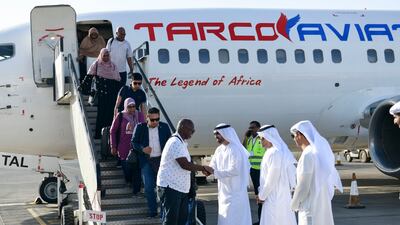
An evacuation flight from Sudan operated by the UAE lands at Abu Dhabi International Airport. All photos: Khushnum Bhandari / The National -
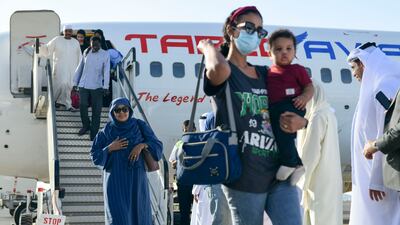
Evacuees arrive at Abu Dhabi International Airport -
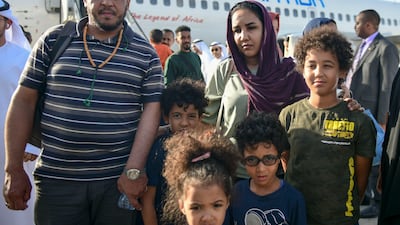
Emad Abbas and Sarah Ahmed with their four children, aged between four and 12 -

The Al Hussein family reunites -
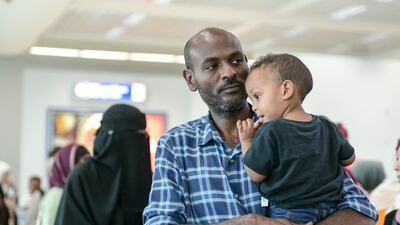
Emad Hassan carries his son -

Bassam Salama, with wife Baraa, who is eight months pregnant -
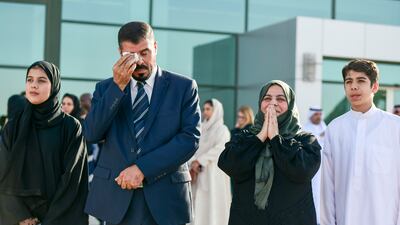
A family prays for other members to arrive safely from Sudan -
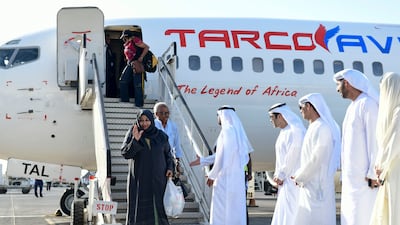
Emirati officials and ambassadors greet evacuees -
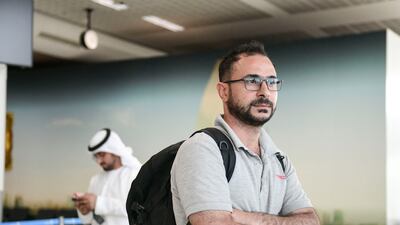
Bashar Salama lands at Abu Dhabi International Airport -
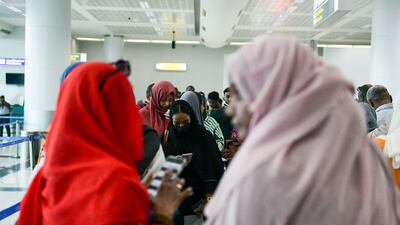
Evacuees wait at immigration



