


Syrian refugee Samer Saleh cuts shawarma all day at a shop on a dusty street in east Amman for $420 a month.
It's his second stint in Jordan after escaping Syria's 11 year civil war. Three years ago he decided to try returning to his home in the eastern suburbs of Damascus.
"I got fed up with the low pay and working without a contract and decided to go back," said 32-year-old Mr Saleh.
"There was nothing. Conditions in Syria turned out much worse than I had thought. But if there is a real change in the economy I would go back again."
He is among a strata of Syrian refugees who may find it easier to return because they are not wanted for military conscription or risk persecution due to their opposition to President Bashar Al Assad, who has ruled since 2000.
Eastern Ghouta was a centre of pro-democracy demonstrations when a revolt broke out against Mr Assad in March 2011. Mr Saleh was then working at a restaurant and stayed away from the street protests.
Security forces suppressed the activists and by the end of the year Syria was in civil war. The economy started collapsing as the currency lost most of its value, and western countries imposed sanctions on the Assad government for its crackdown.
Millions fled the country, mainly to Turkey, Lebanon and Jordan.
At the beginning of 2011, the Syrian pound was trading at about 50 to the dollar, compared with 1,700 when Mr Saleh went back in 2020. Today the exchange rate is 8,500 to $1.
Mr Saleh had obtained an "exit and return" permit from the Jordanian Interior Ministry before he returned.
-
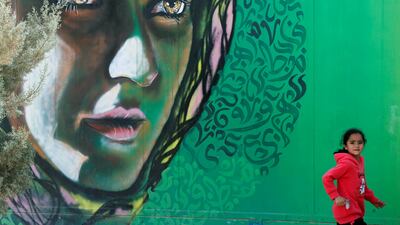
A Syrian child passes a mural at Al Zaatari refugee camp, which is near the Jordanian city of Mafraq, close to the border with Syria. Reuters -
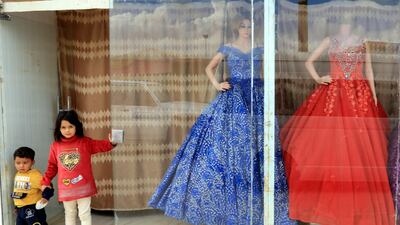
Syrian children at Al Zaatari refugee camp, Jordan. EPA -
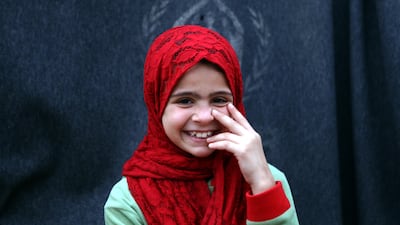
A Syrian refugee at Al Zaatari refugee camp. EPA -
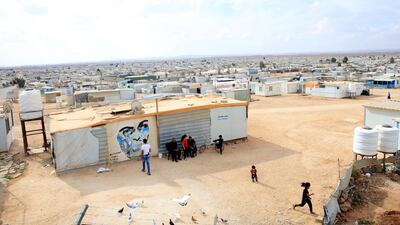
Al Zaatari refugee camp. EPA -
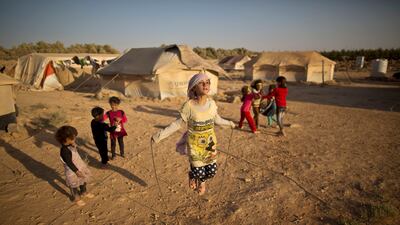
Syrian refugee Zubaida Faisal, 10, skipping rope at an informal tented settlement near the Syrian border on the outskirts of Mafraq, Jordan. AP Photo -
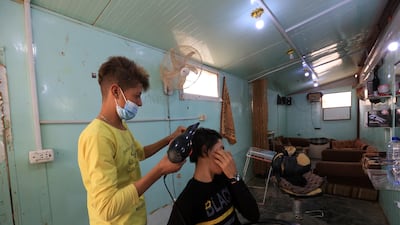
A barber shop at the refugee camp. EPA


But a rapprochement between Arab countries and Damascus in recent years, which culminated in Syria's admission to the Arab League this month, has revived speculation among refugees of Arab funding possibly ushering in reconstruction of the country, although no financial commitments have been made.
Jordan has been a main proponent for a regional rapprochement with Damascus, along with Saudi Arabia and other players.
Last year, 52,000 Syrians returned to the country from Jordan elsewhere in the region. A large proportion of these refugees returned to areas in northern Syria controlled by rebel groups allied with Ankara, as opposed to places under the control of Damascus.
In 2021, a total 35,800 returned from the region, compared with 38,200 the previous year, the United Nations High Commissioner for Refugees (UNHCR) said.
There are 670,000 Syrian refugees registered in Jordan, according to UNHCR figures.
UN data shows 4,013 Syrian refugees returned to their homeland from Jordan last year, compared to 4,200 in 2021.
Registered refugees need to inform the office of the High Commissioner in Amman that they want go back. Those who fled Syria without obtaining a passport stamp must visit the Syrian embassy to obtain a return permit, an official source who requested anonymity said.
Geir Pedersen, the UN special envoy for Syria, said after meeting Jordan's Foreign Minister Ayman Al Safadi in Geneva this week that “addressing protection concerns” for refugees was needed before “any contemplated returns”.
Fares Ghanem, a shared-taxi driver who works on the Amman-Damascus route said numbers of Syrians returning have been "very light since the crisis".
"Rumours are flying around that a million refugees are about to return from Jordan but I have not seen anything," he said.
In Geneva, Mr Al Safadi said Jordan had "exceeded its capacity" for refugees. The kingdom closed its borders in front of incomers in 2014. Unemployment in the aid-dependent kingdom is officially at 23 per cent and the economy has been stagnant for more than a decade.
But Nader Radi, a Syrian contractor in the construction business, said there was no fear among refugees of forced returns, as is the case in Lebanon. Mr Radi fled to Amman from Damascus in 2012 after taking part in the protest movement against the Assad regime.
He cited a large proportion of the billions of dollars spent by donors to help Jordan absorb refugees, saying this helped assuage host communities in the kingdom, as well as historic ties between clan and families on the two sides.
"In Jordan the economic pressures could force some refugees to think more about going back," said Mr Radi. "Without reconstruction, however, it is difficult to foresee any real return movement."

