

Israel’s Supreme Court has blocked the eviction of a Palestinian family in East Jerusalem, ending a legal battle that lasted more than 30 years.
The 18-member household was locked in a dispute with right-wing settler organisations supported by Elad, which operates primarily in the East Jerusalem neighbourhood of Silwan.
The Supreme Court on Monday criticised the state’s handling of the case and said: “The property was once declared as absentee without any basis in law, since the owner was without a doubt a resident of Jerusalem at the time of the initial declaration.”
The family’s lawyer, Waseem Dakwar, praised the “precedent-setting” decision.
He said the ruling criticises “how the authorities behaved on this matter and in their declaration of the Sumarin home as absentee property”.
Israel’s 1950 absentees’ property law automatically relates to anyone who fled or left as a result of the 1948 war, after which the state of Israel was founded.
The law, which allows for the transfer of vacated properties to Israel, has come under intense criticism from rights bodies for infringing on the property rights of Palestinians.
Mr Dawkar said the ruling “demonstrates the importance of the Supreme Court as the last bastion for every resident and citizen of the country”.
The powers of the Supreme Court and Israel’s wider judiciary are set to be significantly reduced by radical legal reforms proposed by Prime Minister Benjamin Netanyahu's government.

The plans have sparked the protest movement in Israel over the past three months, with opponents of the measures saying they are a direct threat to democracy.
Israeli President Isaac Herzog has said social rifts caused by the legal overhaul risk causing “civil war” in Israel.
Mr Herzog is holding negotiations between the government and opposition to find a compromise on the measures after Mr Netanyahu paused their passage through parliament following mass protests and a general strike last week.
-

Israeli police disperse demonstrators blocking a road in Tel Aviv during a protest against plans by the government to overhaul the judicial system. AP -
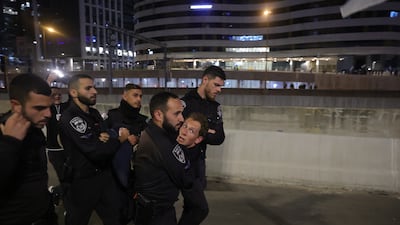
Police arrest a protester in Tel Aviv. EPA -
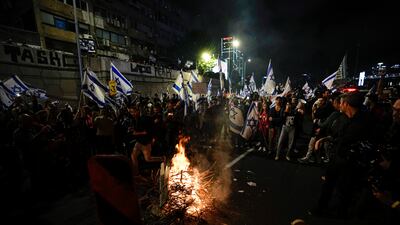
Demonstrators set up a bonfire on a road. AP -
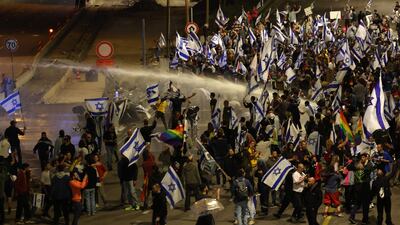
Israeli security forces use a water cannon to disperse protesters. AFP -
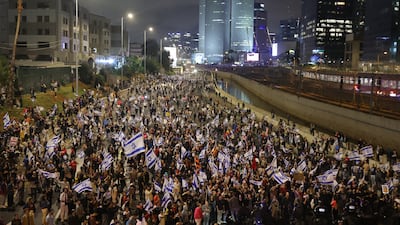
Thousands of protesters block the Ayalon main road. EPA -
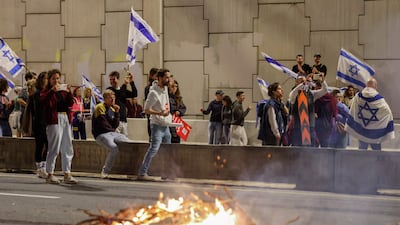
The Tel Aviv protest swelled on Saturday to about 200,000 demonstrators, according to Israeli media estimates. AFP -
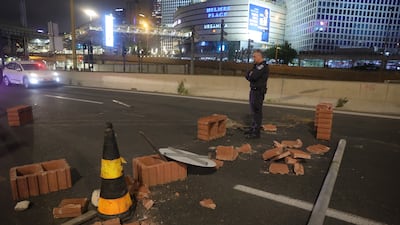
A roadblock placed by protesters on the Ayalon main road. EPA -
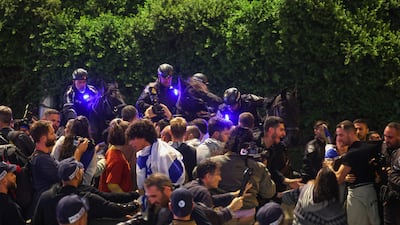
Demonstrations erupted in January after the coalition government announced its package of changes. AFP -
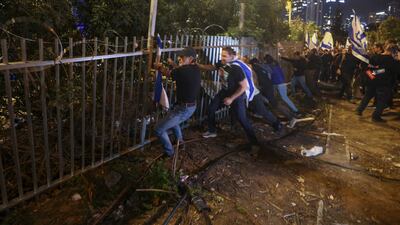
Israeli protesters dislodge a fence. AFP -
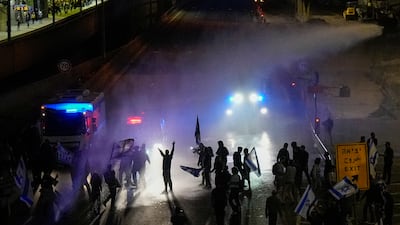
Police use a water cannon to disperse protesters. AP -
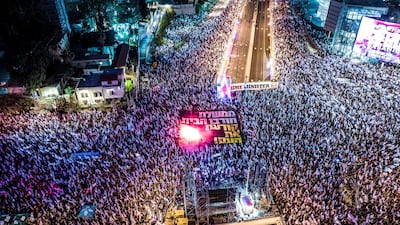
An aerial view of the protest. Reuters -
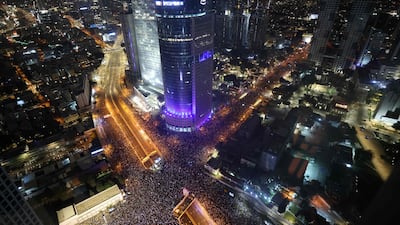
Plans to hand more control to politicians and diminish the role of the court have been questioned by Israel’s allies including the US. AFP -
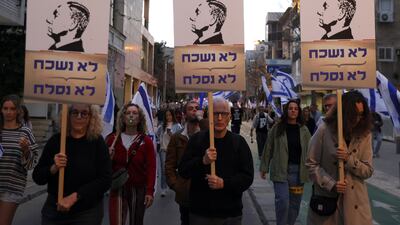
Protesters with placards of Prime Minister Netanyahu saying 'We will not forget, we will not forgive'. EPA


Prominent Israeli lawyer Daniel Seidemann, who focuses on relations between Israelis and Palestinians in Jerusalem, told The National that while the Supreme Court cannot “rule on the basis of what is really happening to the Palestinians,” it still has the “possibility” of getting justice.
His warning came despite ambivalence among Palestinian citizens of Israel over the reforms.

