Sudan's military leader Gen Abdel Fattah Al Burhan said reform of the armed forces was unwise. AFP

Sudan's Gen Al Burhan warns politicians against meddling in military affairs


Hamza Hendawi
  • English
  • Arabic

Sudan’s military leader says he will not allow civilian politicians to “meddle” in the affairs of the armed forces and vowed to reject any attempts at military reform.

“It’s impossible, impossible for me to compromise on the military and the Sudanese army,” Gen Abdel Fattah Al Burhan told troops at the end of combat drills.

“Don’t listen to the politicians’ talk about reforming the army,” he said, using the English phrase “military reforms” in a contemptuous tone. “No one will be allowed to meddle in the army’s affairs.”

Gen Al Burhan’s comments, released on Wednesday night by his office, came less than two weeks after he signed a preliminary agreement with a major pro-democracy group — the Forces of Freedom and Change — that outlines steps to restore Sudan’s democratic transition that was upended when he seized power in a military coup last year.

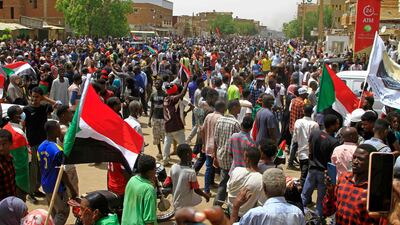
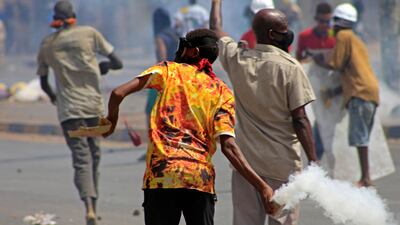
  • Sudanese protesters demonstrate against military rule in Omdurman, Khartoum's twin city. AFP
    Sudanese protesters demonstrate against military rule in Omdurman, Khartoum's twin city. AFP
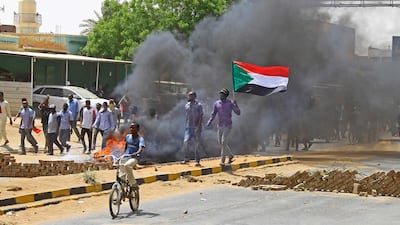
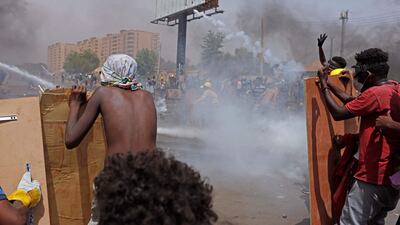
  • Obscured by smoke, protesters march. AFP
    Obscured by smoke, protesters march. AFP
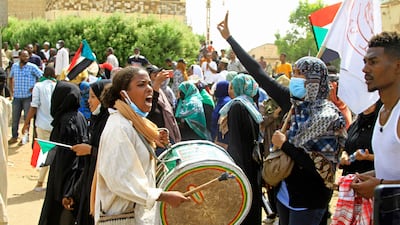
  • They beat drums and call for an end to military rule. AFP
    They beat drums and call for an end to military rule. AFP
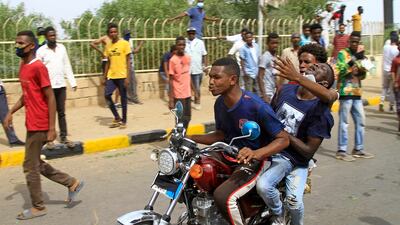
  • A wounded man is taken away by motorbike. AFP
    A wounded man is taken away by motorbike. AFP
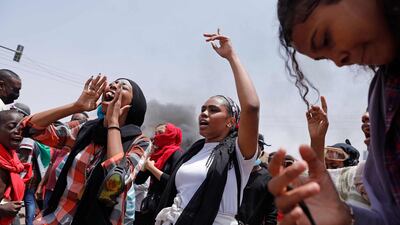
  • Protesters angry at the military's seizure of power in October chant slogans. AFP
    Protesters angry at the military's seizure of power in October chant slogans. AFP
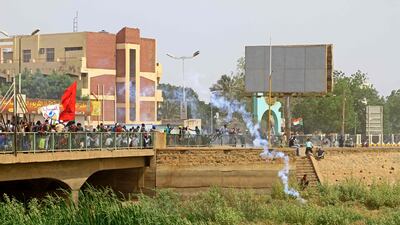
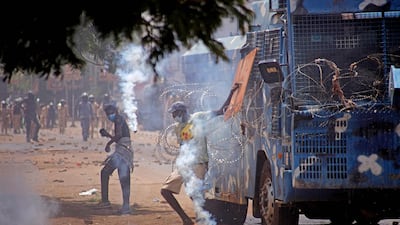
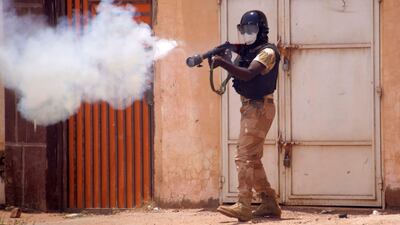
  • Security forces fire tear gas. AFP
    Security forces fire tear gas. AFP
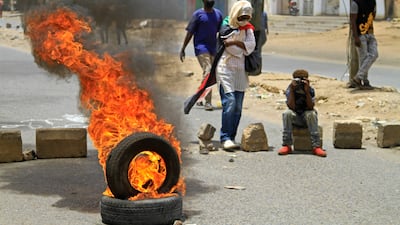
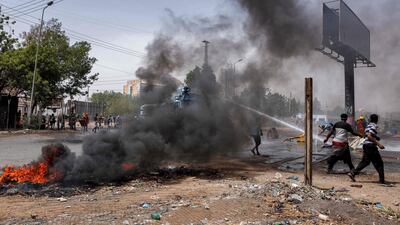
  • Flames leap as protesters burn tyres. AFP
    Flames leap as protesters burn tyres. AFP
  • Demonstrators on the move in Khartoum's northern Bahari district. AFP
    Demonstrators on the move in Khartoum's northern Bahari district. AFP
  • They clash with security forces in Bahari. AFP
    They clash with security forces in Bahari. AFP
  • A show of hands in Khartoum. AP
    A show of hands in Khartoum. AP
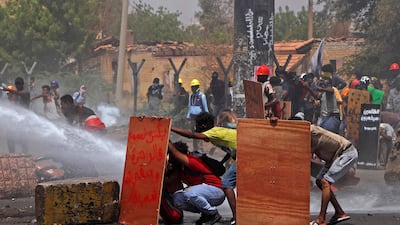
  • Shields raised, protesters face water cannon and tear gas. AFP
    Shields raised, protesters face water cannon and tear gas. AFP
  • They hide from jets of water fired by security forces. AFP
    They hide from jets of water fired by security forces. AFP
  • Violence flares in the centre of Khartoum. AFP
    Violence flares in the centre of Khartoum. AFP
  • A makeshift wooden shield offers little protection from tear gas. AFP
    A makeshift wooden shield offers little protection from tear gas. AFP
  • Protesters advance towards a security forces armoured personnel carrier. AFP
    Protesters advance towards a security forces armoured personnel carrier. AFP
  • Tear gas is fired at protesters. AFP
    Tear gas is fired at protesters. AFP
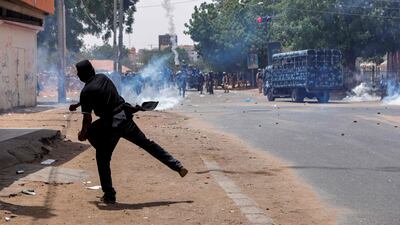
  • But this demonstrator threw a tear gas canister back at security forces. AFP
    But this demonstrator threw a tear gas canister back at security forces. AFP
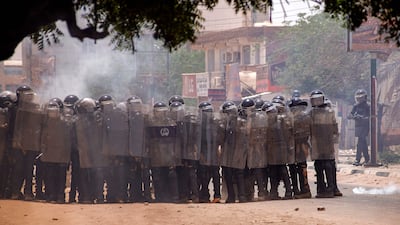
  • A phalanx of riot police, with shields raised. AFP
    A phalanx of riot police, with shields raised. AFP
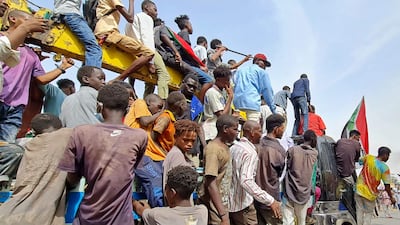
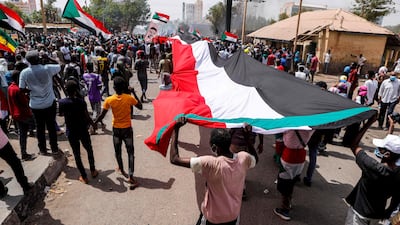
  • Draped in the national flag, demonstrators march against military rule. AFP
    Draped in the national flag, demonstrators march against military rule. AFP
  • Tear gas canisters fly amid clashes in central Khartoum. AFP
    Tear gas canisters fly amid clashes in central Khartoum. AFP

The military has ruled Sudan for most of time since the vast Afro-Arab nation gained independence in 1956, with power-hungry generals toppling elected but dysfunctional governments. Adding to Sudan’s political woes have been ruinous civil wars in its outlying southern and western regions, a chronically ailing economy and the influx of millions of refugees from neighbouring countries.

The December 5 agreement, which has no timetable and lacks specifics on major issues, envisages a civilian prime minister who steers the country for 24 months until elections are held. It also provides for the military to quit politics and to have a civilian as supreme commander of the armed forces.

An anti-military protester in Khartoum. Reuters

Since the agreement was signed Gen Al Burhan has been seeking to play down the significance of the deal, describing it as merely ideas and principles on which a final deal can be based to ease the country’s way out of its political crisis.

A final agreement, he contends, must involve all civilian stakeholders, a virtually impossible scenario given the complexity of Sudan’s political landscape. Already, some key players, such as the powerful pro-democracy Resistance Committees, a neighbourhood-based group, has rejected the agreement.

It wants the military to step aside unconditionally and be held accountable for the killing of more than 120 protesters since the coup on October 25 last year. At least 6,000 civilians were injured in the protests of the past 13 months, mostly organised by the Resistance Committees.

The Communist Party, Islamists loyal to the ousted regime of dictator Omar Al Bashir and the Association of Sudanese professions — another major pro-democracy group — have rejected the deal.

Al Bashir was ousted in April 2019 after 29 years in power.

“There is nothing called settlement at present, there are just some points that we in the military agreed to,” Gen Al Burhan said of the agreement.

“There are so many issues that can only be decided when an elected government is in office. We will not agree to or accept anything in the final agreement that will hurt or disrupt the armed forces.”


Citizenship-by-investment programmes

United Kingdom

The UK offers three programmes for residency. The UK Overseas Business Representative Visa lets you open an overseas branch office of your existing company in the country at no extra investment. For the UK Tier 1 Innovator Visa, you are required to invest £50,000 (Dh238,000) into a business. You can also get a UK Tier 1 Investor Visa if you invest £2 million, £5m or £10m (the higher the investment, the sooner you obtain your permanent residency).

All UK residency visas get approved in 90 to 120 days and are valid for 3 years. After 3 years, the applicant can apply for extension of another 2 years. Once they have lived in the UK for a minimum of 6 months every year, they are eligible to apply for permanent residency (called Indefinite Leave to Remain). After one year of ILR, the applicant can apply for UK passport.

The Caribbean

Depending on the country, the investment amount starts from $100,000 (Dh367,250) and can go up to $400,000 in real estate. From the date of purchase, it will take between four to five months to receive a passport. 

Portugal

The investment amount ranges from €350,000 to €500,000 (Dh1.5m to Dh2.16m) in real estate. From the date of purchase, it will take a maximum of six months to receive a Golden Visa. Applicants can apply for permanent residency after five years and Portuguese citizenship after six years.

“Among European countries with residency programmes, Portugal has been the most popular because it offers the most cost-effective programme to eventually acquire citizenship of the European Union without ever residing in Portugal,” states Veronica Cotdemiey of Citizenship Invest.

Greece

The real estate investment threshold to acquire residency for Greece is €250,000, making it the cheapest real estate residency visa scheme in Europe. You can apply for residency in four months and citizenship after seven years.

Spain

The real estate investment threshold to acquire residency for Spain is €500,000. You can apply for permanent residency after five years and citizenship after 10 years. It is not necessary to live in Spain to retain and renew the residency visa permit.

Cyprus

Cyprus offers the quickest route to citizenship of a European country in only six months. An investment of €2m in real estate is required, making it the highest priced programme in Europe.

Malta

The Malta citizenship by investment programme is lengthy and investors are required to contribute sums as donations to the Maltese government. The applicant must either contribute at least €650,000 to the National Development & Social Fund. Spouses and children are required to contribute €25,000; unmarried children between 18 and 25 and dependent parents must contribute €50,000 each.

The second step is to make an investment in property of at least €350,000 or enter a property rental contract for at least €16,000 per annum for five years. The third step is to invest at least €150,000 in bonds or shares approved by the Maltese government to be kept for at least five years.

Candidates must commit to a minimum physical presence in Malta before citizenship is granted. While you get residency in two months, you can apply for citizenship after a year.

Egypt 

A one-year residency permit can be bought if you purchase property in Egypt worth $100,000. A three-year residency is available for those who invest $200,000 in property, and five years for those who purchase property worth $400,000.

Source: Citizenship Invest and Aqua Properties

Key findings of Jenkins report
  • Founder of the Muslim Brotherhood, Hassan al Banna, "accepted the political utility of violence"
  • Views of key Muslim Brotherhood ideologue, Sayyid Qutb, have “consistently been understood” as permitting “the use of extreme violence in the pursuit of the perfect Islamic society” and “never been institutionally disowned” by the movement.
  • Muslim Brotherhood at all levels has repeatedly defended Hamas attacks against Israel, including the use of suicide bombers and the killing of civilians.
  • Laying out the report in the House of Commons, David Cameron told MPs: "The main findings of the review support the conclusion that membership of, association with, or influence by the Muslim Brotherhood should be considered as a possible indicator of extremism."
Ten tax points to be aware of in 2026

1. Domestic VAT refund amendments: request your refund within five years

If a business does not apply for the refund on time, they lose their credit.

2. E-invoicing in the UAE

Businesses should continue preparing for the implementation of e-invoicing in the UAE, with 2026 a preparation and transition period ahead of phased mandatory adoption. 

3. More tax audits

Tax authorities are increasingly using data already available across multiple filings to identify audit risks. 

4. More beneficial VAT and excise tax penalty regime

Tax disputes are expected to become more frequent and more structured, with clearer administrative objection and appeal processes. The UAE has adopted a new penalty regime for VAT and excise disputes, which now mirrors the penalty regime for corporate tax.

5. Greater emphasis on statutory audit

There is a greater need for the accuracy of financial statements. The International Financial Reporting Standards standards need to be strictly adhered to and, as a result, the quality of the audits will need to increase.

6. Further transfer pricing enforcement

Transfer pricing enforcement, which refers to the practice of establishing prices for internal transactions between related entities, is expected to broaden in scope. The UAE will shortly open the possibility to negotiate advance pricing agreements, or essentially rulings for transfer pricing purposes. 

7. Limited time periods for audits

Recent amendments also introduce a default five-year limitation period for tax audits and assessments, subject to specific statutory exceptions. While the standard audit and assessment period is five years, this may be extended to up to 15 years in cases involving fraud or tax evasion. 

8. Pillar 2 implementation 

Many multinational groups will begin to feel the practical effect of the Domestic Minimum Top-Up Tax (DMTT), the UAE's implementation of the OECD’s global minimum tax under Pillar 2. While the rules apply for financial years starting on or after January 1, 2025, it is 2026 that marks the transition to an operational phase.

9. Reduced compliance obligations for imported goods and services

Businesses that apply the reverse-charge mechanism for VAT purposes in the UAE may benefit from reduced compliance obligations. 

10. Substance and CbC reporting focus

Tax authorities are expected to continue strengthening the enforcement of economic substance and Country-by-Country (CbC) reporting frameworks. In the UAE, these regimes are increasingly being used as risk-assessment tools, providing tax authorities with a comprehensive view of multinational groups’ global footprints and enabling them to assess whether profits are aligned with real economic activity. 

Contributed by Thomas Vanhee and Hend Rashwan, Aurifer

TYPES%20OF%20ONLINE%20GIG%20WORK
%3Cp%3E%3Cstrong%3EDesign%2C%20multimedia%20and%20creative%20work%3A%20%3C%2Fstrong%3ELogo%20design%2C%20website%20design%2C%20visualisations%3C%2Fp%3E%0A%3Cp%3E%3Cstrong%3EBusiness%20and%20professional%20management%3A%20%3C%2Fstrong%3ELegal%20or%20management%20consulting%2C%20architecture%3C%2Fp%3E%0A%3Cp%3E%3Cstrong%3EBusiness%20and%20professional%20support%3A%20%3C%2Fstrong%3EResearch%20support%2C%20proofreading%2C%20bookkeeping%3C%2Fp%3E%0A%3Cp%3E%3Cstrong%3ESales%20and%20marketing%20support%3A%20%3C%2Fstrong%3ESearch%20engine%20optimisation%2C%20social%20media%20marketing%3C%2Fp%3E%0A%3Cp%3E%3Cstrong%3EData%20entry%2C%20administrative%2C%20and%20clerical%3A%20%3C%2Fstrong%3EData%20entry%20tasks%2C%20virtual%20assistants%3C%2Fp%3E%0A%3Cp%3E%3Cstrong%3EIT%2C%20software%20development%20and%20tech%3A%20%3C%2Fstrong%3EData%20analyst%2C%20back-end%20or%20front-end%20developers%3C%2Fp%3E%0A%3Cp%3E%3Cstrong%3EWriting%20and%20translation%3A%20%3C%2Fstrong%3EContent%20writing%2C%20ghost%20writing%2C%20translation%3C%2Fp%3E%0A%3Cp%3E%3Cstrong%3EOnline%20microtasks%3A%20%3C%2Fstrong%3EImage%20tagging%2C%20surveys%3C%2Fp%3E%0A%3Cp%3E%3Cem%3ESource%3A%20World%20Bank%3C%2Fem%3E%3C%2Fp%3E%0A
PROFILE BOX

Company name: Overwrite.ai

Founder: Ayman Alashkar

Started: Established in 2020

Based: Dubai International Financial Centre, Dubai

Sector: PropTech

Initial investment: Self-funded by founder

Funding stage: Seed funding, in talks with angel investors

Results:

5pm: Conditions (PA) Dh80,000 1,400m | Winner: AF Tahoonah, Richard Mullen (jockey), Ernst Oertel (trainer)

5.30pm: Handicap (TB) Dh90,000 1,400m | Winner: Ajwad, Gerald Avranche, Rashed Bouresly

6pm: Maiden (PA) Dh80,000 1,600m | Winner: RB Lam Tara, Fabrice Veron, Eric Lemartinel

6.30pm: Handicap (PA) Dh80,000 1,600m | Winner: Duc De Faust, Szczepan Mazur, Younis Al Kalbani

7pm: Wathba Stallions Cup (PA) Dh70,000 2,200m | Winner: Shareef KB, Fabrice Veron, Ernst Oertel

7.30pm: Handicap (PA) Dh90,000 1,500m | Winner: Bainoona, Pat Cosgrave, Eric Lemartinel

Updated: December 15, 2022, 2:41 PM