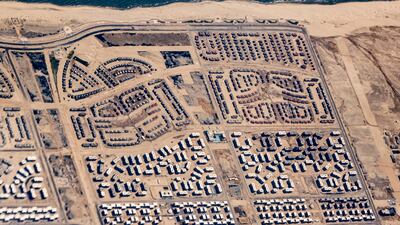

The first phase of New Mansoura, an urban development built on a 15km stretch of Egypt’s norther Mediterranean coast, was inaugurated on Thursday by President Abdel Fattah El Sisi, along with his cabinet.
The city, announced in 2017 as part of a national strategy to construct urban centres in several of Egypt’s rural provinces, is expected to invigorate the Nile Delta’s economy, mainly through boosting tourism and offering access to higher quality education and employment opportunities for the area’s 20.6 million residents.
Building new cities has been a cornerstone of Mr El Sisi's high-octane, multibillion-dollar drive to overhaul the country's infrastructure, provide affordable housing and safer roads. But the Egyptian leader on Thursday warned that the work of his government could well be in vain if the country's rapid population growth is not arrested.

“We are not trying to frighten anyone when we say that this population growth will eat up the country,” he said. “I don't think anyone can do as much as what we are doing.”
The first phase of the project, which cost 45 billion Egyptian pounds ($1.8 billion), was completed this year and consists of 19,500 housing units, 90 per cent of which will accommodate middle and low-income families, with the remainder being luxury homes.
As part of the first phase, two hotels also began operating this month in New Mansoura.
When complete, after three additional phases, the city is expected to absorb 1.5 million residents, and the first phase accounts for 40 per cent of that.
“Today we are in New Mansoura to reap one of the rewards of the New Republic plans to boost the economy,” Assem El Gazzar, the housing minister, said at the inauguration ceremony.
Mr El Gazzar said the priority for the government was to develop the area’s infrastructure to attract investors into more of Egypt’s provinces, many of which are underdeveloped following years of “government neglect”, as per Mr El Sisi's description.
“We are truly building a new republic, because when there is a strong infrastructure, it will promote investments into these cities which will in turn improve the lives of those who live in or around them,” Mr El Gazzar said.
The minister said that urban communities worldwide generate 70-75 per cent of a given country’s gross domestic product (GDP), which highlights the pressing need to urbanise more of Egypt’s agricultural provinces to enable them to contribute more meaningfully to economic growth.
As it stands, the Nile Delta is 72 per cent rural, which the minister said is why the area has high unemployment levels.
Two schools and four universities were also opened as part of the first phase, and they have begun enrolling students from nearby provinces, Mr El Gazzar said.
New Mansoura is 54km north of Mansoura, the largest city of Egypt’s Daqahliyah province.
The Nile Delta is Egypt’s second most densely populated region after Greater Cairo.
Rail, entertainment and water
An electric train is expected to be launched in a later phase of development that will transport passengers between the two Mansouras in under 15 minutes.
When completed, the city will also be equipped with a number of smart features including solar-panelled roofs and a smart surveillance system which will connect to a central command centre, much like the New Administrative Capital, another of Mr El Sisi’s urban developments which has become a divisive project in his two-term presidency.
Twenty-five per cent of New Mansoura will be made up of green spaces, according to Mr El Gazzar, who added that sustainability was one the project’s top priorities. This translates into 12.6 square metres of green spaces per resident, he said.
Additionally, the city was built 2m above sea level to accommodate the Mediterranean's rising waters, a pressing environmental concern for Egypt.
To accommodate its growing population, Egypt must construct 600,000 new homes every year, Mr El Gazzar said, adding that since 2014, 100 billion Egyptian pounds (about $4 billion) had been spent on public service infrastructure alone for the 30 new cities the government has started building since then.
Since 2014, 333 billion Egyptian pounds has been spent on building the cities themselves, the minister said, without specifying how much of that came from the country's coffers and how much came from private-sector investment.
Mr El Sisi interrupted Mr El Gazzar’s address on Thursday to stress the direness of the country’s population problem.
“When we say that overpopulation is going to ravage this country, we are not just trying to scare you, we are saying this to get all the country’s institutions, especially its religious authorities, to help us combat this problem,” Mr El Sisi said. “With this level of population growth and the resources available to us, we are definitely ill-equipped.”
Mr El Sisi also took a moment to answer criticisms of his construction-heavy national strategy, which has contributed significantly to the country’s debt.
“There are people who wonder why we are building roads and bridges instead of feeding people. If I were to do this, it would be an injustice not just for this generation but also for the next one,” Mr El Sisi said.
“The only way for us is patience and work, only patience and work. The only other option is to let this country deteriorate and just accept that it won’t make a difference anyway.”
Mr El Gazzar highlighted how New Mansoura’s beaches will be open to all with no preference given to more affluent Egyptians, as is the case in other prominent Egyptian beach resorts on the Mediterranean.
A number of recreational and entertainment facilities have also been launched under the first phase that “the area’s residents might not have seen the likes of” in the past, the minister said.
Furthermore, the city will house the Nile Delta’s first desalination plant, which was announced in 2019 and built by Hassan Allam Developments, one of the Sisi administration’s most prolific private-sector developer partners.
The plant is expected to generate 40,000 cubic metres of water per day when completed.
Mr El Sisi said that he plans to increase the number of desalination plants to provide water for agriculture and residential use in provinces on the coast.
He said that ideally the Nile’s waters, which are under threat of dwindling with the construction of the Grand Ethiopian Renaissance Dam, will be directed to the country’s inland provinces, while coastal provinces can cover their water needs from desalination plants.
“Our population is growing every day and we need to find viable sources of water for them to use,” Mr El Sisi said. “These plans were the product of years of study, we had scientists and experts study how best to construct the desalination plants.”

