



Today may be voting day in Israel, but after five elections in three years there is little public enthusiasm for the contest to be found on the streets of Jerusalem.
If all voters in Israel's election were like Naomi, though, turnout would be sky-high. The 22-year-old architecture student, who grew up in France, is full of energy, even though she has been up since the early morning.
It was her passion for the far-right Religious Zionism party, particularly its most famous politician, Itamar Ben-Gvir, that got her out of bed. “He stands for what people actually believe deep down. Only he has the courage to say it, particularly about terrorism.”
Outside a polling station on central Jerusalem's Hillel Street, Naomi and her fellow volunteers are manning a gazebo plastered with images of Mr Ben-Gvir. “I have already voted, but my friend here can't. He's 17, which makes him too young.”
-
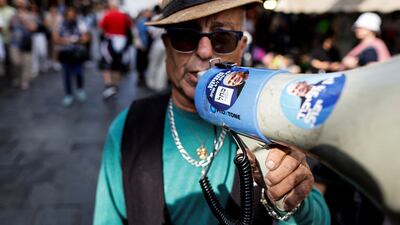
A supporter of former Israeli prime minister Benjamin Netanyahu's Likud party on the campaign trail at Mahane Yehuda market in Jerusalem on polling day's eve. Reuters -
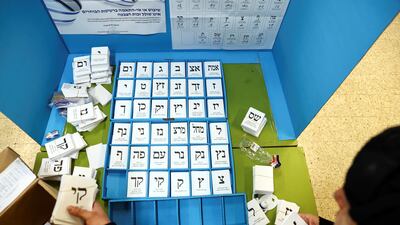
Officials sort ballot papers before a polling station opens to the voters of Kiryat Arba, a Jewish settlement in Hebron in the Israeli-occupied West Bank. Reuters -

Far-right politician Itamar Ben-Gvir at the ballot box on general election day in Kiryat Arba, a Jewish settlement in Hebron in the Israeli-occupied West Bank. Reuters -
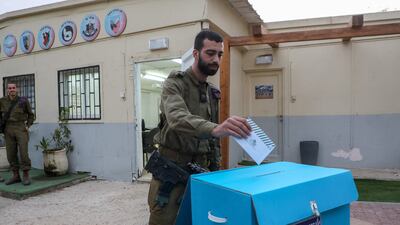
An Israeli soldier casts a ballot at Kerem Shalom Army Base in the south of Israel, close to the border with the Gaza strip. AFP -
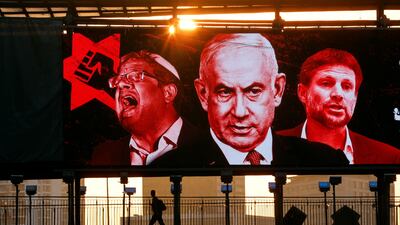
An election campaign billboard by Blue and White party on a bridge in Ramat Gan, Tel Aviv. Reuters -
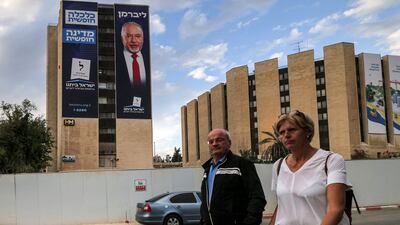
A billboard for Finance Minister Avigdor Lieberman's Yisrael Beiteinu party in Jerusalem. AFP -
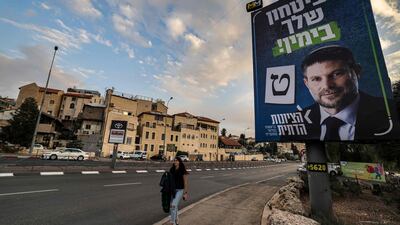
An billboard for the far-right Religious Zionist party led by Bezalel Smotrich. AFP -
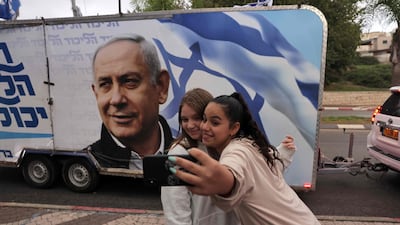
An election campaign bandwagon and a chance for a selfie as Benjamin Netanyahu aims to return Likud to power. AFP -

Itamar Ben-Gvir, Israeli far-right politician and leader of the Otzma Yehudit (Jewish power) party, greets supporters. AFP -

Israelis hang a poster of Likud party candidate Benjamin Netanyahu in the southern city of Beersheva in the run up to Israel's election on November 1. AFP -
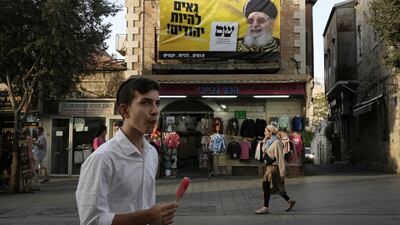
A popsicle break beneath an election campaign hoarding for Israel's ultra-Orthodox Shas political party near Mahane Yehuda market in Jerusalem. Israelis are back at the polls for a fifth time in less than four years. AP -
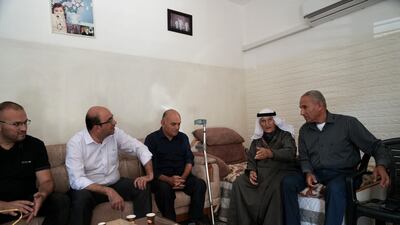
Knesset member Sami Abu Shehadeh, second left, head of the nationalist Balad party, meets Israel's Palestinian citizens during his election campaign tour in Musmus village. AP -
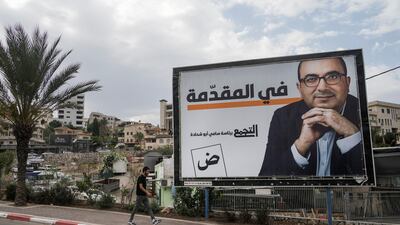
An election hoarding for Sami Abu Shehadeh's Balad party campaign in Umm Al Fahm. Israel’s Palestinian citizens could be central to breaking the country’s political deadlock. AP -
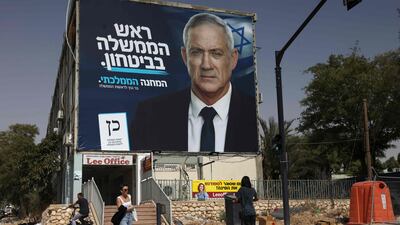
A campaign poster of National Unity Party leader Benny Gantz in the southern city of Beersheva. AFP -
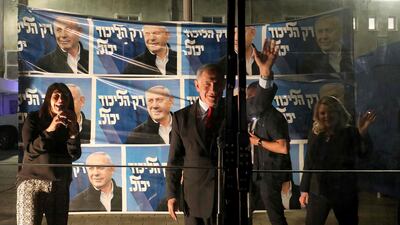
Benjamin Netanyahu addresses supporters from behind a security screen beside his wife Sara, right, and Likud member Miri Regev during a campaign rally in the northern city of Tirat Carmel. AFP -
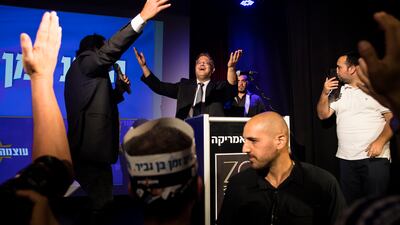
Itamar Ben-Gvir, Israeli far-right politician and leader of the Otzma Yehudit, at an event in Tel Aviv. Getty -
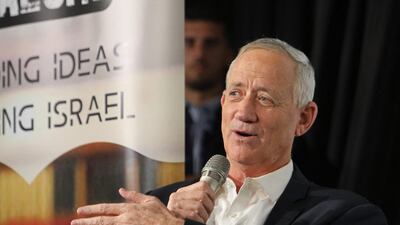
National Unity leader Benny Gantz makes an address in Tel Aviv. AFP -
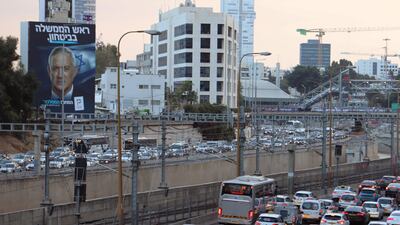
Since 2019, Israel has had four inconclusive elections, which resulted in two short-lived coalition governments. AFP -
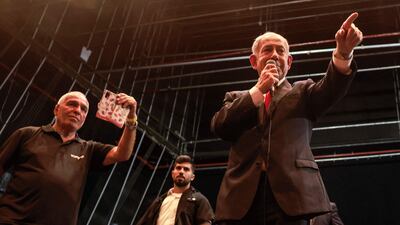
Likud's Benjamin Netanyahu speaks at a campaign rally at Migdal HaEmek in the Northern District of Israel. AFP -
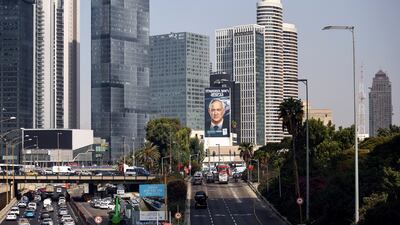
A giant image of National Unity's Benny Gantz looks over one of the motorways into Tel Aviv. Reuters -
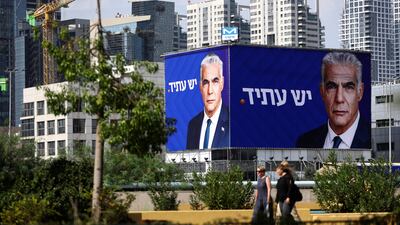
Israeli Prime Minister Yair Lapid leads a fragmented coalition spanning left to right. Reuters -
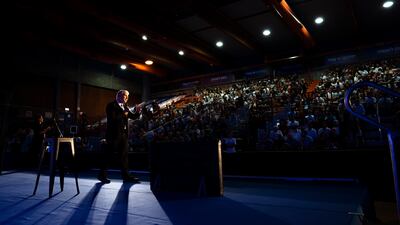
Polls suggest Prime Minister Yair Lapid's camp is set for a weaker showing than in the last election. AP -
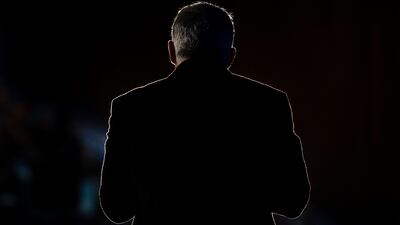
Prime Minister Yair Lapid speaks at an event in the city of Rishon Lezion in Gush Dan. AP -
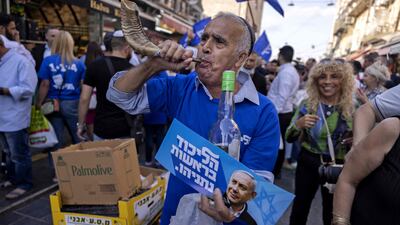
In Jerusalem, a Netanyahu supporter blows a shofar, made of a ram's horn. AFP -
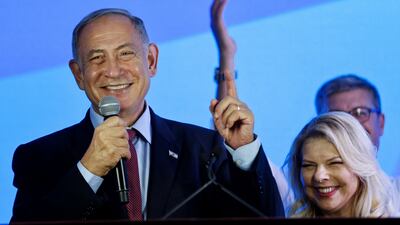
Benjamin Netanyahu has pledged to form a 'strong, stable and national' government. Reuters -
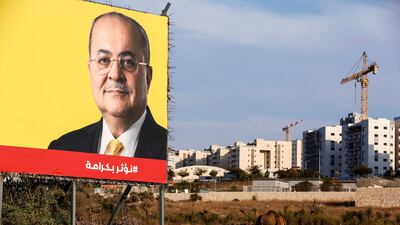
A poster of Arab politician Ahmad Tibi of the Ta'al party in his home town of Taibe in Gilboa region. Reuters


But away from the buzz around Mr Ben-Gvir, whose increasingly noisy and extreme input could prove instrumental in putting former prime minister Benjamin Netanyahu back in power, interest is distinctly patchy.
In a cafe a few minutes' walk away, music producer Ephraim, 35, is having a coffee opposite a particularly busy polling station. He is an example of how these elections could pass some Israelis by altogether. “Oh, that's why it is so lively,” he says, after he told why the area is crowded. “I didn't even realise people were voting there,” he says, listlessly.
Ephraim is not voting this time. “It's pointless, nothing changes and there will probably be another one in a few months.”
The barista of the cafe, Zahar, 24, was planning on voting, although she did not seem quite sure. “I'll probably vote for Labour after work,” she says hesitantly.
Her party is one of a number on Israel's left that are struggling to get noticed this time round. Liberal messages are going out of fashion as the right seizes momentum. Despite Zahar's lack of enthusiasm, she is nonetheless angry that everyone is talking about her ideological opponents. “It's depressing how many people my age like him,” she says about Mr Ben-Gvir's appeal.
Nearby, a group of women, who did not want to be named, were campaigning for the ultraorthodox Shas party. “Shas is a gift from God. Other parties are just politics. Shas is perfect!” Traditional religious parties such as theirs can always rely on a high turnout. Rabbis tell their communities how to vote, and the majority listen.
Despite this, the situation is still better than many politically engaged Israelis had feared.
Communications strategist Jason, 40, describes himself as living in “middle class, middle Israel suburbia city”. He reported a “steady flow” of voters at polling stations throughout his politically diverse neighbourhood.
The data seemed to be backing him up. Cumulative turnout figures were released every two hours. By 4pm they had reached 47.5 per cent, the highest level since 1999.
The data does not show who is voting. In Israel's complex system of proportional representation, this detail is key, particularly when it comes to the Arab vote, which this time round has been cast as the most troubled and important bloc of all.

While turnout overall may be on the high side, in Arab areas it will, as ever, be depressed, even though their vote could be pivotal in stopping a government led by Mr Netanyahu, which would probably include extreme-right, anti-Arab ministers.
As polls begin to close and campaigners pack up stands and move towards party headquarters, the picture from the streets is a mixed one and the drama is far from over.
The nature of a new government will not be clear for days. Israel may not even get one at all. In that case, the country can expect to see the same banners, the same politicians and the same mixed emotions in just a few months' time, in yet another election.
Ephraim at the cafe says that if that happens, more Israelis will give up voting like he has. “I want them to stop taking place, not because I care about politics, but because they are so expensive.” He will get an answer soon.

