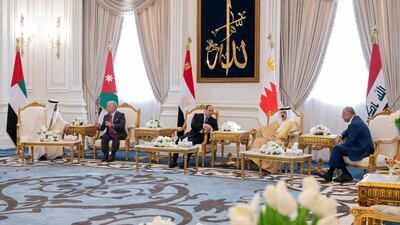
• Sheikh Mohamed meets with, from left, Bahrain's King Hamad, Jordan's King Abdullah II and Mr El Sisi, at El Alamein Presidential Palace in New Alamein. Ryan Carter / UAE Presidential Court
    Sheikh Mohamed meets with, from left, Bahrain's King Hamad, Jordan's King Abdullah II and Mr El Sisi, at El Alamein Presidential Palace in New Alamein. Ryan Carter / UAE Presidential Court
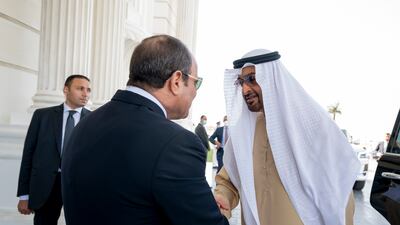
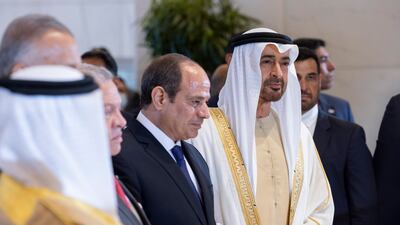
  • Sheikh Mohamed and Mr El Sisi exchange greetings. Mohamed Al Hammadi / UAE Presidential Court
    Sheikh Mohamed and Mr El Sisi exchange greetings. Mohamed Al Hammadi / UAE Presidential Court
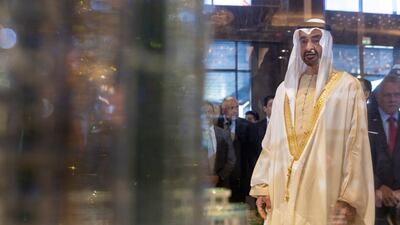
  • President Sheikh Mohamed is received by Egypt's President Abdel Fattah El Sisi, before a meeting at the El Alamein Presidential Palace, at New Alamein, on Egypt's Mediterranean coast. Hamad Al Kaabi / UAE Presidential Court
    President Sheikh Mohamed is received by Egypt's President Abdel Fattah El Sisi, before a meeting at the El Alamein Presidential Palace, at New Alamein, on Egypt's Mediterranean coast. Hamad Al Kaabi / UAE Presidential Court
  • Sheikh Hazza greets Mr El Sisi at the presidential palace, accompanied by Sheikh Mansour and Sheikh Mohamed. Hamad Al Kaabi / UAE Presidential Court
    Sheikh Hazza greets Mr El Sisi at the presidential palace, accompanied by Sheikh Mansour and Sheikh Mohamed. Hamad Al Kaabi / UAE Presidential Court
  • Sheikh Mansour and Sheikh Hazza at El Alamein Presidential Palace. Hamad Al Kaabi / UAE Presidential Court
    Sheikh Mansour and Sheikh Hazza at El Alamein Presidential Palace. Hamad Al Kaabi / UAE Presidential Court
  • From right, Sheikh Mohamed bin Hamad, Sheikh Abdullah, Sheikh Mansour and Sheikh Hazza at El Alamein Presidential Palace. Ryan Carter / UAE Presidential Court
    From right, Sheikh Mohamed bin Hamad, Sheikh Abdullah, Sheikh Mansour and Sheikh Hazza at El Alamein Presidential Palace. Ryan Carter / UAE Presidential Court
  • From right, Dr Anwar Gargash, Diplomatic Adviser to the President, Sheikh Mohamed bin Hamad, Sheikh Abdullah, Sheikh Mansour and Sheikh Hazza at the presidential palace. Hamad Al Kaabi / UAE Presidential Court
    From right, Dr Anwar Gargash, Diplomatic Adviser to the President, Sheikh Mohamed bin Hamad, Sheikh Abdullah, Sheikh Mansour and Sheikh Hazza at the presidential palace. Hamad Al Kaabi / UAE Presidential Court
  • Sheikh Abdullah, Sheikh Mansour and Sheikh Hazza greet Mr El Sisi before a meeting. Hamad Al Kaabi / UAE Presidential Court
    Sheikh Abdullah, Sheikh Mansour and Sheikh Hazza greet Mr El Sisi before a meeting. Hamad Al Kaabi / UAE Presidential Court
  • The meeting was hailed as an opportunity to enhance inter-Arab partnerships. Ryan Carter / UAE Presidential Court
    The meeting was hailed as an opportunity to enhance inter-Arab partnerships. Ryan Carter / UAE Presidential Court
  • Sheikh Mohamed poses with King Hamad, Mr El Sisi and King Abdullah, with New Alamein's coast in the background. Ryan Carter / UAE Presidential Court
    Sheikh Mohamed poses with King Hamad, Mr El Sisi and King Abdullah, with New Alamein's coast in the background. Ryan Carter / UAE Presidential Court
  • Sheikh Mohamed at a private meeting with Mr El Sisi, King Hamad and King Abdullah II at El Alamein Presidential Palace. Ryan Carter / UAE Presidential Court
    Sheikh Mohamed at a private meeting with Mr El Sisi, King Hamad and King Abdullah II at El Alamein Presidential Palace. Ryan Carter / UAE Presidential Court

Leaders of UAE, Egypt, Bahrain, Jordan and Iraq meet in mini Arab summit


Hamza Hendawi
  • English
  • Arabic

The leaders of the UAE, Egypt, Bahrain, Jordan and Iraq met on Tuesday on Egypt’s Mediterranean coast for a mini Arab summit that has been hailed as an opportunity to enhance inter-Arab partnerships.

President Sheikh Mohamed arrived in the coastal city of New Alamein on Sunday, where he and Egyptian President Abdel Fattah El Sisi. They were joined on Monday by Bahrain's King Hamad, Jordan's King Abdullah II and Iraqi Prime Minister Mustafa Al Kadhimi.

On Tuesday, the UAE President, Mr El Sisi, King Abdullah and King Hamad took part in “El Alamein Meeting”.

“I was pleased to participate alongside the leaders of Egypt, Bahrain and Jordan in a productive meeting in El Alamein, Egypt,” said Sheikh Mohamed. “The UAE continues to co-ordinate with its Arab neighbours to promote stability, development and prosperity in the region.”

During the meeting, the leaders discussed co-operation, including economic and development partnerships, a statement from state news agency Wam said.

“The leaders renewed their support for any effort and endeavour aimed at enhancing peace, stability and joint co-operation … to achieve the aspirations of the people of the region for progress, prosperity and development,” it said.

They also discussed the latest regional and international developments, emphasising further talks to boost stability and prosperity in the region.

The Egyptian president also hosted a lunch attended by Sheikh Mohamed, King Hamad and King Abdullah.

Among those who attended the banquet were Sheikh Hazza bin Zayed, Deputy Chairman of Abu Dhabi Executive Council; Sheikh Mansour bin Zayed, Deputy Prime Minister and Minister of Presidential Affairs; Sheikh Abdullah bin Zayed, Minister of Foreign Affairs and International Co-operation; Sheikh Zayed bin Mohamed; and Sheikh Mohammed bin Hamad, Adviser for Special Affairs at the Presidential Court.

Also in attendance were Dr Sultan Al Jaber, Minister of Industry and Advanced Technology; Dr Anwar Gargash, Diplomatic Adviser to the President; Ali Al Shamsi, deputy secretary general of the Supreme National Security Council; and Humaid Abushibs, chairman of the Abu Dhabi Accountability Authority.

The five leaders met informally on Monday and “exchanged views on ways to strengthen bilateral relations and co-operation” between their countries, the Egyptian presidency said.

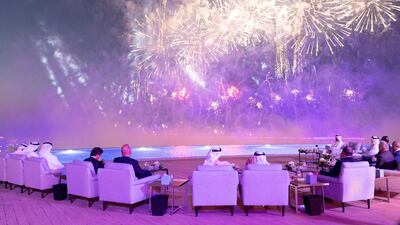
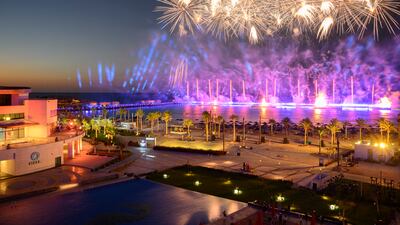
Later on Monday, the leaders inaugurated a luxury seaside resort at New Alamein, one of about a dozen new cities built since Mr El Sisi took office in 2014. A massive display of fireworks marked the occasion.

They met again on Tuesday before the Iraqi prime minister cut short his stay and flew home to deal with the latest development in his country’s months-old political crisis, the Egyptian presidency reported.

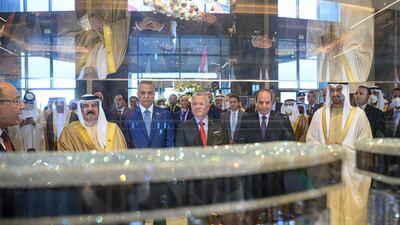
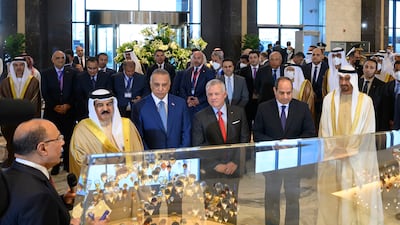
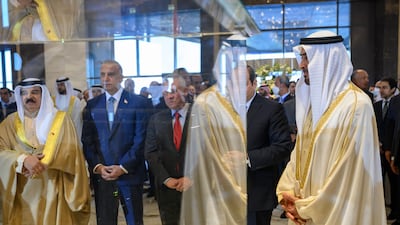
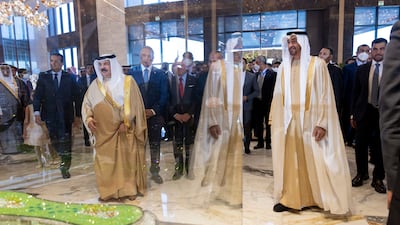
  • President Sheikh Mohamed, King Abdullah II of Jordan, Egyptian President Abdel Fattah El Sisi, King Hamad of Bahrain and Iraqi Prime Minister Mustafa Al Kadhimi view a model of a resort in El Alamein, Egypt, which was inaugurated on August 24. All photos: UAE Presidential Court
    President Sheikh Mohamed, King Abdullah II of Jordan, Egyptian President Abdel Fattah El Sisi, King Hamad of Bahrain and Iraqi Prime Minister Mustafa Al Kadhimi view a model of a resort in El Alamein, Egypt, which was inaugurated on August 24. All photos: UAE Presidential Court
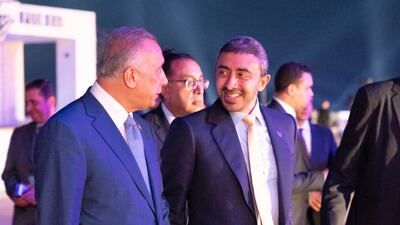
  • Sheikh Mohamed, King Abdullah, King Hamad, Mr El Sisi and Mr Al Kadhimi attend a reception at El Alamein International Airport.
    Sheikh Mohamed, King Abdullah, King Hamad, Mr El Sisi and Mr Al Kadhimi attend a reception at El Alamein International Airport.
  • Sheikh Mohamed is received by Mr El Sisi before the reception at El Alamein International Airport.
    Sheikh Mohamed is received by Mr El Sisi before the reception at El Alamein International Airport.
  • Sheikh Mohamed views a model of the Regal Heights Hotel during the hotel's inauguration ceremony.
    Sheikh Mohamed views a model of the Regal Heights Hotel during the hotel's inauguration ceremony.
  • Sheikh Mansour bin Zayed, UAE Deputy Prime Minister and Minister of the Presidential Court, and Sheikh Nasser bin Hamed, a prominent member of the Bahraini royal family, at the inauguration ceremony.
    Sheikh Mansour bin Zayed, UAE Deputy Prime Minister and Minister of the Presidential Court, and Sheikh Nasser bin Hamed, a prominent member of the Bahraini royal family, at the inauguration ceremony.
  • President Sheikh Mohamed views a model of the Regal Heights.
    President Sheikh Mohamed views a model of the Regal Heights.
  • Sheikh Mohamed, King Abdullah, King Hamad, Mr El Sisi and Mr Al Kadhimi look at a model of the Regal Heights Hotel.
    Sheikh Mohamed, King Abdullah, King Hamad, Mr El Sisi and Mr Al Kadhimi look at a model of the Regal Heights Hotel.
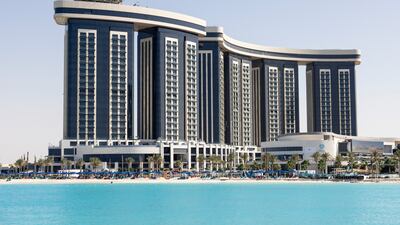
  • The newly opened Regal Heights Hotel.
    The newly opened Regal Heights Hotel.
  • Sheikh Hazza bin Zayed, Deputy Chairman of the Abu Dhabi Executive Council, with Jordanian Prime Minister Bisher Al Khasawneh during the inauguration ceremony.
    Sheikh Hazza bin Zayed, Deputy Chairman of the Abu Dhabi Executive Council, with Jordanian Prime Minister Bisher Al Khasawneh during the inauguration ceremony.
  • Sheikh Mohamed and Mr El Sisi look at the model of the Regal Heights Hotel.
    Sheikh Mohamed and Mr El Sisi look at the model of the Regal Heights Hotel.
  • Sheikh Mohamed and Mr El Sisi look at the model of the Regal Heights Hotel.
    Sheikh Mohamed and Mr El Sisi look at the model of the Regal Heights Hotel.
  • Sheikh Mohamed, King Abdullah, King Hamad, Mr El Sisi and Mr Al Kadhimi at the ceremony.
    Sheikh Mohamed, King Abdullah, King Hamad, Mr El Sisi and Mr Al Kadhimi at the ceremony.
  • President Sheikh Mohamed and King Hamad view the model.
    President Sheikh Mohamed and King Hamad view the model.
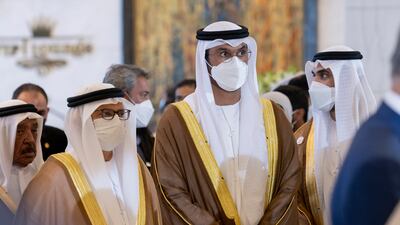
  • Dr Sultan Al Jaber, Minister of Industry and Advanced Technology, and Dr Anwar Gargash, diplomatic adviser to the President, at the inauguration ceremony in Egypt.
    Dr Sultan Al Jaber, Minister of Industry and Advanced Technology, and Dr Anwar Gargash, diplomatic adviser to the President, at the inauguration ceremony in Egypt.
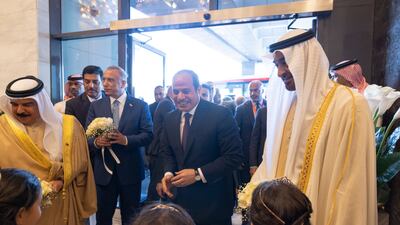
  • Sheikh Mohamed, King Hamad and Mr Al Kadhimi receive flowers as Mr El Sisi watches on.
    Sheikh Mohamed, King Hamad and Mr Al Kadhimi receive flowers as Mr El Sisi watches on.
  • Sheikh Abdullah, right, speaks with Prime Minister Al Kadhimi.
    Sheikh Abdullah, right, speaks with Prime Minister Al Kadhimi.
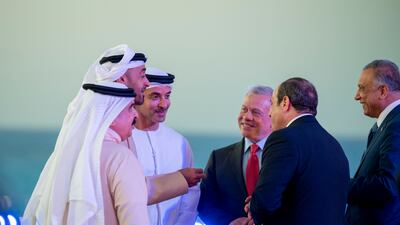
  • President Sheikh Mohamed speaks with King Hamad of Bahrain, left, Sheikh Hazza bin Zayed Al Nahyan, Vice Chairman of the Abu Dhabi Executive Council, third left, King Abdullah II of Jordan, Egyptian President Abdel Fattah El Sisi and Iraqi Prime Minister Mustafa Al Kadhimi during the inauguration ceremony.
    President Sheikh Mohamed speaks with King Hamad of Bahrain, left, Sheikh Hazza bin Zayed Al Nahyan, Vice Chairman of the Abu Dhabi Executive Council, third left, King Abdullah II of Jordan, Egyptian President Abdel Fattah El Sisi and Iraqi Prime Minister Mustafa Al Kadhimi during the inauguration ceremony.
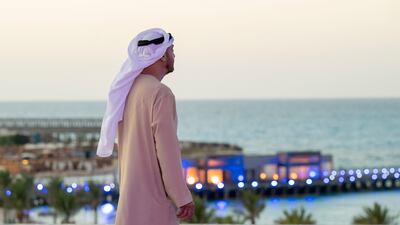
  • Sheikh Mohamed takes in the view from the Regal Heights hotel.
    Sheikh Mohamed takes in the view from the Regal Heights hotel.
  • A fireworks display brings the inauguration ceremony to a close.
    A fireworks display brings the inauguration ceremony to a close.
  • The dazzling display lights up the night sky.
    The dazzling display lights up the night sky.

Mr Al Kadhimi decided to leave following the escalation of protests in Baghdad, with followers of powerful Shiite cleric Moqtada Al Sadr starting a sit-in outside the Supreme Judiciary Council inside the Iraqi capital's Green Zone, home to government offices, judicial complexes and foreign embassies.

The prime minister returned home “to directly monitor the performance of the security forces in protecting the state's institutions and the judiciary”, his office said.

Mr El Sisi saw the Iraqi leader off at Alamein airport, the Egyptian presidency said.

Tuesday's meeting in New Alamein comes at a time when many Arab countries — including Egypt and Jordan — are struggling to cope with the economic impact of the Russia-Ukraine war.

The conflict, involving two of the world's biggest grain producers, has caused food and energy prices to rise steeply.

The Egyptian presidency said the five leaders on Tuesday discussed “all aspects of joint co-operation”.

It added: “The leaders also renewed their support to all efforts and endeavours that aim at deepening security, peace, stability and co-operation on all levels.

“The five leaders also reviewed and exchanged views on a number of regional and international issues.”

The statement by the Egyptian presidency did not elaborate but state media and diplomatic sources familiar with the agenda of the talks said the leaders' discussions dealt with economic co-operation and national security as well as regional and international issues.

State-owned Egyptian daily Al Ahram reported that they also discussed the dispute pitting Egypt and Sudan against Ethiopia over its nearly completed dam on the Blue Nile.

The $4.2 billion Grand Ethiopian Renaissance Dam, set to be the largest hydroelectric project in Africa, has been at the centre of a regional dispute since Ethiopia broke ground on the project in 2011.

Egypt and Sudan want Ethiopia to enter a legally binding agreement on the operation and filling of the dam. Addis Ababa has rejected their demand, arguing that guidelines should suffice.

The wars in Yemen, Syria and Libya, as well as the Israeli-Palestinian conflict, were also on the agenda, according to Al Ahram.

Iraq is the only country among the five summit participants that does not recognise Israel.

Egypt made peace with Israel in 1979, Jordan signed a peace treaty in 1994, and the UAE and Bahrain normalised ties with the country in 2020.

“This summit gives Arab citizens a dose of optimism that the time has come for serious joint Arab action,” said Egyptian political analyst and retired diplomat Mustafa Al Fiqi.

Egypt's former assistant foreign minister, Mohamed Hegazy, now a political commentator, said the summit “offers a glimpse of hope to Arab nations because it aims to reach Arab solutions for the crises besetting the region”.

“We are entering a phase of serious inter-Arab co-operation,” said political analyst Sobhy Aseela.

“This one is for security, economic and political integration for everyone's benefit,” he added, referring to the summit in New Alamein.

A significant level of co-operation among the five nations is already in place.

Last month, Bahrain joined the Industrial Partnership for Sustainable Economic Development that had previously comprised the UAE, Egypt and Jordan.

The agreement boosts the industrial manufacturing value of the informal alliance to more than $112.5bn.

The partnership aims to establish large, joint industrial projects, create job opportunities, contribute to a growth in economic output, diversify the economies of partner countries, support industrial production and boost exports, said officials.


Various Artists 
Habibi Funk: An Eclectic Selection Of Music From The Arab World (Habibi Funk)
​​​​​​​

BLACK%20ADAM
%3Cp%3E%3Cstrong%3EDirector%3A%3C%2Fstrong%3E%20Jaume%20Collet-Serra%3C%2Fp%3E%0A%3Cp%3E%3Cstrong%3EStars%3A%3C%2Fstrong%3E%20Dwayne%20Johnson%2C%20Sarah%20Shahi%2C%20Viola%20Davis%2C%20Pierce%20Brosnan%3C%2Fp%3E%0A%3Cp%3E%3Cstrong%3ERating%3A%20%3C%2Fstrong%3E3%2F5%3C%2Fp%3E%0A
T20 World Cup Qualifier

Final: Netherlands beat PNG by seven wickets

Qualified teams

1. Netherlands
2. PNG
3. Ireland
4. Namibia
5. Scotland
6. Oman

T20 World Cup 2020, Australia

Group A: Sri Lanka, PNG, Ireland, Oman
Group B: Bangladesh, Netherlands, Namibia, Scotland

Our legal consultants

Name: Hassan Mohsen Elhais

Position: legal consultant with Al Rowaad Advocates and Legal Consultants.

COMPANY%20PROFILE%20
%3Cp%3EName%3A%20DarDoc%3Cbr%3EBased%3A%20Abu%20Dhabi%3Cbr%3EFounders%3A%20Samer%20Masri%2C%20Keswin%20Suresh%3Cbr%3ESector%3A%20HealthTech%3Cbr%3ETotal%20funding%3A%20%24800%2C000%3Cbr%3EInvestors%3A%20Flat6Labs%2C%20angel%20investors%20%2B%20Incubated%20by%20Hub71%2C%20Abu%20Dhabi's%20Department%20of%20Health%3Cbr%3ENumber%20of%20employees%3A%2010%3C%2Fp%3E%0A
The specs

Engine: 4.0-litre V8 twin-turbocharged and three electric motors

Power: Combined output 920hp

Torque: 730Nm at 4,000-7,000rpm

Transmission: 8-speed dual-clutch automatic

Fuel consumption: 11.2L/100km

On sale: Now, deliveries expected later in 2025

Price: expected to start at Dh1,432,000

Sweet%20Tooth
%3Cp%3E%3Cstrong%3ECreator%3A%20%3C%2Fstrong%3EJim%20Mickle%3Cbr%3E%3Cstrong%3EStarring%3A%20%3C%2Fstrong%3EChristian%20Convery%2C%20Nonso%20Anozie%2C%20Adeel%20Akhtar%2C%20Stefania%20LaVie%20Owen%3Cbr%3E%3Cstrong%3ERating%3A%20%3C%2Fstrong%3E2.5%2F5%3C%2Fp%3E%0A
UAE currency: the story behind the money in your pockets
Fresh faces in UAE side

Khalifa Mubarak (24) An accomplished centre-back, the Al Nasr defender’s progress has been hampered in the past by injury. With not many options in central defence, he would bolster what can be a problem area.

Ali Salmeen (22) Has been superb at the heart of Al Wasl’s midfield these past two seasons, with the Dubai club flourishing under manager Rodolfo Arrubarrena. Would add workrate and composure to the centre of the park.

Mohammed Jamal (23) Enjoyed a stellar 2016/17 Arabian Gulf League campaign, proving integral to Al Jazira as the capital club sealed the championship for only a second time. A tenacious and disciplined central midfielder.

Khalfan Mubarak (22) One of the most exciting players in the UAE, the Al Jazira playmaker has been likened in style to Omar Abdulrahman. Has minimal international experience already, but there should be much more to come.

Jassim Yaqoub (20) Another incredibly exciting prospect, the Al Nasr winger is becoming a regular contributor at club level. Pacey, direct and with an eye for goal, he would provide the team’s attack an extra dimension.

World record transfers

1. Kylian Mbappe - to Real Madrid in 2017/18 - €180 million (Dh770.4m - if a deal goes through)
2. Paul Pogba - to Manchester United in 2016/17 - €105m
3. Gareth Bale - to Real Madrid in 2013/14 - €101m
4. Cristiano Ronaldo - to Real Madrid in 2009/10 - €94m
5. Gonzalo Higuain - to Juventus in 2016/17 - €90m
6. Neymar - to Barcelona in 2013/14 - €88.2m
7. Romelu Lukaku - to Manchester United in 2017/18 - €84.7m
8. Luis Suarez - to Barcelona in 2014/15 - €81.72m
9. Angel di Maria - to Manchester United in 2014/15 - €75m
10. James Rodriguez - to Real Madrid in 2014/15 - €75m

Living in...

This article is part of a guide on where to live in the UAE. Our reporters will profile some of the country’s most desirable districts, provide an estimate of rental prices and introduce you to some of the residents who call each area home.

What sanctions would be reimposed?

Under ‘snapback’, measures imposed on Iran by the UN Security Council in six resolutions would be restored, including:

  • An arms embargo
  • A ban on uranium enrichment and reprocessing
  • A ban on launches and other activities with ballistic missiles capable of delivering nuclear weapons, as well as ballistic missile technology transfer and technical assistance
  • A targeted global asset freeze and travel ban on Iranian individuals and entities
  • Authorisation for countries to inspect Iran Air Cargo and Islamic Republic of Iran Shipping Lines cargoes for banned goods
Indoor cricket in a nutshell

Indoor Cricket World Cup - Sep 16-20, Insportz, Dubai

16 Indoor cricket matches are 16 overs per side

8 There are eight players per team

There have been nine Indoor Cricket World Cups for men. Australia have won every one.

5 Five runs are deducted from the score when a wickets falls

Batsmen bat in pairs, facing four overs per partnership

Scoring In indoor cricket, runs are scored by way of both physical and bonus runs. Physical runs are scored by both batsmen completing a run from one crease to the other. Bonus runs are scored when the ball hits a net in different zones, but only when at least one physical run is score.

Zones

A Front net, behind the striker and wicketkeeper: 0 runs

B Side nets, between the striker and halfway down the pitch: 1 run

Side nets between halfway and the bowlers end: 2 runs

Back net: 4 runs on the bounce, 6 runs on the full

Key facilities
  • Olympic-size swimming pool with a split bulkhead for multi-use configurations, including water polo and 50m/25m training lanes
  • Premier League-standard football pitch
  • 400m Olympic running track
  • NBA-spec basketball court with auditorium
  • 600-seat auditorium
  • Spaces for historical and cultural exploration
  • An elevated football field that doubles as a helipad
  • Specialist robotics and science laboratories
  • AR and VR-enabled learning centres
  • Disruption Lab and Research Centre for developing entrepreneurial skills
Cryopreservation: A timeline
  1. Keyhole surgery under general anaesthetic
  2. Ovarian tissue surgically removed
  3. Tissue processed in a high-tech facility
  4. Tissue re-implanted at a time of the patient’s choosing
  5. Full hormone production regained within 4-6 months
The specs: 2019 Aston Martin DBS Superleggera

Price, base: Dh1.2 million

Engine: 5.2-litre twin-turbo V12

Transmission: Eight-speed automatic

Power: 725hp @ 6,500pm

Torque: 900Nm @ 1,800rpm

Fuel economy, combined:  12.3L / 100km (estimate)

Pakistanis%20at%20the%20ILT20%20
%3Cp%3EThe%20new%20UAE%20league%20has%20been%20boosted%20this%20season%20by%20the%20arrival%20of%20five%20Pakistanis%2C%20who%20were%20not%20released%20to%20play%20last%20year.%20%0D%3Cbr%3E%0D%0D%0D%3Cbr%3E%3Cstrong%3EShaheen%20Afridi%20(Desert%20Vipers)%20%3C%2Fstrong%3E%0D%3Cbr%3ESet%20for%20at%20least%20four%20matches%2C%20having%20arrived%20from%20New%20Zealand%20where%20he%20captained%20Pakistan%20in%20a%20series%20loss.%20%0D%3C%2Fp%3E%0A%3Cp%3E%3Cstrong%3EShadab%20Khan%20(Desert%20Vipers)%20%3C%2Fstrong%3E%0D%3Cbr%3E%0DThe%20leg-spin%20bowling%20allrounder%20missed%20the%20tour%20of%20New%20Zealand%20after%20injuring%20an%20ankle%20when%20stepping%20on%20a%20ball.%20%0D%3C%2Fp%3E%0A%3Cp%3E%3Cstrong%3EAzam%20Khan%20(Desert%20Vipers)%20%3C%2Fstrong%3E%0D%3Cbr%3EPowerhouse%20wicketkeeper%20played%20three%20games%20for%20Pakistan%20on%20tour%20in%20New%20Zealand.%20He%20was%20the%20first%20Pakistani%20recruited%20to%20the%20ILT20.%20%0D%3C%2Fp%3E%0A%3Cp%3E%3Cstrong%3EMohammed%20Amir%20(Desert%20Vipers)%20%3C%2Fstrong%3E%0D%3Cbr%3EHas%20made%20himself%20unavailable%20for%20national%20duty%2C%20meaning%20he%20will%20be%20available%20for%20the%20entire%20ILT20%20campaign.%20%0D%3C%2Fp%3E%0A%3Cp%3E%3Cstrong%3EImad%20Wasim%20(Abu%20Dhabi%20Knight%20Riders)%20%3C%2Fstrong%3E%0D%3Cbr%3EThe%20left-handed%20allrounder%2C%2035%2C%20retired%20from%20international%20cricket%20in%20November%20and%20was%20subsequently%20recruited%20by%20the%20Knight%20Riders.%26nbsp%3B%3C%2Fp%3E%0A
Banned items
Dubai Police has also issued a list of banned items at the ground on Sunday. These include:
  • Drones
  • Animals
  • Fireworks/ flares
  • Radios or power banks
  • Laser pointers
  • Glass
  • Selfie sticks/ umbrellas
  • Sharp objects
  • Political flags or banners
  • Bikes, skateboards or scooters

Mercer, the investment consulting arm of US services company Marsh & McLennan, expects its wealth division to at least double its assets under management (AUM) in the Middle East as wealth in the region continues to grow despite economic headwinds, a company official said.

Mercer Wealth, which globally has $160 billion in AUM, plans to boost its AUM in the region to $2-$3bn in the next 2-3 years from the present $1bn, said Yasir AbuShaban, a Dubai-based principal with Mercer Wealth.

Within the next two to three years, we are looking at reaching $2 to $3 billion as a conservative estimate and we do see an opportunity to do so,” said Mr AbuShaban.

Mercer does not directly make investments, but allocates clients’ money they have discretion to, to professional asset managers. They also provide advice to clients.

“We have buying power. We can negotiate on their (client’s) behalf with asset managers to provide them lower fees than they otherwise would have to get on their own,” he added.

Mercer Wealth’s clients include sovereign wealth funds, family offices, and insurance companies among others.

From its office in Dubai, Mercer also looks after Africa, India and Turkey, where they also see opportunity for growth.

Wealth creation in Middle East and Africa (MEA) grew 8.5 per cent to $8.1 trillion last year from $7.5tn in 2015, higher than last year’s global average of 6 per cent and the second-highest growth in a region after Asia-Pacific which grew 9.9 per cent, according to consultancy Boston Consulting Group (BCG). In the region, where wealth grew just 1.9 per cent in 2015 compared with 2014, a pickup in oil prices has helped in wealth generation.

BCG is forecasting MEA wealth will rise to $12tn by 2021, growing at an annual average of 8 per cent.

Drivers of wealth generation in the region will be split evenly between new wealth creation and growth of performance of existing assets, according to BCG.

Another general trend in the region is clients’ looking for a comprehensive approach to investing, according to Mr AbuShaban.

“Institutional investors or some of the families are seeing a slowdown in the available capital they have to invest and in that sense they are looking at optimizing the way they manage their portfolios and making sure they are not investing haphazardly and different parts of their investment are working together,” said Mr AbuShaban.

Some clients also have a higher appetite for risk, given the low interest-rate environment that does not provide enough yield for some institutional investors. These clients are keen to invest in illiquid assets, such as private equity and infrastructure.

“What we have seen is a desire for higher returns in what has been a low-return environment specifically in various fixed income or bonds,” he said.

“In this environment, we have seen a de facto increase in the risk that clients are taking in things like illiquid investments, private equity investments, infrastructure and private debt, those kind of investments were higher illiquidity results in incrementally higher returns.”

The Abu Dhabi Investment Authority, one of the largest sovereign wealth funds, said in its 2016 report that has gradually increased its exposure in direct private equity and private credit transactions, mainly in Asian markets and especially in China and India. The authority’s private equity department focused on structured equities owing to “their defensive characteristics.”

Specs

Engine: 51.5kW electric motor

Range: 400km

Power: 134bhp

Torque: 175Nm

Price: From Dh98,800

Available: Now

Ten tax points to be aware of in 2026

1. Domestic VAT refund amendments: request your refund within five years

If a business does not apply for the refund on time, they lose their credit.

2. E-invoicing in the UAE

Businesses should continue preparing for the implementation of e-invoicing in the UAE, with 2026 a preparation and transition period ahead of phased mandatory adoption. 

3. More tax audits

Tax authorities are increasingly using data already available across multiple filings to identify audit risks. 

4. More beneficial VAT and excise tax penalty regime

Tax disputes are expected to become more frequent and more structured, with clearer administrative objection and appeal processes. The UAE has adopted a new penalty regime for VAT and excise disputes, which now mirrors the penalty regime for corporate tax.

5. Greater emphasis on statutory audit

There is a greater need for the accuracy of financial statements. The International Financial Reporting Standards standards need to be strictly adhered to and, as a result, the quality of the audits will need to increase.

6. Further transfer pricing enforcement

Transfer pricing enforcement, which refers to the practice of establishing prices for internal transactions between related entities, is expected to broaden in scope. The UAE will shortly open the possibility to negotiate advance pricing agreements, or essentially rulings for transfer pricing purposes. 

7. Limited time periods for audits

Recent amendments also introduce a default five-year limitation period for tax audits and assessments, subject to specific statutory exceptions. While the standard audit and assessment period is five years, this may be extended to up to 15 years in cases involving fraud or tax evasion. 

8. Pillar 2 implementation 

Many multinational groups will begin to feel the practical effect of the Domestic Minimum Top-Up Tax (DMTT), the UAE's implementation of the OECD’s global minimum tax under Pillar 2. While the rules apply for financial years starting on or after January 1, 2025, it is 2026 that marks the transition to an operational phase.

9. Reduced compliance obligations for imported goods and services

Businesses that apply the reverse-charge mechanism for VAT purposes in the UAE may benefit from reduced compliance obligations. 

10. Substance and CbC reporting focus

Tax authorities are expected to continue strengthening the enforcement of economic substance and Country-by-Country (CbC) reporting frameworks. In the UAE, these regimes are increasingly being used as risk-assessment tools, providing tax authorities with a comprehensive view of multinational groups’ global footprints and enabling them to assess whether profits are aligned with real economic activity. 

Contributed by Thomas Vanhee and Hend Rashwan, Aurifer

Sly%20Cooper%20and%20the%20Thievius%20Raccoonus
%3Cp%3E%3Cstrong%3EDeveloper%3A%3C%2Fstrong%3E%20Sucker%20Punch%20Productions%3Cbr%3E%3Cstrong%3EPublisher%3A%3C%2Fstrong%3E%20Sony%20Computer%20Entertainment%3Cbr%3E%3Cstrong%3EConsole%3A%3C%2Fstrong%3E%20PlayStation%202%20to%205%3Cbr%3E%3Cstrong%3ERating%3A%3C%2Fstrong%3E%205%2F5%3C%2Fp%3E%0A
Updated: August 24, 2022, 3:06 AM