Egyptian workshop making replica Kiswas - in pictures
-
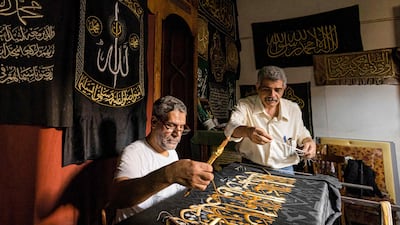
The family of Egyptian embroiderer Ahmed El Kassabgy, right, used to produce the kiswa, the cloth used to cover the Kaaba at the Grand Mosque in Makkah. All photos: AFP -

His family's creations would be sent aboard a camel caravan to Islam's holiest site in western Saudi Arabia, towards which Muslims across the world turn to pray. -

Now the family sews verses from the Quran on replicas of the kiswa that they sell as souvenirs to tourists visiting the historic district of Al Hussein in Cairo. -

From the 13th century, Egyptian artisans made the giant cloth in sections, which authorities transported to Makkah. -

Celebrations would mark the processions through cities, flanked by guards and clerics as Egyptians sprinkled rosewater from balconies above. -

Mr El Kassabgy said 10 craftsmen would work on the kiswa for an entire year. -

His grandfather, Othman Abdelhamid, was the last to supervise a fully Egyptian-made kiswa in 1926. -

From 1927, manufacturing began to move to Makkah in Saudi Arabia, which would fully take over production of the kiswa in 1962. -

Despite this, Mr El Kassabgy says he has stayed loyal to techniques learnt as a child. 'It is on us to uphold the craft the same way we learnt it, so it is authentic to the legacy we inherited,' he says.


Most popular today

