

The UN has released a report on the Iraqi government’s failure to protect protesters and activists over the course of the more than two years since Prime Minister Mustafa Al Kadhimi took office.
Following a bloody October 2019 crackdown on people protesting widespread government corruption, and a lack of jobs and services, former prime minister Adil Abdul Mahdi stepped down.

His successor, Mr Al Kadhimi, pledged to listen to the demands of demonstrators and ensure they would not be attacked by security forces.
But the violence continued nonetheless: in a report released on Thursday, the UN warned of deadly threats that activists often receive, documenting 26 incidents since May 2021 that it said were “aimed at suppressing dissent and criticism carried out by 'unidentified armed elements'".
The report added that the “environment of fear and intimidation” felt by activists and protesters has put a stranglehold on freedom of expression.
Militia influence
Mr Al Kadhimi’s government is now largely powerless, nearly nine months after national elections failed to produce a new government, leaving the sitting prime minister to contend with squabbling factions and no constitutional right to set the legislative agenda.
He has largely been able to rein in vicious crackdowns by official security forces, including the army and police, which characterised the former government's response to the mass protest movement.
During the crackdown, at least 500 protesters and activists were shot dead in the streets of Baghdad, Najaf, Basra and Nasiriyah — much of central and southern Iraq, where there is a Shiite majority.
As many as 100 others, as highlighted by the UN, have been assassinated since the 2019 protests, and analysts widely blame Iran-backed militias.
-
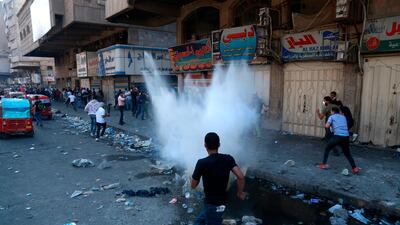
Protesters run for cover while riot police fire tear gas during clashes between Iraqi security forces and anti-government protesters in Baghdad, Iraq. AP Photo -
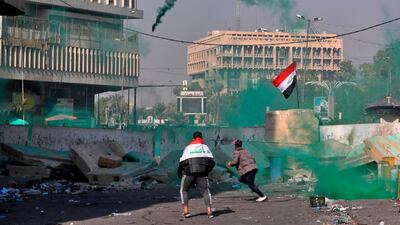
Riot police fire tear gas and smoke bombs during clashes between Iraqi security forces and anti-government protesters in Baghdad, Iraq. AP Photo -
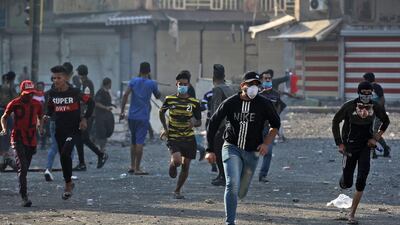
Iraqi protesters clash with Iraqi security forces at Baghdad's Khallani square during ongoing anti-government demonstrations on November 11, 2019. AFP -
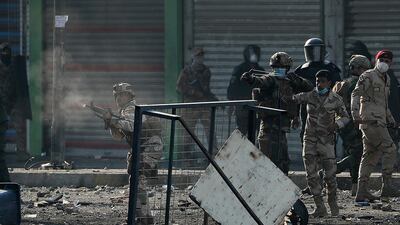
Iraqi security forces fire tear gas, a slingshot and smoke bombs during clashes between Iraqi security forces and anti-government protesters, in Baghdad. AP Photo -
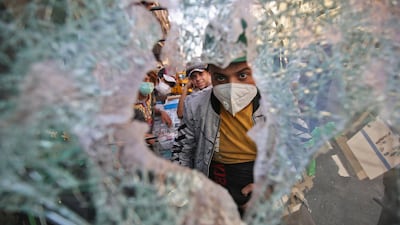
Iraqi protesters clash with Iraqi security forces at Baghdad's Khallani square during ongoing anti-government demonstrations on November 11, 2019. AFP -
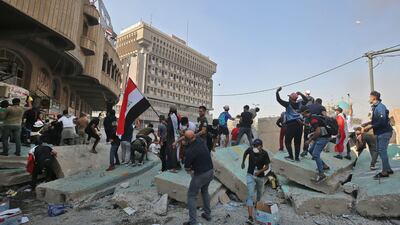
Iraqi protesters clash with Iraqi security forces at Baghdad's Khallani square during ongoing anti-government demonstrations on November 11, 2019. AFP -
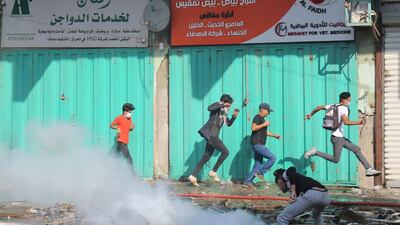
Iraqi protesters clash with Iraqi security forces at Baghdad's Khallani square during ongoing anti-government demonstrations on November 11, 2019. AFP -

Iraqi protesters clash with Iraqi security forces at Baghdad's Khallani square during ongoing anti-government demonstrations on November 11, 2019. AFP -
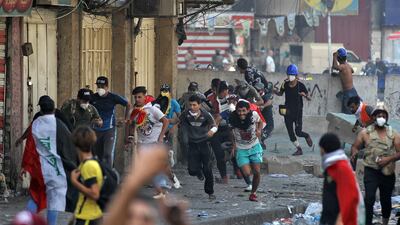
Iraqi protesters clash with Iraqi security forces at Baghdad's Khallani square during ongoing anti-government demonstrations on November 11, 2019. AFP -
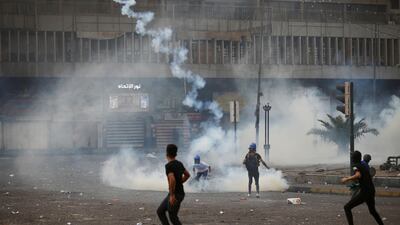
A demonstrator throws away a tear gas canister during the ongoing anti-government protests in Baghdad, Iraq. Reuters -
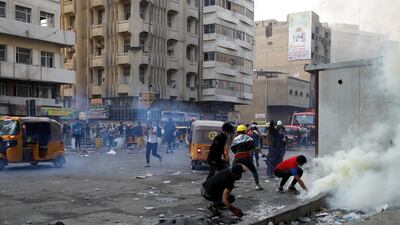
Demonstrators try to put out a tear gas canister during an anti-government protests in Baghdad, Iraq. Reuters -
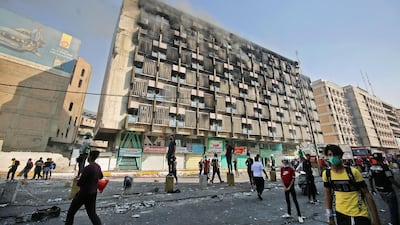
Iraqi protesters clash with Iraqi security forces at Baghdad's Khallani square during ongoing anti-government demonstrations on November 11, 2019. AFP -
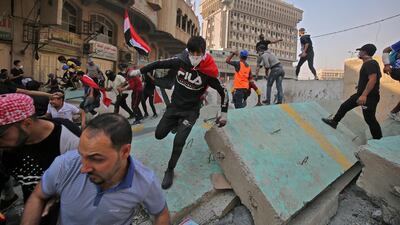
Iraqi protesters clash with Iraqi security forces at Baghdad's Khallani square during ongoing anti-government demonstrations on November 11, 2019. AFP -

Riot police fire tear gas and smoke bombs during clashes between Iraqi security forces and anti-government protesters in Baghdad, Iraq. AP Photo


This is due to the fact that, for the first time since the US-led invasion in 2003, the mostly Shiite demonstrators focused their anger on Iranian influence on Iraqi politics.
With Iran's backing, the militias responded violently. Ostensibly under Iraqi government control, they are a collection of armed groups in an umbrella organisation called the Popular Mobilisation Forces (PMF).
Many PMF groups were accused of sectarian violence against civilians during the US occupation.
Since 2018, when protests over poor water and electricity supplies erupted in Basra, they have frequently been accused of killing activists.
Senior leaders of PMF groups, including Qais Al Khazali and the now deceased Abu Mahdi Al Muhandis, made frequent public threats of violence against demonstrators, accusing them of being supported by foreign powers.
Failed crackdowns
Mr Al Kadhimi has reason to push back against the PMF, having lost a former adviser, Hisham Al Hashemi, in an assassination that has been blamed on an unnamed Iran-backed group.
After the killer was arrested, Iraqi officials said he was a member of one of the militia groups that had infiltrated the police.
The UN report looked at the fallout from Al Hashemi’s killing and the subsequent trial of the killer.
After repeated delays, the trial has again been postponed — this time with no new start-date — “due to the 'inability of bringing the defendant to the court'", the report added.
Targeted killings
Mr Al Kadhimi’s moves to rein in the militias, which have also launched numerous attacks on coalition forces and Iraqi intelligence officials, have been met with strong pushback.
His residence was attacked with an explosive drone in November and his political allies also became the targets of assassination attempts after he ordered the arrest of several PMF commanders.
Among the 26 cases investigated, the UN report includes “one targeted killing, three attempted targeted killings, five violent assaults, one house raid, 14 attacks using improvised explosive devices [and] one abduction”.
It refers to the “persistent impunity with respect to targeted attacks against protesters” as well as against people “seeking accountability for these attacks, and activists and critics espousing views critical of armed elements and affiliated political actors”.
The report, focusing on the period of May 2021 to May 2022, is based on 27 interviews, including with judicial officials in Baghdad and southern Iraq. It was compiled by the UN's Office of the High Commissioner for Human Rights (OHCHR) and the UN Assistance Mission for Iraq (Unami).
The report notes, however, that “significant progress” has been made in providing compensation to the families of those killed during the protests.
More than 500 families have received compensation of about $7,000 dollars each, it said.
The UN said that while the Iraqi government has held some security force members to account, not enough is being done — something that could embolden more killers.

