Arab cuisine at stake as people turn to junk food amid Ukraine war price surge


Ahmed Maher
  • English
  • Arabic

Consumers across the Arab world are opting for unhealthy fast food as fresh produce prices surge, leaving many traditional foods unsold.

People from Iraq, Egypt and Tunisia have told The National how economic factors are propelling them to sacrifice healthy diets and meals out at restaurants for cheaper fast food and frozen items, sold at cheaper prices.

The geopolitics of Europe, sweeping sanctions on Russia and the blockade of Ukrainian seaports have affected food supplies around the world and caused a major energy and food crisis.

In the Middle East, where many rely on imports from warring Ukraine and Russia for basic foodstuffs, the prices of vegetables, fruit, wheat and essential table items have more than doubled, and tripled in some places.

Prices were already high before the war due to the coronavirus pandemic, which caused huge supply disruption. But the consequences of the continuing war have made matters worse for the middle-income and the poor.

It is a destructive war that benefits no one, not even in the longer run
Karim Maher Abadir,
Emeritus professor of financial econometrics at Imperial College London

The World Food Programme issued a warning this month that the world would face severe food shortages in months if Ukrainian seaports remain blocked by Russia, as more than 20 million tonnes of grain are sitting idle.

Karim Maher Abadir, an Emeritus professor of financial econometrics at Imperial College London, told The National: “It is a destructive war that benefits no one, not even in the longer run.

“There are at least two types of sanctions: financial and economic. The former is fast to implement and disruptive but not sufficient to achieve the stated aims. Some of the latter is fast to implement — such as tech-sharing and essentials’ export embargoes — but import embargoes, such as oil and gas, entails disruptive costs for the sanctioning countries, as well as the sanctioned ones.”

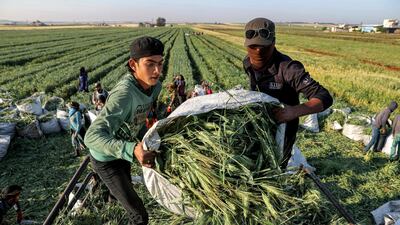
  • Labourers in a field outside the Syrian town of Binnish in the rebel-held province of Idlib in northwestern Syria harvest durum wheat. All photos by AFP
    Labourers in a field outside the Syrian town of Binnish in the rebel-held province of Idlib in northwestern Syria harvest durum wheat. All photos by AFP
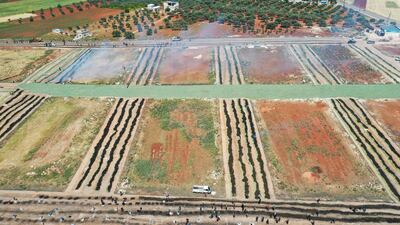
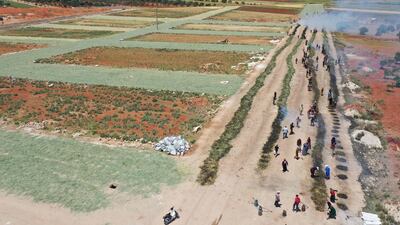
  • An aerial view shows labourers in the Syrian town of Binnish in Idlib province harvesting durum wheat to produce freekeh, a cereal that is roasted to give it flavour.
    An aerial view shows labourers in the Syrian town of Binnish in Idlib province harvesting durum wheat to produce freekeh, a cereal that is roasted to give it flavour.
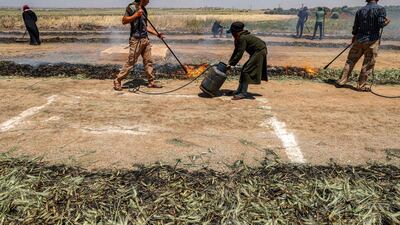
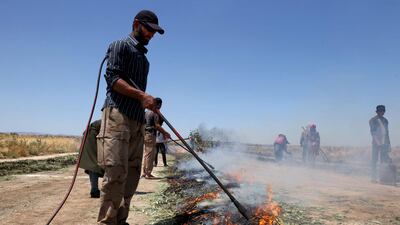
  • Labourers roast durum wheat to produce freekeh after harvesting a field, in the Syrian town of Binnish in the rebel-held province of Idlib in northwestern Syria.
    Labourers roast durum wheat to produce freekeh after harvesting a field, in the Syrian town of Binnish in the rebel-held province of Idlib in northwestern Syria.
  • Labourers harvesting durum wheat to produce freekeh in the Syrian town of Binnish work agricultural land in Idlib province that has been heavily depleted by years of bombing and shelling.
    Labourers harvesting durum wheat to produce freekeh in the Syrian town of Binnish work agricultural land in Idlib province that has been heavily depleted by years of bombing and shelling.
  • Harvesting and roasting durum wheat in the Syrian town of Binnish. In April, the UN said unexploded and improvised devices claimed three lives in northeastern Syria.
    Harvesting and roasting durum wheat in the Syrian town of Binnish. In April, the UN said unexploded and improvised devices claimed three lives in northeastern Syria.
  • Harvesting fields of durum wheat in the Syrian town of Binnish in rebel-held Idlib province goes on in the strong spring sunshine.
    Harvesting fields of durum wheat in the Syrian town of Binnish in rebel-held Idlib province goes on in the strong spring sunshine.
  • While the essential work of wheat harvesting goes on at Binnish in northwestern Syria, efforts have been made to educate field workers to beware of the civil war's harvest of unexploded shells and bombs.
    While the essential work of wheat harvesting goes on at Binnish in northwestern Syria, efforts have been made to educate field workers to beware of the civil war's harvest of unexploded shells and bombs.
  • Demand for wheat to produce freekeh keeps the economy of the Syrian town of Binnish in northwestern Syria alive.
    Demand for wheat to produce freekeh keeps the economy of the Syrian town of Binnish in northwestern Syria alive.
  • Agriculture in Syrian towns such as Binnish contributes a quarter of Syria's gross domestic product and provides work for 6.5 million people, the UN says.
    Agriculture in Syrian towns such as Binnish contributes a quarter of Syria's gross domestic product and provides work for 6.5 million people, the UN says.
  • After labourers in the Syrian town of Binnish harvest durum wheat, the ground is scorched in preparation for the next crop.
    After labourers in the Syrian town of Binnish harvest durum wheat, the ground is scorched in preparation for the next crop.
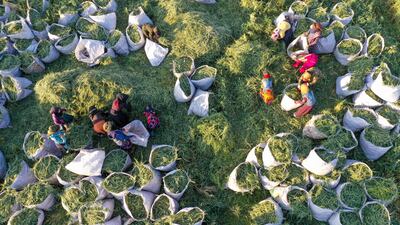
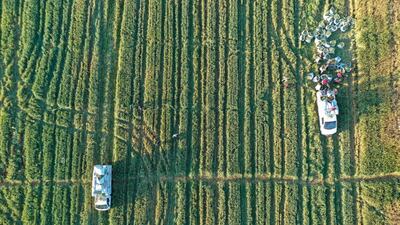
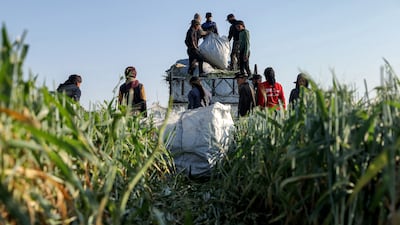
  • Labourers sort and bag their crop in the Syrian town of Binnish in the rebel-held province of Idlib, northwestern Syria.
    Labourers sort and bag their crop in the Syrian town of Binnish in the rebel-held province of Idlib, northwestern Syria.

'Cheaper, faster and easier'

The global food and cost-of-living crisis is affecting people like Asan Atallah, a single Iraqi woman, 27, who works as a digital supervisor in the northern city of Irbil.

Ms Atallah, who lives alone, said she has embarked on an unhealthy habit of eating burgers from local fast food outlets as they are cheaper than preparing traditional food at home such as a tashreeb dish, which is broth-soaked bread topped with meat or vegetables and rice.

“I can’t find the right quality for the right price, so I tend to buy junk food, which is cheaper, faster and easier as an alternative,” she told The National.

“I know this is harmful to my health if I keep going like that ... but what can I do with the recent crazy hike in cooking oil? I can’t afford buying it on a regular basis, let alone the vegetables, meat and bread ... I can buy a burger with all ingredients from A to Z at half price.”

Asan Atallah has embarked on an unhealthy habit of eating burgers from local fast food outlets as they are cheaper than traditional, healthy, home-made meals. Photo: Asan Atallah

The price of a litre of cooking oil rose to more than 4,000 Iraqi dinars ($2.75) from 2,500 dinars before the crisis, while the price of a 50kg bag of flour reached 50,000 dinars. It was less than half that price in February before Russia invaded Ukraine.

Iraq is a major grain importer and its authorities said they would take measures to secure stocks of wheat and support a local food subsidies programme as food supply concerns are rising.

The current crisis could add up to $3bn to Iraq’s bill this year, highlighting the dangerous vulnerability of the country's food supply as its economy is already grappling with budget deficit and corruption.

Continuing drought is also threatening fields of rice, which is the main dish accompanying lunch and dinner every day for millions of Iraqis. Iraq is classified as one of the five countries most vulnerable to climate change effects and desertification.

“There’s no middle class anymore," said Ms Atallah, who also called for a decent pay rise to keep up with inflation. "There are rich and poor people. This is a very disturbing imbalance in society, especially if the prices keep going up.

“My monthly grocery spending increased from $100 to about $200 in a span of three months. This $100 difference is a lot to me and many middle-income people.”

An Iraqi farmer works on harvesting wheat at his farm in Jaliha village in the central Diwaniya province. AFP

A cultural expense

Ruba Ali Al Hassani, an interdisciplinary sociologist and postdoctoral research associate at Lancaster University and research consultant at King's College London, says rising food prices only exacerbate existing class divides in societies.

“Fresher and more nutritious foods have always been costlier all across the board, not just in the Middle East," Ms Al Hassani told The National. "This is why we see a class disparity in health and wellness everywhere."

She said she was concerned that traditional and cultural dishes — based on the expensive grains — could vanish in the not-too-distant future because Iraq and other Arab countries do not exist in isolation from global financial and economic terms set by major powers in societies where inequality dominates and the middle-income and poor seek cheaper products.

“The middle class has been gradually deteriorating for quite some time and this has been largely due to the neoliberalisation of society and institutions,” she said.

“There has been a growing sense of individualism and a move away from collective culture in which the region prides itself. This is becoming more of a problem as people switch to survival mode in light of increasing cost of life and political issues in each corresponding country.”

Costly carbohydrates

Karim can no longer afford the homemade potato chips and opt for the unhealthy ready salted packets of crisps. Photo: Karim Hussein

Karim Hussein, a single Egyptian who works as a chief accountant at a private company in Cairo, said the announced double-digit rate of 12 per cent inflation made no sense to him as it varies from one person to another depending on their monthly food and living expenses.

Mr Hussein, 37, can no longer afford homemade potato chips and opts for the unhealthy, ready-salted packets of crisps.

“I used to buy potatoes and fry at home," he said. "Today, it would cost me a lot as I have to buy sunflower oil, less than a litre for around 30 Egyptian pounds [LE], one kilo of potatoes for LE6 and of course the bread for LE2. This is compared to just one big packet of crisps for LE8, which is still expensive but you see the difference.

“So, I still eat the crisps I love, though unhealthy, and listen to the amazing sound of the crunch,” he laughed.

“Do you want more examples? OK, the popular ful [stewed fava beans] sandwich every Egyptian has at breakfast is now sold at LE7 up from LE3.5. A small cup of latte or flat white costs LE40 up from LE30 and 100 grams of tea costs LE12 jumping from only LE2 a few years ago. Everything has become costlier even the popular street dish koshari [a mixture of rice, brown lentils topped with chickpeas, tomato sauce, garlic vinegar and crispy fried onions].”

Mr Hussein feels for his friends who are obsessed with bodybuilding and depend daily on expensive eggs as the main source of protein.

“I’m sure some of them can’t afford to buy the regular box of 30 eggs for LE60 and started using [anabolic] steroids even if it’s expensive as it will sustain them longer,” he said.

The price of bread in Egypt is rising fast. The most populous Arab country — with a population of more than 100 million — is the world's largest wheat importer, buying more than 60 per cent from abroad.

Russia and Ukraine accounted for some 80 per cent of those imports last year, the World Bank says.

Recent price increases could nearly double annual state spending on wheat imports to $5.7 billion from about $3bn, a study by the International Food Policy Research Institute indicated.

Egypt further devalued its currency one month after the Russian invasion of Ukraine, which is also another form of inflation, says Amro Zakaria, chief executive of Madarik Ventures, a global financial market advisory firm with headquarters in Dubai and New York.

We don't hear the rich complaining, as their assets get inflated as well and naturally get richer. In the process, the poor get poorer and the middle class become the new poor
Amro Zakaria,
chief executive of Madarik Ventures

“Any increase in global food prices would have a more severe effect on North African countries compared to Gulf countries whose currencies are stable as they are pegged to the US dollar, which is at the strongest level today in about two years, and this has shielded them from the purchasing power erosion experienced by North African countries,” Mr Zakaria told The National.

Mr Zakaria says the Middle East — like many parts of the world — will see middle-income people squeezed even further as household incomes fall against the triple whammy of food, energy and currency devaluation.

“Their expenditure on housing, transportation, education or food will always constitute a higher percentage of their overall income, which most likely comes from a fixed source like a salary, the growth of which does not keep up with inflation,” he said.

“We don't hear the rich complaining, as their assets get inflated as well and naturally get richer. In the process, the poor get poorer and the middle class become the new poor.”

An Egyptian man works at a bakery at a market in Cairo. AFP

Giving up organic

Naema Khlissa, a single 38-year-old Tunisian woman who studies for a Master of Arts in political communication at University of Manouba, suspects that the cheap salad she buys from local shops is contaminated with pesticides.

Ms Khlissa had to stop buying organic vegetables to make her favourite grilled salad dish every day as they and the ingredients for the traditional couscous [made from tiny steamed balls of semolina flour] have become unbelievably expensive.

“One kilo of organic red or yellow peppers rose from 1.5 dinars to seven dinars [$0.49-$2.31]. One kilo of tomatoes costs today around six dinars compared to just two dinars before April,” she told The National.

She is not happy with the chemicals used to protect crops against insects as she worries they may cause adverse health effects. But she feels she has no other option.

Naima has had to cut down on rice and eat fast food takeaways. Photo: Naima Khlissa

“I really love the grilled salad and have to buy just 200 grams of it for only three dinars from the supermarket," she said. "Not the same quality at all, but it will cost me 20 dinars to have a good meal of grilled salad at home. This is insane.”

Tunisia has been subsidising essential food items such as bread and vegetable oil since the 1970s. But the country has been facing severe food shortages in recent years, which has been exacerbated by the war in Ukraine. Prices were already high before the war.

Local media have broadcast long queues outside bakeries and reported that some warehouses are offering subsidised food on condition that locals buy other items as well.

Ms Khlissa said: “Yes, this is happening. It happened to me personally. I went to one shop and he told me he would give me subsidised eggs only if I buy things for a minimum of 30 dinars. Greed.

“The food items are really expensive in the unsubsidised private sector, where one litre of cooking oil sells for nine dinars instead of six.”

Tunisia is a wheat producer, growing between 70 per cent and 90 per cent of its durum supplies, which is used to make pasta, the World Food Programme says.

But it only produces 10 per cent to 30 per cent of its bread flour and is heavily reliant on imports, much of which used to come from Ukraine.

Ms Khlissa has adapted herself to the new financial circumstances and created an effective budget much like Asna in Iraq and Karim in Egypt.

“I buy vegetables by piece no kilos, stopped eating outside completely," she said. "Having a cup of coffee and a croissant for breakfast at a cafe is now a luxury for me. But I like to buy myself these little luxuries from time to time."


Tips for job-seekers
  • Do not submit your application through the Easy Apply button on LinkedIn. Employers receive between 600 and 800 replies for each job advert on the platform. If you are the right fit for a job, connect to a relevant person in the company on LinkedIn and send them a direct message.
  • Make sure you are an exact fit for the job advertised. If you are an HR manager with five years’ experience in retail and the job requires a similar candidate with five years’ experience in consumer, you should apply. But if you have no experience in HR, do not apply for the job.

David Mackenzie, founder of recruitment agency Mackenzie Jones Middle East

Winners

Ballon d’Or (Men’s)
Ousmane Dembélé (Paris Saint-Germain / France)

Ballon d’Or Féminin (Women’s)
Aitana Bonmatí (Barcelona / Spain)

Kopa Trophy (Best player under 21 – Men’s)
Lamine Yamal (Barcelona / Spain)

Best Young Women’s Player
Vicky López (Barcelona / Spain)

Yashin Trophy (Best Goalkeeper – Men’s)
Gianluigi Donnarumma (Paris Saint-Germain and Manchester City / Italy)

Best Women’s Goalkeeper
Hannah Hampton (England / Aston Villa and Chelsea)

Men’s Coach of the Year
Luis Enrique (Paris Saint-Germain)

Women’s Coach of the Year
Sarina Wiegman (England)

The specs

Engine: 4.0-litre V8 twin-turbocharged and three electric motors

Power: Combined output 920hp

Torque: 730Nm at 4,000-7,000rpm

Transmission: 8-speed dual-clutch automatic

Fuel consumption: 11.2L/100km

On sale: Now, deliveries expected later in 2025

Price: expected to start at Dh1,432,000

ENGLAND SQUAD

Goalkeepers Henderson, Johnstone, Pickford, Ramsdale

Defenders Alexander-Arnold, Chilwell, Coady, Godfrey, James, Maguire, Mings, Shaw, Stones, Trippier, Walker, White

Midfielders Bellingham, Henderson, Lingard, Mount, Phillips, Rice, Ward-Prowse

Forwards Calvert-Lewin, Foden, Grealish, Greenwood, Kane, Rashford, Saka, Sancho, Sterling, Watkins 

MATCH INFO

Euro 2020 qualifier

Norway v Spain, Saturday, 10.45pm, UAE

Ten tax points to be aware of in 2026

1. Domestic VAT refund amendments: request your refund within five years

If a business does not apply for the refund on time, they lose their credit.

2. E-invoicing in the UAE

Businesses should continue preparing for the implementation of e-invoicing in the UAE, with 2026 a preparation and transition period ahead of phased mandatory adoption. 

3. More tax audits

Tax authorities are increasingly using data already available across multiple filings to identify audit risks. 

4. More beneficial VAT and excise tax penalty regime

Tax disputes are expected to become more frequent and more structured, with clearer administrative objection and appeal processes. The UAE has adopted a new penalty regime for VAT and excise disputes, which now mirrors the penalty regime for corporate tax.

5. Greater emphasis on statutory audit

There is a greater need for the accuracy of financial statements. The International Financial Reporting Standards standards need to be strictly adhered to and, as a result, the quality of the audits will need to increase.

6. Further transfer pricing enforcement

Transfer pricing enforcement, which refers to the practice of establishing prices for internal transactions between related entities, is expected to broaden in scope. The UAE will shortly open the possibility to negotiate advance pricing agreements, or essentially rulings for transfer pricing purposes. 

7. Limited time periods for audits

Recent amendments also introduce a default five-year limitation period for tax audits and assessments, subject to specific statutory exceptions. While the standard audit and assessment period is five years, this may be extended to up to 15 years in cases involving fraud or tax evasion. 

8. Pillar 2 implementation 

Many multinational groups will begin to feel the practical effect of the Domestic Minimum Top-Up Tax (DMTT), the UAE's implementation of the OECD’s global minimum tax under Pillar 2. While the rules apply for financial years starting on or after January 1, 2025, it is 2026 that marks the transition to an operational phase.

9. Reduced compliance obligations for imported goods and services

Businesses that apply the reverse-charge mechanism for VAT purposes in the UAE may benefit from reduced compliance obligations. 

10. Substance and CbC reporting focus

Tax authorities are expected to continue strengthening the enforcement of economic substance and Country-by-Country (CbC) reporting frameworks. In the UAE, these regimes are increasingly being used as risk-assessment tools, providing tax authorities with a comprehensive view of multinational groups’ global footprints and enabling them to assess whether profits are aligned with real economic activity. 

Contributed by Thomas Vanhee and Hend Rashwan, Aurifer

Types of fraud

Phishing: Fraudsters send an unsolicited email that appears to be from a financial institution or online retailer. The hoax email requests that you provide sensitive information, often by clicking on to a link leading to a fake website.

Smishing: The SMS equivalent of phishing. Fraudsters falsify the telephone number through “text spoofing,” so that it appears to be a genuine text from the bank.

Vishing: The telephone equivalent of phishing and smishing. Fraudsters may pose as bank staff, police or government officials. They may persuade the consumer to transfer money or divulge personal information.

SIM swap: Fraudsters duplicate the SIM of your mobile number without your knowledge or authorisation, allowing them to conduct financial transactions with your bank.

Identity theft: Someone illegally obtains your confidential information, through various ways, such as theft of your wallet, bank and utility bill statements, computer intrusion and social networks.

Prize scams: Fraudsters claiming to be authorised representatives from well-known organisations (such as Etisalat, du, Dubai Shopping Festival, Expo2020, Lulu Hypermarket etc) contact victims to tell them they have won a cash prize and request them to share confidential banking details to transfer the prize money.

* Nada El Sawy

The National Archives, Abu Dhabi

Founded over 50 years ago, the National Archives collects valuable historical material relating to the UAE, and is the oldest and richest archive relating to the Arabian Gulf.

Much of the material can be viewed on line at the Arabian Gulf Digital Archive - https://www.agda.ae/en

Game Changer

Director: Shankar 

Stars: Ram Charan, Kiara Advani, Anjali, S J Suryah, Jayaram

Rating: 2/5

COMPANY PROFILE

Name: Lamsa

Founder: Badr Ward

Launched: 2014

Employees: 60

Based: Abu Dhabi

Sector: EdTech

Funding to date: $15 million

Mercer, the investment consulting arm of US services company Marsh & McLennan, expects its wealth division to at least double its assets under management (AUM) in the Middle East as wealth in the region continues to grow despite economic headwinds, a company official said.

Mercer Wealth, which globally has $160 billion in AUM, plans to boost its AUM in the region to $2-$3bn in the next 2-3 years from the present $1bn, said Yasir AbuShaban, a Dubai-based principal with Mercer Wealth.

Within the next two to three years, we are looking at reaching $2 to $3 billion as a conservative estimate and we do see an opportunity to do so,” said Mr AbuShaban.

Mercer does not directly make investments, but allocates clients’ money they have discretion to, to professional asset managers. They also provide advice to clients.

“We have buying power. We can negotiate on their (client’s) behalf with asset managers to provide them lower fees than they otherwise would have to get on their own,” he added.

Mercer Wealth’s clients include sovereign wealth funds, family offices, and insurance companies among others.

From its office in Dubai, Mercer also looks after Africa, India and Turkey, where they also see opportunity for growth.

Wealth creation in Middle East and Africa (MEA) grew 8.5 per cent to $8.1 trillion last year from $7.5tn in 2015, higher than last year’s global average of 6 per cent and the second-highest growth in a region after Asia-Pacific which grew 9.9 per cent, according to consultancy Boston Consulting Group (BCG). In the region, where wealth grew just 1.9 per cent in 2015 compared with 2014, a pickup in oil prices has helped in wealth generation.

BCG is forecasting MEA wealth will rise to $12tn by 2021, growing at an annual average of 8 per cent.

Drivers of wealth generation in the region will be split evenly between new wealth creation and growth of performance of existing assets, according to BCG.

Another general trend in the region is clients’ looking for a comprehensive approach to investing, according to Mr AbuShaban.

“Institutional investors or some of the families are seeing a slowdown in the available capital they have to invest and in that sense they are looking at optimizing the way they manage their portfolios and making sure they are not investing haphazardly and different parts of their investment are working together,” said Mr AbuShaban.

Some clients also have a higher appetite for risk, given the low interest-rate environment that does not provide enough yield for some institutional investors. These clients are keen to invest in illiquid assets, such as private equity and infrastructure.

“What we have seen is a desire for higher returns in what has been a low-return environment specifically in various fixed income or bonds,” he said.

“In this environment, we have seen a de facto increase in the risk that clients are taking in things like illiquid investments, private equity investments, infrastructure and private debt, those kind of investments were higher illiquidity results in incrementally higher returns.”

The Abu Dhabi Investment Authority, one of the largest sovereign wealth funds, said in its 2016 report that has gradually increased its exposure in direct private equity and private credit transactions, mainly in Asian markets and especially in China and India. The authority’s private equity department focused on structured equities owing to “their defensive characteristics.”

South Africa squad

: Faf du Plessis (captain), Hashim Amla, Temba Bavuma, Quinton de Kock (wkt), Theunis de Bruyn, AB de Villiers, Dean Elgar, Heinrich Klaasen (wkt), Keshav Maharaj, Aiden Markram, Morne Morkel, Chris Morris, Wiaan Mulder, Lungi Ngidi, Duanne Olivier, Vernon Philander and Kagiso Rabada.

The Florida Project

Director: Sean Baker

Starring: Bria Vinaite, Brooklynn Prince, Willem Dafoe

Four stars

UAE SQUAD

Goalkeepers: Ali Khaseif, Fahad Al Dhanhani, Mohammed Al Shamsi, Adel Al Hosani

Defenders: Bandar Al Ahbabi, Shaheen Abdulrahman, Walid Abbas, Mahmoud Khamis, Mohammed Barghash, Khalifa Al Hammadi, Hassan Al Mahrami, Yousef Jaber, Salem Rashid, Mohammed Al Attas, Alhassan Saleh

Midfielders: Ali Salmeen, Abdullah Ramadan, Abdullah Al Naqbi, Majed Hassan, Yahya Nader, Ahmed Barman, Abdullah Hamad, Khalfan Mubarak, Khalil Al Hammadi, Tahnoun Al Zaabi, Harib Abdallah, Mohammed Jumah, Yahya Al Ghassani

Forwards: Fabio De Lima, Caio Canedo, Ali Saleh, Ali Mabkhout, Sebastian Tagliabue, Zayed Al Ameri

Updated: June 01, 2022, 10:33 PM