

Thousands of people from Iraq’s Yazidi minority group have been forced to flee as fighting rages in Sinjar.
The town in northern Iraq made headlines in 2014 when ISIS took over vast parts of the country and attempted to wipe out the small minority group.
In the latest clashes, the Iraqi army has been engaged in heavy fighting with a local Yazidi militia group, amid a wider tussle for control of territory, as local communities are drawn into regional conflicts involving Turkey, Iran and Iraq.

Fighting between the Iraqi army and the Yazidi Sinjar Resistance Units (YBS) over the past two days has killed at least one Iraqi soldier and as many as 12 Yazidis, the Iraqi army said.
Sinjar has a predominantly Yazidi population. Members of the minority Yazidi community in northern Iraq follow an ancient religion similar to the Zoroastrian religion of pre-Islamic Iran.
The latest violence "led to the displacement of 710 families, or 4,083 people", Hussein Klari, of the Kurdish interior ministry's crisis unit, told a press conference.
They received sanctuary in the Kurdistan region's Dohuk province, he said.
On Monday, Mahma Khalilm, a Yazidi MP aligned to the Kurdish Democratic Party in Iraq's parliament, blamed the clashes on the presence of the Kurdistan Workers' Party (PKK) in Sinjar, which was "attacking the Iraqi army and the citizens of Shingal and using them as human shields."
The town is home to several Yazidi militias, including the YBS, a small group formed to protect the community from ISIS. Mr Khalilm and Turkish authorities say it has ties to the PKK ― a Kurdish rebel group seeking an autonomous region within Turkey.
Murad Ismael, a Yazidi activist, said that his community was being forced to flee Sinjar “once again,” amid the latest violence.
The PKK has bases in the mountains of the Kurdish Region of Iraq and has used the area as a base to attack Turkish forces.
Fighting previously erupted in January between the Iraqi army and the YBS, when Iraqi soldiers tried to take control of a YBS-run checkpoint.
In the Iraqi capital Baghdad, an immigration ministry official who handles issues of internal displacement said the situation in Sinjar had "returned to normal".
"These displacements are temporary. The security situation is very good," said the official, Ali Abbas.
-

A group of PKK soldiers walk near their base camp high in the mountains of northern Iraq on June 1, 2004. Reuters -
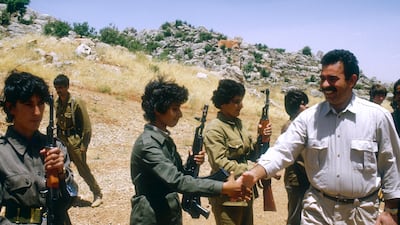
Kurdistan Workers' Party (PKK) leader Abdullah Ocalan greets women soldiers at the Mahsun Korkmaz Academy military training camp in Lebanon on June, 18, 1988. Getty Images -

Peshmerga and Turkish soldiers prepare to storm a hill on October 23, 1992, near a stronghold held by the PKK in Hakurk Valley. AFP -

Abdullah Ocalan was abducted in Nairobi in 1999 by the Turkish National Intelligence Agency (MIT), with assistance from the US, and taken to Turkey. Reuters -

Turkish riot police detain a Kurdish protester following a demonstration in central Istanbul on April 2, 2006. Reuters -
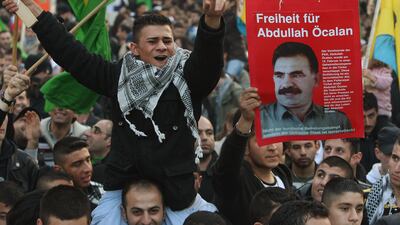
A man holds a sign demanding freedom for imprisoned Kurdish leader Abdullah Ocalan at a protest of mostly Kurdish demonstrators on November 4, 2007, in Berlin, Germany. Getty Images -
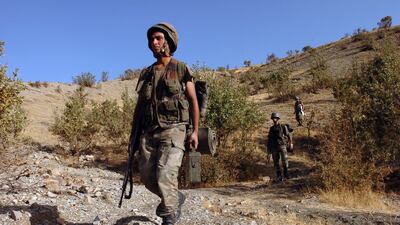
Turkish army commandos on patrol near the Iraq border on October 27, 2007, in the Uludere district of Sirnak province, south-eastern Turkey. Getty Images -
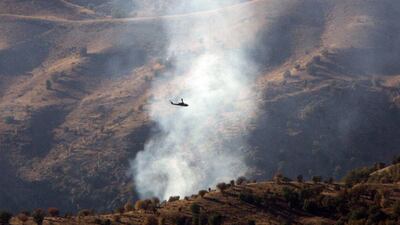
A Turkish helicopter flies over the Cudi Mountains during an attack on an outlawed PKK camp October 30, 2007, in Sirnak province, near the Iraq border. AFP -
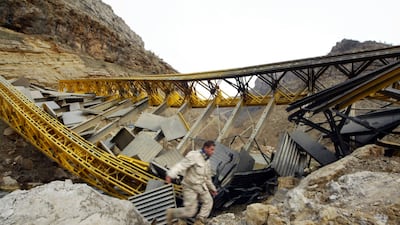
A ruined bridge lies in northern Iraq's Kurdistan region during fighting between Turkish forces and PKK fighters on February 24, 2008. AFP -
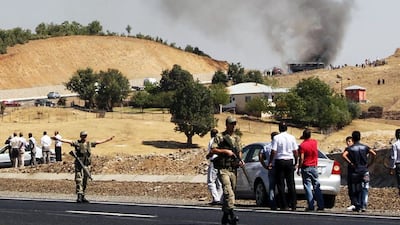
Turkish soldiers stand guard as smokes rises from a bus that was attacked by members of the PKK on September 18, 2012, in Bingol. AFP -
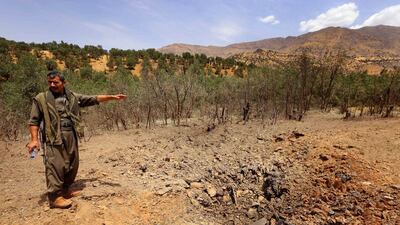
A member of the PKK inspects a crater reportedly caused by an air strike by Turkish warplanes on July 29, 2015, in the Qandil Mountains in northern Iraq. AFP -
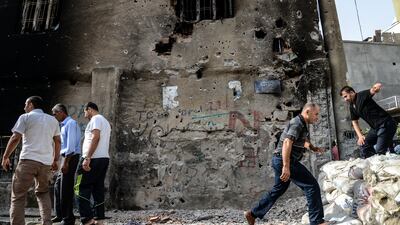
Locals assess the damage following clashes between Turkish forces and PKK militants in the Kurdish-majority city of Cizre, in south-eastern Turkey, on September 12, 2015. AFP -
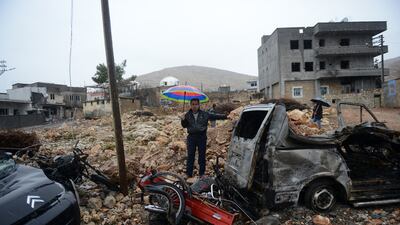
People return to their homes in Dargecit after a curfew imposed by the Turkish government was lifted on December 30, 2015, in Mardin province. AFP -
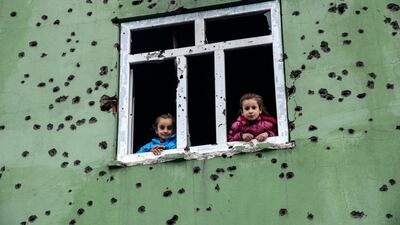
Children look out from a window of a bullet-scarred house in the Kurdish town of Silopi in south-eastern Turkey, near the border with Iraq, on January 19, 2016. AFP -
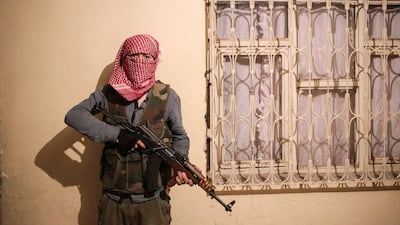
A member of the Patriotic Revolutionary Youth Movement (YDG-H), a division of the PKK, stands guard in the south-eastern Turkish city of Nusaybin on February 25, 2016. Getty Images


In December, Iraqi Prime Minister Mustafa Al Kadhimi gave a warning that Iraqi forces would "continue to impose the authority of the state and the law in Sinjar," amid growing concerns over the proliferation of armed groups.
Meanwhile, Turkey is in the midst of a large-scale military operation to clear northern Iraq of PKK fighters who have had hideouts in the area since the 1980s.
Amid these operations, the YBS has also come under attack from Turkish forces, including air strikes aimed at its leadership.
This has put the YBS in a difficult position because powerful political groups in Iraq have also turned on their allies the PKK, amid the escalating conflict that has seen oil infrastructure destroyed.
Iran and Turkey at odds
The YBS also has ties to the Iraqi Popular Mobilisation Forces, or PMF, a collection of militias ostensibly under Iraqi government control, many of which are funded by Iran.
Some of these Iran-backed PMF groups stand accused of firing rockets at Iraqi-Kurdish oil infrastructure, angering the Kurdistan Democratic Party, which is currently aligned with powerful Iraqi cleric Moqtada Al Sadr, a Shiite who is at loggerheads with Tehran-supported groups.
PMF groups also stand accused of an assassination attempt against sitting Prime Minister Al Kadhimi, another factor that places the small, PMF-aligned YBS in the Iraqi government's sights.
The KDP, whose power base in Erbil is 200 kilometres away from Sinjar, has few reasons to intervene in the clashes.
It is aligned with Turkey, whose forces in northern Iraq have come under attack from PMF groups. With strong ties to Turkey, the KDP is now in conflict with the PKK, which has clashed in the past with KDP-linked Kurdish forces known as Peshmerga.
This has left the YBS with few supporters in northern Iraq.
The group controls checkpoints around Sinjar but finds itself at odds with powerful groups in Baghdad, the Turkish government and the Kurdish Democratic Party — the most powerful Kurdish party.
Sherwan Al Douberdani, a provincial deputy, said the YBS fighters were rejecting demands to pull out of Sinjar and for “the withdrawal of foreign agents”, a reference to the PKK.

