'The New England Journal of Medicine' has published results of a latest study of booster Covid-19 vaccines. AFP

Israeli Covid study finds fourth Pfizer vaccine dose shields elderly


  • English
  • Arabic

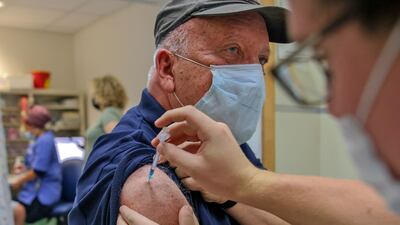
A second booster of the Pfizer-BioNTech coronavirus vaccine lowered rates of Covid-19 among the elderly but the protection against infection appeared short-lived, a study in Israel has found.

Protection against infection after receiving the second booster – or fourth dose – dwindled after four weeks, Israeli researchers noted in their study published on Tuesday in The New England Journal of Medicine.

Protection against severe illness did not wane during the six weeks after the dose but researchers said more research was needed to evaluate its longer-term protection.

The study of 1.3 million people aged 60 and older analysed data from the Israeli Ministry of Health database from January 10 to March 2, when the Omicron variant was predominant.

"Rates of confirmed SARS-CoV-2 infection and severe Covid-19 were lower after a fourth dose of BNT162b2 vaccine than after only three doses. Protection against confirmed infection appeared short-lived, whereas protection against severe illness did not wane during the study period," the report said.

The US Food and Drug Administration is set to convene on Wednesday to discuss the need for additional boosters, a week after America authorised a second booster shot for people aged 50 and older amid a spread of the Omicron subvariant BA.2, Reuters reported.

  • Israeli President Isaac Herzog and his wife Michal receive their third coronavirus vaccine injections at Sheba Medical Centre in Ramat Gan, Israel.
    Israeli President Isaac Herzog and his wife Michal receive their third coronavirus vaccine injections at Sheba Medical Centre in Ramat Gan, Israel.
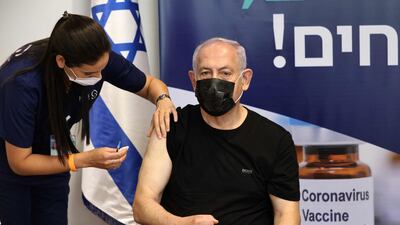
  • Former Israeli prime minister Benjamin Netanyahu and his wife Sara receive their third doses of the Pfizer-BioNTech Covid-19 vaccine in Tel Aviv.
    Former Israeli prime minister Benjamin Netanyahu and his wife Sara receive their third doses of the Pfizer-BioNTech Covid-19 vaccine in Tel Aviv.
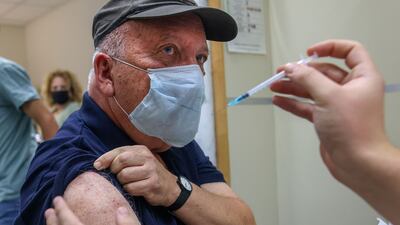
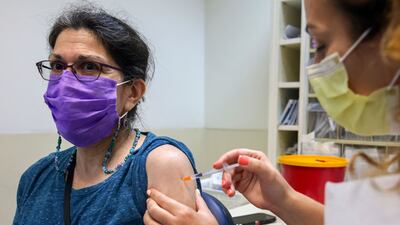
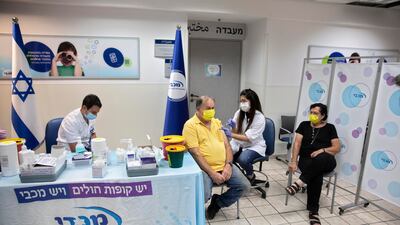
  • Israel has launched a campaign to give booster shots to people 60 years and over.
    Israel has launched a campaign to give booster shots to people 60 years and over.
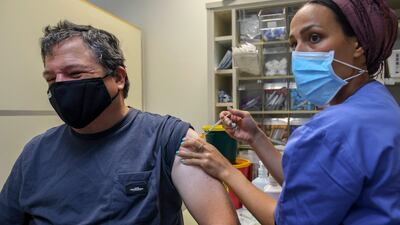
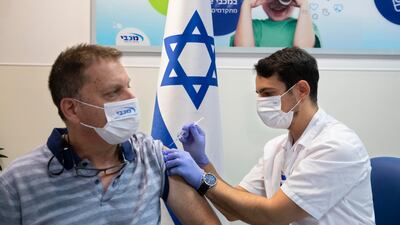
  • An Israeli health worker prepares to administer a third dose of the Pfizer-BioNtech vaccine at a Maccabi Health Service clinic in Jerusalem.
    An Israeli health worker prepares to administer a third dose of the Pfizer-BioNtech vaccine at a Maccabi Health Service clinic in Jerusalem.
  • More than 57 per cent of the country’s 9.3 million citizens have received two doses of the Pfizer-BioNTech vaccine.
    More than 57 per cent of the country’s 9.3 million citizens have received two doses of the Pfizer-BioNTech vaccine.
  • Israel is the first country to offer a third dose of a Western vaccine to its citizens on a wide scale.
    Israel is the first country to offer a third dose of a Western vaccine to its citizens on a wide scale.
  • Anyone over 60 who was vaccinated more than five months ago will be eligible for a third vaccine.
    Anyone over 60 who was vaccinated more than five months ago will be eligible for a third vaccine.
  • Neither the US nor the EU have approved coronavirus booster shots.
    Neither the US nor the EU have approved coronavirus booster shots.
  • Israeli Prime Minister Naftali Bennett, first right from centre, said a team of expert advisers had agreed it made sense to launch the booster campaign.
    Israeli Prime Minister Naftali Bennett, first right from centre, said a team of expert advisers had agreed it made sense to launch the booster campaign.
  • Mr Bennett said the recommendation was made after 'considerable research and analysis'.
    Mr Bennett said the recommendation was made after 'considerable research and analysis'.
  • Israel said its research behind the third vaccine would be shared around the world.
    Israel said its research behind the third vaccine would be shared around the world.
  • The decision to offer booster shots to older citizens comes at a time of rising infections and signs the vaccine’s efficacy dwindles over time.
    The decision to offer booster shots to older citizens comes at a time of rising infections and signs the vaccine’s efficacy dwindles over time.

European health ministers have also urged the bloc's governments to back a fourth dose for people aged 60 and older.

In Asia, South Korea started giving out fourth doses of Covid vaccines in February. Singapore said a second booster dose is planned for those aged 80 and older.

Another study from Israel last month showed that older people who received a second booster of the Pfizer-BioNTech vaccine had a 78 per cent lower mortality rate than those who had only one.

Israel began offering a second booster in January.

Mercer, the investment consulting arm of US services company Marsh & McLennan, expects its wealth division to at least double its assets under management (AUM) in the Middle East as wealth in the region continues to grow despite economic headwinds, a company official said.

Mercer Wealth, which globally has $160 billion in AUM, plans to boost its AUM in the region to $2-$3bn in the next 2-3 years from the present $1bn, said Yasir AbuShaban, a Dubai-based principal with Mercer Wealth.

Within the next two to three years, we are looking at reaching $2 to $3 billion as a conservative estimate and we do see an opportunity to do so,” said Mr AbuShaban.

Mercer does not directly make investments, but allocates clients’ money they have discretion to, to professional asset managers. They also provide advice to clients.

“We have buying power. We can negotiate on their (client’s) behalf with asset managers to provide them lower fees than they otherwise would have to get on their own,” he added.

Mercer Wealth’s clients include sovereign wealth funds, family offices, and insurance companies among others.

From its office in Dubai, Mercer also looks after Africa, India and Turkey, where they also see opportunity for growth.

Wealth creation in Middle East and Africa (MEA) grew 8.5 per cent to $8.1 trillion last year from $7.5tn in 2015, higher than last year’s global average of 6 per cent and the second-highest growth in a region after Asia-Pacific which grew 9.9 per cent, according to consultancy Boston Consulting Group (BCG). In the region, where wealth grew just 1.9 per cent in 2015 compared with 2014, a pickup in oil prices has helped in wealth generation.

BCG is forecasting MEA wealth will rise to $12tn by 2021, growing at an annual average of 8 per cent.

Drivers of wealth generation in the region will be split evenly between new wealth creation and growth of performance of existing assets, according to BCG.

Another general trend in the region is clients’ looking for a comprehensive approach to investing, according to Mr AbuShaban.

“Institutional investors or some of the families are seeing a slowdown in the available capital they have to invest and in that sense they are looking at optimizing the way they manage their portfolios and making sure they are not investing haphazardly and different parts of their investment are working together,” said Mr AbuShaban.

Some clients also have a higher appetite for risk, given the low interest-rate environment that does not provide enough yield for some institutional investors. These clients are keen to invest in illiquid assets, such as private equity and infrastructure.

“What we have seen is a desire for higher returns in what has been a low-return environment specifically in various fixed income or bonds,” he said.

“In this environment, we have seen a de facto increase in the risk that clients are taking in things like illiquid investments, private equity investments, infrastructure and private debt, those kind of investments were higher illiquidity results in incrementally higher returns.”

The Abu Dhabi Investment Authority, one of the largest sovereign wealth funds, said in its 2016 report that has gradually increased its exposure in direct private equity and private credit transactions, mainly in Asian markets and especially in China and India. The authority’s private equity department focused on structured equities owing to “their defensive characteristics.”

England's all-time record goalscorers:
Wayne Rooney 53
Bobby Charlton 49
Gary Lineker 48
Jimmy Greaves 44
Michael Owen 40
Tom Finney 30
Nat Lofthouse 30
Alan Shearer 30
Viv Woodward 29
Frank Lampard 29

Ten tax points to be aware of in 2026

1. Domestic VAT refund amendments: request your refund within five years

If a business does not apply for the refund on time, they lose their credit.

2. E-invoicing in the UAE

Businesses should continue preparing for the implementation of e-invoicing in the UAE, with 2026 a preparation and transition period ahead of phased mandatory adoption. 

3. More tax audits

Tax authorities are increasingly using data already available across multiple filings to identify audit risks. 

4. More beneficial VAT and excise tax penalty regime

Tax disputes are expected to become more frequent and more structured, with clearer administrative objection and appeal processes. The UAE has adopted a new penalty regime for VAT and excise disputes, which now mirrors the penalty regime for corporate tax.

5. Greater emphasis on statutory audit

There is a greater need for the accuracy of financial statements. The International Financial Reporting Standards standards need to be strictly adhered to and, as a result, the quality of the audits will need to increase.

6. Further transfer pricing enforcement

Transfer pricing enforcement, which refers to the practice of establishing prices for internal transactions between related entities, is expected to broaden in scope. The UAE will shortly open the possibility to negotiate advance pricing agreements, or essentially rulings for transfer pricing purposes. 

7. Limited time periods for audits

Recent amendments also introduce a default five-year limitation period for tax audits and assessments, subject to specific statutory exceptions. While the standard audit and assessment period is five years, this may be extended to up to 15 years in cases involving fraud or tax evasion. 

8. Pillar 2 implementation 

Many multinational groups will begin to feel the practical effect of the Domestic Minimum Top-Up Tax (DMTT), the UAE's implementation of the OECD’s global minimum tax under Pillar 2. While the rules apply for financial years starting on or after January 1, 2025, it is 2026 that marks the transition to an operational phase.

9. Reduced compliance obligations for imported goods and services

Businesses that apply the reverse-charge mechanism for VAT purposes in the UAE may benefit from reduced compliance obligations. 

10. Substance and CbC reporting focus

Tax authorities are expected to continue strengthening the enforcement of economic substance and Country-by-Country (CbC) reporting frameworks. In the UAE, these regimes are increasingly being used as risk-assessment tools, providing tax authorities with a comprehensive view of multinational groups’ global footprints and enabling them to assess whether profits are aligned with real economic activity. 

Contributed by Thomas Vanhee and Hend Rashwan, Aurifer

Updated: April 06, 2022, 8:25 AM