Iraqi tanks advance towards ISIS positions in Mosul in 2017. The country acquires much of its weaponry from Russia, but for how much longer? Reuters

US sanctions on Russia's weapon makers could cause problems for Iraq


  • English
  • Arabic

Live updates: follow the latest news on Russia-Ukraine

US sanctions on Russia could significantly damage the country’s arms industry, which exports about $15 billion of weapons a year, including for the Iraqi army which continues to battle an ISIS insurgency.

A US official told The National on condition of anonymity that Washington is looking for full implementation of the sanctions but could grant waivers to nations such as Iraq, in strict cases and based on “national security exceptions”.

Baghdad ordered more than $1bn of Russian tanks in 2017 and has been considering purchasing multibillion-dollar Russian anti-aircraft systems, including the S-300 and S-400. Many of Iraq’s existing armoured vehicles are made in Russia.

Sanctions imposed on Russian arms manufacturers have grown tougher over the years.

A round of sanctions hit manufacturers including Kalashnikov after the annexation of Crimea in 2014, while a 2017 law known as Countering America’s Adversaries through Sanctions (CAATSA) put companies dealing with Russian companies in danger of being subjected to so-called secondary sanctions.

A US president can waive the measures for key allies, however, which appears to have been done for Egypt and India.

Washington placed sanctions on several Turkish defence officials under CAATSA in 2020, after Ankara purchased the Russian S-400 system.

After the Ukraine invasion, dealing with Russian defence companies is fraught with risk, US State Department official Donald Lu recently told a Senate Foreign Relations panel.

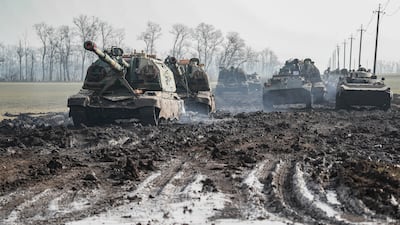
  • A group of 2S19 Msta vehicles stand on the road in the Rostov region of Russia. EPA
    A group of 2S19 Msta vehicles stand on the road in the Rostov region of Russia. EPA
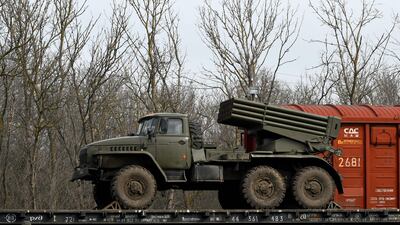
  • A BM-21 Grad truck is seen loaded on train platforms some 50km from the border with the self-proclaimed Donetsk People's Republic, in Russia's southern Rostov region. AFP
    A BM-21 Grad truck is seen loaded on train platforms some 50km from the border with the self-proclaimed Donetsk People's Republic, in Russia's southern Rostov region. AFP
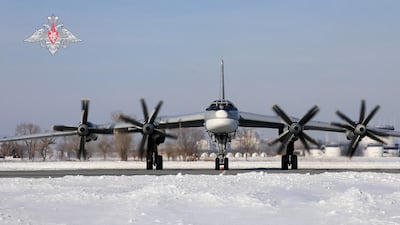
  • A Russian Tu-95MS bomber aircraft during the Grom-2022 Strategic Deterrence Force exercise at an undefined location in Russia. AFP
    A Russian Tu-95MS bomber aircraft during the Grom-2022 Strategic Deterrence Force exercise at an undefined location in Russia. AFP
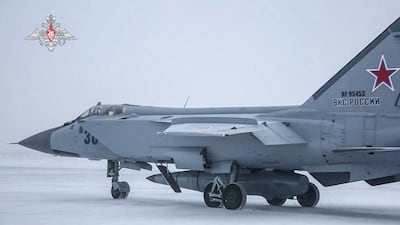
  • A MiG-31K fighter of the Russian air force carrying a Kinzhal hypersonic cruise missile during the Grom-2022 Strategic Deterrence Force exercise at an undefined location in Russia. AFP
    A MiG-31K fighter of the Russian air force carrying a Kinzhal hypersonic cruise missile during the Grom-2022 Strategic Deterrence Force exercise at an undefined location in Russia. AFP
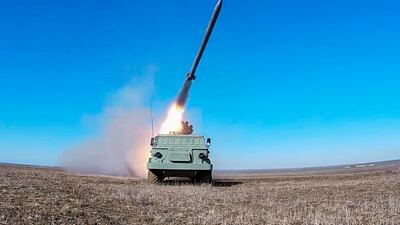
  • A Russian Iskander-K missile launching during a training launch as part of the Grom-2022 Strategic Deterrence Force exercise at an undefined location in Russia. AFP
    A Russian Iskander-K missile launching during a training launch as part of the Grom-2022 Strategic Deterrence Force exercise at an undefined location in Russia. AFP
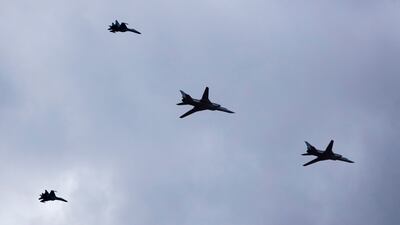
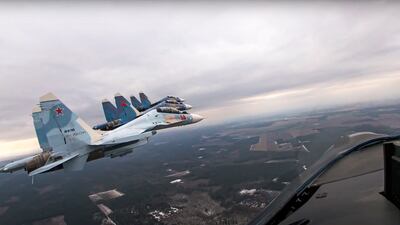
  • Two Tu-22M3 bombers escorted by Su-35 fighters of the Russian air force during the Union Courage-2022 Russia-Belarus military drills in Belarus. AP Photo
    Two Tu-22M3 bombers escorted by Su-35 fighters of the Russian air force during the Union Courage-2022 Russia-Belarus military drills in Belarus. AP Photo
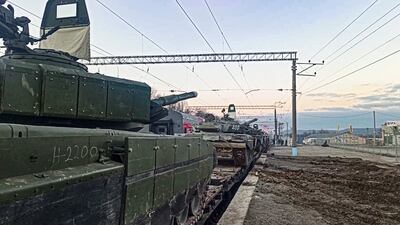
  • Russian army tanks are loaded on to railway platforms to move back to their permanent base after drills in Russia. AP Photo
    Russian army tanks are loaded on to railway platforms to move back to their permanent base after drills in Russia. AP Photo
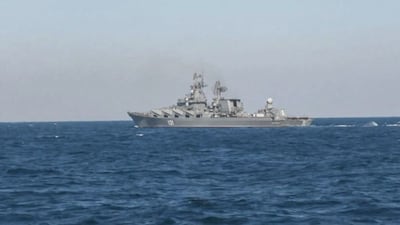
  • A 'Moskva' Russian cruiser during the Black sea naval exercises outside the Crimean port of Sevastopol. AFP
    A 'Moskva' Russian cruiser during the Black sea naval exercises outside the Crimean port of Sevastopol. AFP
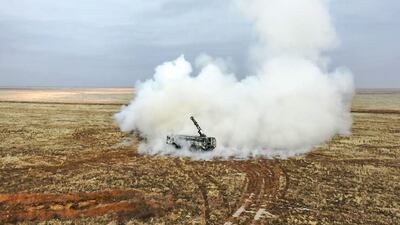
  • A BM-27 Uragan self-propelled multiple rocket launcher system during a live firing drill at the 'Opuk' interspecific training ground in Crimea. EPA
    A BM-27 Uragan self-propelled multiple rocket launcher system during a live firing drill at the 'Opuk' interspecific training ground in Crimea. EPA
  • Russian tanks leaving for Russia after joint exercises of the armed forces of Russia and Belarus. AFP
    Russian tanks leaving for Russia after joint exercises of the armed forces of Russia and Belarus. AFP
  • Su-30 fighters of the Russian and Belarusian air forces fly in a joint mission during the Union Courage-2022 Russia-Belarus military drills in Belarus. AP Photo
    Su-30 fighters of the Russian and Belarusian air forces fly in a joint mission during the Union Courage-2022 Russia-Belarus military drills in Belarus. AP Photo
  • Russian armoured vehicles are loaded on to railway platforms after the end of military drills in southern Russia. AP Photo
    Russian armoured vehicles are loaded on to railway platforms after the end of military drills in southern Russia. AP Photo

Exemptions would need approval from US President Joe Biden but only after making the case that these countries are trying to phase out Russian arms imports in the long run.

Bilal Wahab, a senior scholar who studies Iraq at the Washington Institute for Near East Policy, said Baghdad is attempting to balance different interests with its reaction to the war.

“Iraq has abstained from condemning the Russian invasion of Ukraine at the UNGA. That is a factor of Iranian influence on one hand and keeping the door open for ties with Russia,m especially as Iraqis feel the US is becoming increasingly aloof,” Mr Wahab told The National.

He said Russian defence co-operation was still necessary for the Iraqi government in the absence of US alternatives.

“The Iranian missile attacks on Erbil should focus Iraq's need for developing its own missile and air defence systems. With US Patriot missile systems in short supply and needed urgently in Europe, Baghdad could rekindle discussions it had with Moscow over the purchase of the Russian S-300 system,” he said.

Iraq has floated the idea of purchasing the S-300 and the more advanced S-400 system since 2018.

S-400 air defence systems are tested in a training exercise at a military base in Kaliningrad, Russia. Reuters

Hakim Al Zamili, a former militia commander loyal to Moqtada Al Sadr, whose party holds the majority of seats in Iraq’s Parliament, told Russia’s Tass news agency that the S-400 could “stop Iraq from becoming an open arena for realisation of US plans”.

Al Zamili was formerly head of the parliamentary security and defence committee and is now deputy speaker.

This month, Iraqi-Kurdish news agency Rudaw reported that the Central Bank of Iraq had suggested the Iraqi government holds off signing contracts with Russia “to protect the Iraqi financial system” from western sanctions.

US arming Iraq

The US has provided Iraq with tens of billions of dollars of military equipment since 2003, an issue that made headlines when ISIS seized hundreds of Humvees and artillery pieces as they took Mosul in 2014.

While some equipment was donated, much has been purchased, notably 36 F-16 fighter jets, in deals worth at least $4.3bn with continuing maintenance contracts. The US also gave Iraq a $3bn credit line to buy US weapons during the war on ISIS.

Big-ticket items supplied to Baghdad include about 140 M1A1 Abrams tanks, an older model of what analysts regard as one of the best tanks in the world.

The US donated about 250 Mine Resistant Armoured Personnel Carriers (MRAPs) at the height of the war against ISIS, a small number of replacement M1A1 tanks and tens of thousands of small arms, including 10,000 M16 assault rifles in a single donation in 2015.

Some experts say that Iraqis prefer Russian equipment, which made up the bulk of the Iraqi army’s gear during Saddam Hussein’s rule, as well as post-2003.

US equipment is considered high maintenance and prone to breakdown without specially trained mechanics. At the height of the war with ISIS, amid an oil price collapse, Iraq borrowed $2.7bn solely to maintain high-end US weapons.

In lieu of more complex US systems, Iraq has increased purchases of Russian tanks including the T-90S made by Uralvagonzavod. Iraq already has a fleet of 73 T-90Ss and is building a new brigade of the vehicles.

Iraq has also placed large orders for the BMP-3 infantry carrier made by Kurganmashzavod.

Uralvagonzavod was sanctioned by the US after the Crimea annexation, as Kurganmashzavod was in March. Both companies could struggle to obtain vital foreign-made components for their vehicles.

Iraqi army’s plan B

Iraqi military leaders have plans to avoid repercussions, a senior Defence Ministry official told The National.

“Our sources for arms are widely varied as we have different agreements, understandings and good relations and co-operation with many countries in this regard,” the official said. “Besides the US, our weapons are coming from some European countries including Ukraine, China, South Korea and others.

“We can rely on other countries, mainly the Eastern European ones, who still produce Russian arms and even spare parts."

Iraq has begun talks with countries such as Saudi Arabia, the UAE and France to boost security co-operation but they are still at early stages, he said.

The country is working on expanding its own military industry, revived after 2014 with production lines for ammunition.

“There’s still a long way to go but it can meet some of our needs now and can be expanded with further co-operation with other countries,” the official said.


COMPANY%20PROFILE
%3Cp%3E%3Cstrong%3EName%3A%20%3C%2Fstrong%3ESmartCrowd%0D%3Cbr%3E%3Cstrong%3EStarted%3A%20%3C%2Fstrong%3E2018%0D%3Cbr%3E%3Cstrong%3EFounder%3A%20%3C%2Fstrong%3ESiddiq%20Farid%20and%20Musfique%20Ahmed%0D%3Cbr%3E%3Cstrong%3EBased%3A%20%3C%2Fstrong%3EDubai%0D%3Cbr%3E%3Cstrong%3ESector%3A%20%3C%2Fstrong%3EFinTech%20%2F%20PropTech%0D%3Cbr%3E%3Cstrong%3EInitial%20investment%3A%20%3C%2Fstrong%3E%24650%2C000%0D%3Cbr%3E%3Cstrong%3ECurrent%20number%20of%20staff%3A%3C%2Fstrong%3E%2035%0D%3Cbr%3E%3Cstrong%3EInvestment%20stage%3A%20%3C%2Fstrong%3ESeries%20A%0D%3Cbr%3E%3Cstrong%3EInvestors%3A%20%3C%2Fstrong%3EVarious%20institutional%20investors%20and%20notable%20angel%20investors%20(500%20MENA%2C%20Shurooq%2C%20Mada%2C%20Seedstar%2C%20Tricap)%3C%2Fp%3E%0A
The specs
 
Engine: 3.0-litre six-cylinder turbo
Power: 398hp from 5,250rpm
Torque: 580Nm at 1,900-4,800rpm
Transmission: Eight-speed auto
Fuel economy, combined: 6.5L/100km
On sale: December
Price: From Dh330,000 (estimate)
COMPANY%20PROFILE%20
%3Cp%3E%3Cstrong%3ECompany%20name%3A%20%3C%2Fstrong%3EAlmouneer%3Cbr%3E%3Cstrong%3EStarted%3A%3C%2Fstrong%3E%202017%3Cbr%3E%3Cstrong%3EFounders%3A%3C%2Fstrong%3E%20Dr%20Noha%20Khater%20and%20Rania%20Kadry%3Cbr%3E%3Cstrong%3EBased%3A%20%3C%2Fstrong%3EEgypt%3Cbr%3E%3Cstrong%3ENumber%20of%20staff%3A%20%3C%2Fstrong%3E120%3Cbr%3E%3Cstrong%3EInvestment%3A%20%3C%2Fstrong%3EBootstrapped%2C%20with%20support%20from%20Insead%20and%20Egyptian%20government%2C%20seed%20round%20of%20%3Cbr%3E%243.6%20million%20led%20by%20Global%20Ventures%3Cbr%3E%3C%2Fp%3E%0A
Timeline

2012-2015

The company offers payments/bribes to win key contracts in the Middle East

May 2017

The UK SFO officially opens investigation into Petrofac’s use of agents, corruption, and potential bribery to secure contracts

September 2021

Petrofac pleads guilty to seven counts of failing to prevent bribery under the UK Bribery Act

October 2021

Court fines Petrofac £77 million for bribery. Former executive receives a two-year suspended sentence 

December 2024

Petrofac enters into comprehensive restructuring to strengthen the financial position of the group

May 2025

The High Court of England and Wales approves the company’s restructuring plan

July 2025

The Court of Appeal issues a judgment challenging parts of the restructuring plan

August 2025

Petrofac issues a business update to execute the restructuring and confirms it will appeal the Court of Appeal decision

October 2025

Petrofac loses a major TenneT offshore wind contract worth €13 billion. Holding company files for administration in the UK. Petrofac delisted from the London Stock Exchange

November 2025

180 Petrofac employees laid off in the UAE

Jetour T1 specs

Engine: 2-litre turbocharged

Power: 254hp

Torque: 390Nm

Price: From Dh126,000

Available: Now

Who's who in Yemen conflict

Houthis: Iran-backed rebels who occupy Sanaa and run unrecognised government

Yemeni government: Exiled government in Aden led by eight-member Presidential Leadership Council

Southern Transitional Council: Faction in Yemeni government that seeks autonomy for the south

Habrish 'rebels': Tribal-backed forces feuding with STC over control of oil in government territory

Avatar: Fire and Ash

Director: James Cameron

Starring: Sam Worthington, Sigourney Weaver, Zoe Saldana

Rating: 4.5/5

Mercer, the investment consulting arm of US services company Marsh & McLennan, expects its wealth division to at least double its assets under management (AUM) in the Middle East as wealth in the region continues to grow despite economic headwinds, a company official said.

Mercer Wealth, which globally has $160 billion in AUM, plans to boost its AUM in the region to $2-$3bn in the next 2-3 years from the present $1bn, said Yasir AbuShaban, a Dubai-based principal with Mercer Wealth.

Within the next two to three years, we are looking at reaching $2 to $3 billion as a conservative estimate and we do see an opportunity to do so,” said Mr AbuShaban.

Mercer does not directly make investments, but allocates clients’ money they have discretion to, to professional asset managers. They also provide advice to clients.

“We have buying power. We can negotiate on their (client’s) behalf with asset managers to provide them lower fees than they otherwise would have to get on their own,” he added.

Mercer Wealth’s clients include sovereign wealth funds, family offices, and insurance companies among others.

From its office in Dubai, Mercer also looks after Africa, India and Turkey, where they also see opportunity for growth.

Wealth creation in Middle East and Africa (MEA) grew 8.5 per cent to $8.1 trillion last year from $7.5tn in 2015, higher than last year’s global average of 6 per cent and the second-highest growth in a region after Asia-Pacific which grew 9.9 per cent, according to consultancy Boston Consulting Group (BCG). In the region, where wealth grew just 1.9 per cent in 2015 compared with 2014, a pickup in oil prices has helped in wealth generation.

BCG is forecasting MEA wealth will rise to $12tn by 2021, growing at an annual average of 8 per cent.

Drivers of wealth generation in the region will be split evenly between new wealth creation and growth of performance of existing assets, according to BCG.

Another general trend in the region is clients’ looking for a comprehensive approach to investing, according to Mr AbuShaban.

“Institutional investors or some of the families are seeing a slowdown in the available capital they have to invest and in that sense they are looking at optimizing the way they manage their portfolios and making sure they are not investing haphazardly and different parts of their investment are working together,” said Mr AbuShaban.

Some clients also have a higher appetite for risk, given the low interest-rate environment that does not provide enough yield for some institutional investors. These clients are keen to invest in illiquid assets, such as private equity and infrastructure.

“What we have seen is a desire for higher returns in what has been a low-return environment specifically in various fixed income or bonds,” he said.

“In this environment, we have seen a de facto increase in the risk that clients are taking in things like illiquid investments, private equity investments, infrastructure and private debt, those kind of investments were higher illiquidity results in incrementally higher returns.”

The Abu Dhabi Investment Authority, one of the largest sovereign wealth funds, said in its 2016 report that has gradually increased its exposure in direct private equity and private credit transactions, mainly in Asian markets and especially in China and India. The authority’s private equity department focused on structured equities owing to “their defensive characteristics.”

The biog

Date of birth: 27 May, 1995

Place of birth: Dubai, UAE

Status: Single

School: Al Ittihad private school in Al Mamzar

University: University of Sharjah

Degree: Renewable and Sustainable Energy

Hobby: I enjoy travelling a lot, not just for fun, but I like to cross things off my bucket list and the map and do something there like a 'green project'.

Updated: March 22, 2022, 8:42 AM