

Israeli politicians reinstated a law barring Palestinian spouses from the occupied West Bank and Gaza Strip from obtaining citizenship via marriage to Israeli citizens.
The law will deny naturalisation to Arabs from the Palestinian territories married to Israeli citizens, forcing thousands of Palestinian families to make the impossible choice of either emigrating or living apart.
Dozens of politicians in the 120-seat chamber did not cast their votes on the divisive legislation that was passed on Thursday.
The bill passed into law in a 45-15 vote.
Known as the “citizenship law”, it reinstates a ban that was first enacted in 2003 during the second Palestinian intifada, or uprising.
The legislation had been renewed continuously until last July, when Prime Minister Naftali Bennett's newly sworn-in coalition did not unite around it after failing to gain the support of the opposition.
Mr Bennett's hawkish Yamina party allied with right-wing factions in the opposition to pass the legislation, ignoring the protests of more liberal parties inside and outside government.
Proponents say the bill helps to ensure Israel's security and maintain its “Jewish character”.
Some Knesset members said it was intended to prevent a gradual right of return for Palestinian refugees who were driven from their homes or fled during the 1948 war that led to Israel's creation.
Under the terms of the citizenship law, which will be valid for a one-year period, Palestinian spouses of Israelis can obtain two-year residence permits, which can be revoked on security grounds.
The restored legislation will have an outsize effect on Israel's 20 per cent Arab minority, who share language, family and cultural ties with Palestinians in the territories Israel has occupied since 1967.
“The combination of forces between the coalition and the opposition led to an important result for the security of the state and its fortification as a Jewish state,” said Interior Minister Ayelet Shaked, the driving force behind the bill and a member of Mr Bennett's party.
-
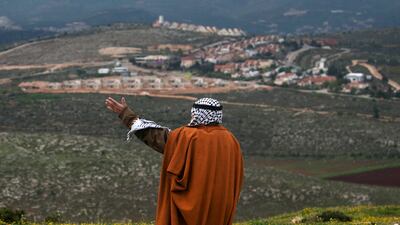
Abdallah Haj Mohamad, head of Jalud village's council, stands in front of the Jewish settlement of Shvut Rachel during a tour organised by Palestinian authorities to show the development of Israeli settlements in the occupied West Bank, on March 16, 2017. All photos: AFP -
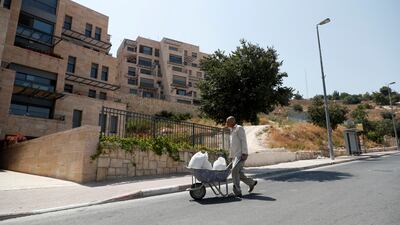
A picture taken on September 10, 2017 from Jabel Mukaber, a Palestinian neighbourhood In Israeli-occupied East Jerusalem, shows a worker pushing a cart in the Israeli settlement of Nof Zion. -
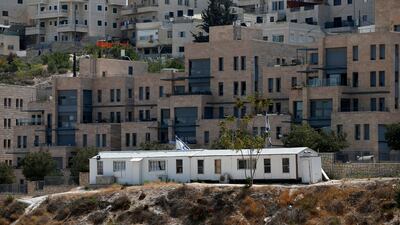
Another picture taken on September 10, 2017 from Jabel Mukaber shows the Israeli settlement of Nof Zion in the foreground. -
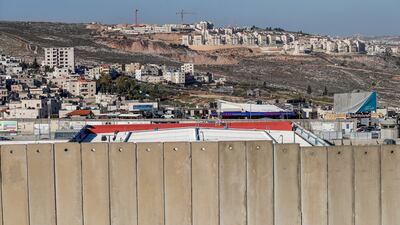
This picture taken on February 13, 2020 shows a section of Israel's separation barrier on the outskirts of Israeli-annexed East Jerusalem in the foreground, the Qalandia camp for Palestinian refugees in the occupied West Bank behind, and Israeli construction cranes at work on new housing units in the Jewish settlement of Kochav Ya'akov in the background. -

This picture taken on September 11, 2018 shows a view of the Palestinian Bedouin village of Khan al-Ahmar, located in a strategic spot in the occupied West Bank east of Jerusalem along the road to the Dead Sea near Israeli settlements. -
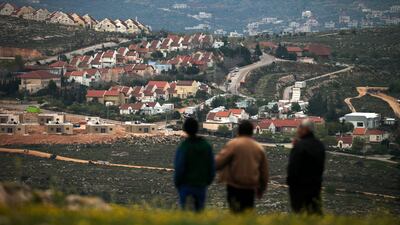
People look at the Jewish settlement of Shvut Rachel during a tour organised by the Palestinian authorities for ambassadors based in Tel Aviv and consuls based in Jerusalem to show the development of Israeli settlements in the occupied West Bank, on March 16, 2017. -

A picture taken on February 2, 2020, shows a general view of the Israeli settlement of Alon, in the Judaean desert, east of Jerusalem in the Israeli-occupied West Bank. -

A picture taken on January 27, 2020 shows the Israeli settlement Neve Yaakov, one of Jerusalem's neighbourhoods that falls between east Jerusalem and al-Ram in the occupied West Bank. -
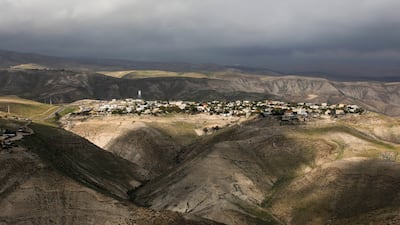
A picture taken on February 2, 2020, shows a general view of the Israeli settlement of Alon, in the Judaean desert, east of Jerusalem in the Israeli-occupied West Bank. -
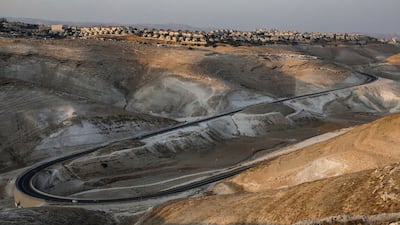
This picture taken from the Palestinian village of al-Sawahre, near the village of Abu Dis in the occupied West Bank on September 20, 2019 shows a view of the Israeli settlement of Maale Adumim.


Bezalel Smotrich of the nationalist Religious Zionism bloc said the law was “a correct and good outline”.
Politician Gaby Lasky from the dovish Meretz party called the law “a black spot on the book of laws in Israel” and wrote on Twitter that “Meretz, as a whole, voted against racism”.
Mansour Abbas, the head of the Raam Islamist party, also opposed the legislation.
Several rights groups have announced that they will challenge the law in Israel's Supreme Court.
“The justices will now have to decide whether, when faced with the law's explicit language, they will continue to allow this racist law to be protected under the eternal pretext of temporality,” said the Adalah advocacy group.
“It comes off as more xenophobic or racist [than other laws] because it is not only giving extra rights and privileges to Jewish people, but also preventing certain basic rights only from the Arab population,” said Reut Shaer, a lawyer with the Association of Civil Rights in Israel.
The law also bars the union of Israeli citizens or residents and spouses from “enemy states”, such as Lebanon, Syria and Iran. However, it mostly affects Palestinian women and children, said Ms Shaer.
It is a form of “collective punishment” because it infringes on the rights of an entire population based on the racist assumption that they are all prone to terrorism, she said.
Israel captured East Jerusalem, the West Bank and Gaza in the 1967 Middle East war.

