
Israel's new grand coalition has won the confidence of the Knesset and is now the official government – ending the 12-year premiership of Benjamin Netanyahu.
With the first test completed, the coalition – which brings together religious, secular, nationalist, leftist, centrist and Arab parties – now has to prove it can overcome its internal contradictions and differences to govern Israel.
The plan, hashed out in the days before the vote on Sunday night, will see the new government focus on internal issues and righting the economy after the Covid-19 pandemic.
Contentious issues, such as the Arab-Israeli peace process, will be put on the back burner, even as Egypt tries to broker a lasting ceasefire after an 11-day conflict in May between Israel and Hamas in Gaza.
Naftali Bennett of the nationalist right-wing Yamina will lead the coalition as prime minister for the first half of the term with Yair Lapid of Yesh Atid – the man who assembled the coalition and whose party is the largest member of the bloc – serving as prime minister for the final two years.
-

People celebrate after Israel's parliament voted in a new coalition government, ending Benjamin Netanyahu's 12-year hold on power, at Rabin Square in Tel Aviv, Israel. Reuters -

People celebrate after Israel's parliament voted in a new coalition government, ending Benjamin Netanyahu's 12-year hold on power, at Rabin Square in Tel Aviv, Israel. Reuters -
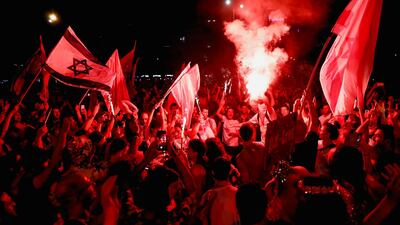
People celebrate after Israel's parliament voted in a new coalition government, ending Benjamin Netanyahu's 12-year hold on power, at Rabin Square in Tel Aviv, Israel. Reuters -

People celebrate after Israel's parliament voted in a new coalition government, ending Benjamin Netanyahu's 12-year hold on power, at Rabin Square in Tel Aviv, Israel. Reuters -

People celebrate after Israel's parliament voted in a new coalition government, ending Benjamin Netanyahu's 12-year hold on power, at Rabin Square in Tel Aviv, Israel. Reuters -
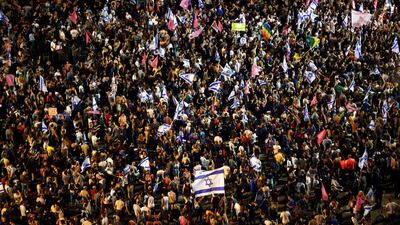
People celebrate after Israel's parliament voted in a new coalition government, ending Benjamin Netanyahu's 12-year hold on power, at Rabin Square in Tel Aviv, Israel. Reuters -

People play in front of a banner with pictures of former Prime Minister Benjamin Netanyahu after Israel's parliament voted in a new coalition government, ending Netanyahu's 12-year hold on power, in Tel Aviv, Israel. Reuters -
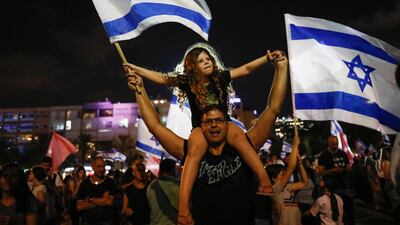
People celebrate after Israel's parliament voted in a new coalition government, ending Benjamin Netanyahu's 12-year hold on power, at Rabin Square in Tel Aviv, Israel. Reuters -

People celebrate after Israel's parliament voted in a new coalition government, ending Benjamin Netanyahu's 12-year hold on power, at Rabin Square in Tel Aviv, Israel. Reuters -
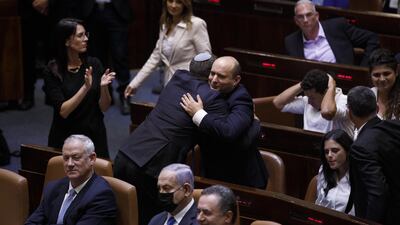
Naftali Bennett, Israeli's new prime minister and leader of the Yamina party, embraces an attendee at the Knesset in Jerusalem, Israel. Bloomberg -
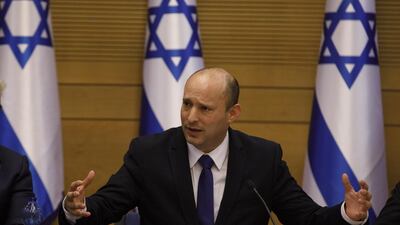
Naftali Bennett, Israeli's new prime minister and leader of the Yamina party, speaks during a meeting of the new government at the Knesset in Jerusalem, Israel. Bloomberg


Here are the main players in the new 61-seat coalition:
Yair Lapid: Yesh Atid (There Is a Future) 17 seats

Mr Lapid, a 57-year-old secular centrist, was given the task of forming a government in the past month after Mr Netanyahu failed to put together his own coalition following elections in March – the fourth inconclusive vote in less than two years. His party, Yesh Atid holds 17 seats, making it the largest in the coalition.
He began his television career in 1994 as the anchor of an evening news programme, but transitioned into politics in 2012, when he founded Yesh Atid (There Is a Future).
Mr Lapid served under Mr Netanyahu from 2013 as Israel's finance minister but joined the opposition in 2015. In 2019, Yesh Atid joined up with two other parties – Telem and the Israel Resilience Party – to form the Blue and White alliance.
Benny Gantz: Kahol Lavan (Blue and White) 8 seats

Benny Gantz, 62, was the 20th Israel military chief of general staff before he became a centrist opponent of Mr Netanyahu. After battling three elections to a near dead-heat with the longest-serving Israeli prime minister, he joined a coalition with the Likud head but that fell apart leading to the March election.
Mr Gantz has sought a similar anti-Netanyahu coalition before. In the lead up to the April 2019 election, he joined his Israel Resilience Party with Yair Lapid's Yesh Atid to form the Kahol Lavan, or Blue and White – the colours of the Israeli flag – citing their "national responsibility". Centre-right party Telem also joined the alliance.
When they failed to unseat Mr Netanhayu, Mr Lapid returned to his original party and Telem also departed, but Mr Gantz continued to head Blue and White, which now holds eight seats in the Knesset.
Mr Netanyahu praised the military man for decades of "excellent service", describing him as "a high-quality, ethical, responsible, balanced and thoughtful chief of staff".
Naftali Bennett: Yamina (Rightwards) 7 seats
One of Mr Netanyahu's former proteges, Mr Bennett, 49, is now set to become the coalition's prime minister for two years, before rotating with Mr Lapid. The seven seats his right-wing Yamina party won in the March elections secured his place as kingmaker in the coalition.
The nationalist tech millionaire is known for his aspirations to expand Israel's settlements and annex up to 60 per cent of the West Bank.
Mr Bennett made his debut as Mr Netanyahu’s chief of staff for two years.
The two clashed when Mr Bennett fiercely opposed Mr Netanyahu's decision in late 2009 to slow settlement construction – a US-led effort to encourage Palestinians to renew peace talks.
Mr Bennett briefly served as head of the West Bank settler’s council, Yesha.
Two months ago, Mr Bennett signed a pledge on national television.
“I won’t let Lapid become prime minister, with or without a rotation, because I’m a man of the right and for me, values are important,” he said.
Avigdor Lieberman: Israel Beiteinu (Israel Our Home) 7 seats

Despite forming part of the Likud-led bloc in the 20th Knesset and running on a joint platform with Likud for the 19th Knesset, Yisrael Beiteinu leader Avigdor Lieberman, 62, has been vocal in his opposition to Mr Netanyahu and is now lending his party's six seats to Mr Lapid's coalition.
Mr Lieberman's party describes itself as "a national movement with the clear vision to follow in the bold path of Ze'ev Jabotinsky", the founder of Revisionist Zionism.
He served as director general of Likud from 1993 to 1996 and then as director general of the prime minister's office.
He founded and became head of the Yisrael Beiteinu party in 1999.
Mr Lieberman, 61, served two terms as foreign minister, from April 2009 to December 2012, and from November 2013 to May 2015.
Merav Michaeli: HaAvoda (Israeli Labour Party) 7 seats

Merav Michaeli, 54, currently heads HaAvoda (Israeli Labour Party), the largest left-wing party in the country, which has been the dominant partner in every government since 1948.
She has been a member of the foreign affairs and defence committees and subcommittees and is also a member of the house committee.
Ms Michaeli chairs the Zionist Union parliamentary group and has engaged in extensive political activity in sectors including society, economy, gender equality and LGBT and worker rights.
Prior to her election to the Knesset, Ms Michaeli was a journalist, regularly producing op-eds and interviews for Haaretz newspaper.
Gideon Sa'ar: Tikva Hadasha (New Hope) 6 seats

Gideon Sa’ar, 54, head of the New Hope party, has played a role in Israeli politics for almost two decades. He has served as aide to the attorney general and the state attorney, as well as serving as Benjamin Netanyahu’s Cabinet secretary.
Elected to the Knesset in 2003, he has served as the Likud parliamentary group chairman.
In 2013, he was appointed minister of internal affairs.
But in December 2020, Mr Sa’ar announced that he would leave Likud and form his own party, New Hope.
Mr Sa’ar is opposed to a two-state solution to the conflict with Palestine and has called for the annexation of the occupied West Bank, while being open to allowing the Palestinians autonomy in a federation with Jordan.
Nitzan Horowitz: Meretz (Vigour) 6 seats

Nitzan Horowitz, 56, leader of Meretz, has largely championed social issues, advocating the rights of African migrants in Tel Aviv and criticising the existence of homophobia in the city.
The Meretz party is a left-wing, social-democratic and green party that reached its political peak between 1992 and 1996, when it had 12 seats. In the March elections, it won six seats.
Mr Horowitz, a 56-year-old former television journalist, served two full terms in the Knesset between 2009 and 2015.
Before being elected to the Knesset, he was the foreign affairs commentator and head of the international desk at Hadashot 10, the news division of Israel's Channel 10.
Mansour Abbas: Ra'am (United Arab List) 4 seats

Mansour Abbas, 47, made history on Sunday night by becoming the first Arab politician in Israel to join the government, taking the position of deputy minister of Arab affairs in the Prime Minister's office.
He is the leader of the small Islamist Arab party known by its Hebrew acronym, Ra'am, with four seats in the current Parliament. Ra'am is the political wing of the southern branch of Israel's Islamic Movement, which was established in 1971 and traces its origins to the Muslim Brotherhood.
Ra'am formally agreed to join a Lapid-Bennett coalition government, though it would not hold any Cabinet seats.
Mr Abbas's party split from Israel's main Arab coalition, the Joint List, before a March 23 election after advocating, unsuccessfully, that they work with Mr Netanyahu and other right-wing factions to improve living conditions for Arabs.
Although Arabs make up just over 20 per cent of Israel’s population, an Arab party has never before been part of an Israeli coalition government.
Ministers in Israel’s coalition government:
Prime Minister/Community Affairs: Naftali Bennett (Yamina)
- Alternate Prime Minister/Foreign Affairs: Yair Lapid (Yesh Atid)
- Deputy Prime Minister/Defence: Benny Gantz (Blue and White)
- Deputy Prime Minister/Justice: Gideon Sa'ar (New Hope)
- Finance: Avigdor Lieberman (Yisrael Beytenu)
- Education: Yifat Shasha-Biton (New Hope)
- Interior: Ayelet Shaked (Yamina)
- Health: Nitzan Horowitz (Meretz)
- Transport: Merav Michaeli (Labour)
- Environmental Protection: Tamar Zandberg (Meretz)
- Internal Security: Omer Bar-Lev (Labour)
- Communications: Yoaz Hendel (New Hope)
- Economy: Orna Barbivai (Yesh Atid)
- Labour, Social Services and Social Affairs: Meir Cohen (Yesh Atid)
- National Infrastructure, Energy and Water: Karine Elharrar (Yesh Atid)
- Diaspora Affairs: Nachman Shai (Labour)
- Intelligence: Elazar Stern (Yesh Atid)
- Tourism: Yoel Razvozov (Yesh Atid)
- Religious Affairs: Matan Kahana (Yamina)
- Culture and Sports: Hili Tropper (Blue and White)
- Aliyah and Integration: Pnina Tamano-Shata (Blue and White)
- Agriculture and Negev and Galilee Development: Oded Forer (Yisrael Beiteinu)
- Housing and Construction/Jerusalem Affairs and Heritage: Ze'ev Elkin (New Hope)
- Regional Co-operation: Issawi Frej (Meretz)
- Science and Technology: Orit Farkash-Hacohen (Blue and White)
- Social Equity: Meirav Cohen (Yesh Atid)
- Minister in the Finance Ministry: Hamad Amar (Yisrael Beiteinu)
Deputy ministers:
- deputy minister of Arab affairs in the Prime Minister's Office: Mansour Abbas (Ra'am)
- deputy minister of economic reforms in the Prime Minister's Office: Abir Kara (Yamina)
- deputy minister of defence: Alon Schuster (Blue and White)
- deputy minister of foreign Affairs: Idan Roll (Yesh Atid)
- deputy minister of internal security: Yoav Segalovich (Yesh Atid)
Knesset positions:
- Knesset Speaker: Mickey Levy (Yesh Atid)
Read more on Israel's coalition here:
New Israeli coalition ousts Netanyahu after parliament votes
Biden and Merkel lead international community in 'warm' welcome for new Israeli government
Crowds celebrate Israel's new coalition government
Israeli legislators elect Isaac Herzog for next president
Israeli PM-in-waiting Naftali Bennett's most controversial remarks

