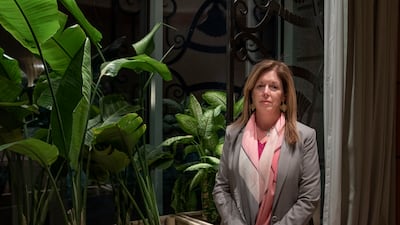

Libya must press ahead with free and fair elections or risk a national disaster with no end in sight, the UN secretary general's special adviser on Libya, Stephanie Williams, tells The National.
While the country faces interconnected security and economic problems, a major challenge stems from the desire of the country's elite to remain in power, she says.
Ms Williams says that the world ignores this power struggle at its peril.
She says that political wrangling has paralysed efforts to build a stable and resilient state. Meanwhile, reforms pursued to reinstate rule of law over the past year are now at risk of freezing or being rolled back.
“All of Libya's institutions suffer from a crisis of popular legitimacy, which can only be solved through the ballot box,” says Ms Williams, a former top US diplomat.
-

Vehicles of the "Tripoli Brigade", a militia loyal to the UN-recognised Government of National Accord (GNA), parade through the Martyrs' Square at the centre of the GNA-held Libyan capital Tripoli on July 10, 2020. AFP -

Vehicles of the "Tripoli Brigade", a militia loyal to the UN-recognised Government of National Accord (GNA), parade through the Martyrs' Square at the centre of the GNA-held Libyan capital Tripoli on July 10, 2020. AFP -
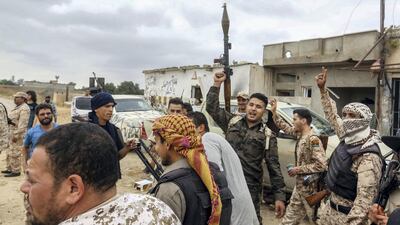
Fighters loyal to the Libyan internationally-recognised Government of National Accord (GNA) are pictured near the frontline during clashes against forces loyal to Khalifa Haftar, on June 1, 2019, in al-Sawani area, south of the Libyan capital Tripoli. AFP -
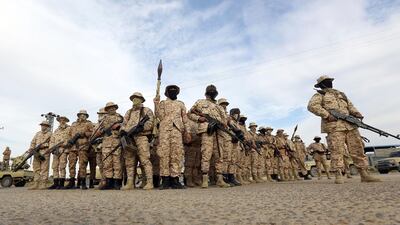
Members of the Tripoli Protection Force, an alliance of militias from the capital city, patrol an area south of the Libyan capital on January 18, 2019, during clashes with the Seventh Brigade group from the town of Tarhuna. Two days of clashes between rival militias near Libya's capital Tripoli have left 10 people dead and 41 wounded, the health ministry said on January 17. Fighting between armed groups erupted Wednesday despite a truce deal four months ago that had halted deadly battles in the city. AFP -
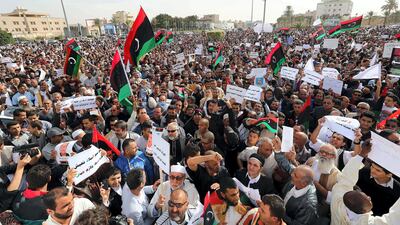
Libyans demonstrate in a street in the capital Tripoli to demand the withdrawal of all armed militias from the capital on November 22, 2013. Residents of Libya's capital were turning out Friday to press militias remaining in the city to follow others and withdraw, aiming to keep up the momentum following deadly clashes last weekend. Many of the groups have long rejected government calls to lay down their arms or integrate into the armed forces, triggering the frustration of Libyans who once hailed them as heroes for toppling Kadhafi. AFP


Libya's political situation has been highly volatile since December 24, when the country failed to hold its first presidential election.
At the time, Ms Williams had only recently taken on the role of senior UN official in the country, holding urgent meetings to stop the fragile political process from going adrift – and potentially turning violent.
the UN secretary general's special adviser on Libya
Libya descended into chaos after the Nato-backed overthrow of longtime autocrat Muammar Qaddafi in 2011.
After failed peace efforts, in October 2020 the two major sides in Libya's civil war – the UN-recognised Government of National Accord in Tripoli and the self-styled Libyan National Army based in the east – agreed a ceasefire.
Hostilities came to an end but both sides are still wary of each other, entrenching their positions militarily and politically.
A UN mediation effort convinced both sides to agree on a roadmap, setting the stage for presidential and parliamentary elections to end the war.
However, elections have been put on hold amid disputes over election laws and the candidacy of several controversial candidates, including Saif Al Islam Qaddafi, the second son of the former leader.
With no end in sight to the deadlock, Ms Williams says there is a simmering frustration among ordinary people in Libya after a decade of conflict.
“As a UN mediator, I work with all the parties in Libya, not only political and security actors, but also with civil society, activists, political parties, community leaders, municipalities and those who are paying most dearly the cost of the ongoing crisis,” she says.
“I am here to support Libyan ownership but also to push the institutions to shoulder their responsibilities towards the Libyan people, especially the 2.8 million citizens who registered to vote and desire an end to the long period of transition, which has afflicted the country since 2011,” Ms Williams says.
-
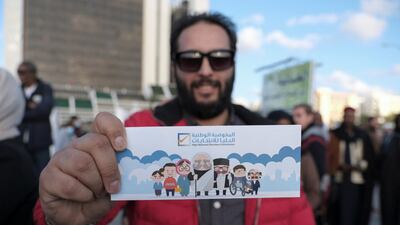
A man shows his electoral card during a protest against the postponement of the Libyan presidential election initially planned for December 24, 2021, in Benghazi, Libya. Reuters -
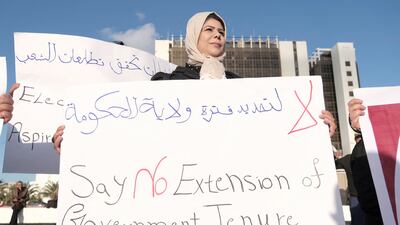
A woman holds a banner during a protest against the delay to the Libyan presidential election, in Benghazi, Libya, on December 24, 2021. Reuters -
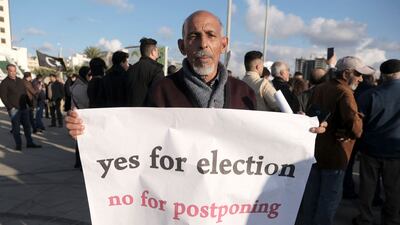
A man protests against the postponement of the Libyan presidential election, in Benghazi, Libya. Reuters -
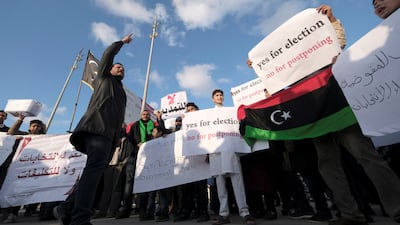
A demonstration against the postponement of the Libyan presidential election, in Benghazi, Libya. Reuters -
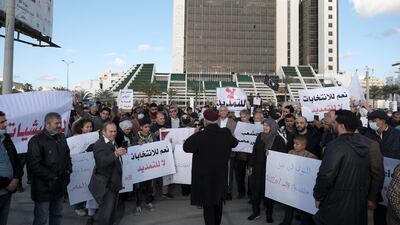
A protest in Benghazi, Libya, against the delaying of the presidential election. Reuters -
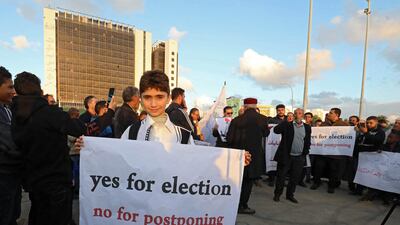
Libyans in Benghazi demonstrate against the postponement of elections. AFP -
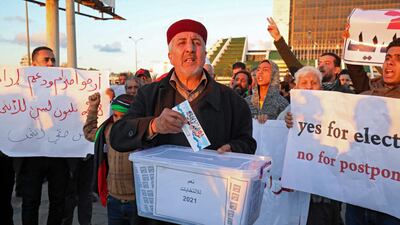
Libyans demonstrate against the postponement of elections, in the city of Benghazi. AFP


The threat of parallel institutions
The crisis in Libya today is related to tensions between two camps of politicians who have locked horns over the mandate of interim Prime Minister Abdul Hamid Dbeibah, who for a year has led a national unity government.
Economically, the country is crippled by the conflict and there are recurrent blockades and closures of vital oil fields, the main source of income. Libya has Africa’s biggest oil reserves.
Businesses and people struggle to carry out basic financial transactions or bank transfers because of these divisions, which cut across different sectors of the divided country.
The current stand-off is between the governor of the Central Bank in the west and his deputy in the east, with each one trying to overrule the other.
In 2014, a parallel government emerged in the east to compete for leverage against the government in the west, which at the time was riven with internal fighting.
Each government had its own political and financial institutions and claimed legitimacy, although for years the National Oil Corporation has managed to maintain relative neutrality, despite significant damage to energy infrastructure.
Today, fears of the re-emergence of parallel institutions has overtaken most of the national debate on the streets and on social media.
Ms Williams says that changing the government, if not done in accordance with political consensus, will further delay the end of the transitional period.
the UN secretary general's special adviser on Libya
“The decision on whether the parliament should endorse a new government is entirely sovereign and within the purview of Libyan institutions," she says.
"But we urge these institutions to operate transparently and consensually with all relevant stakeholders and actors, on the basis of established rules and procedures, including international agreements. We remind them of the demand of their people to focus on addressing the challenges which prevented the holding of the presidential elections on time,” she said.
Parliament convened on Thursday to vote for a new prime minister to replace Mr Dbeibah, who refuses to step aside before endorsing a constitution first and a presidential election takes place.
It declared former interior minister Fathi Bashagha as the new interim prime minister after a rival candidate withdrew, but it was not clear if the chamber had held a vote.
If confirmed, an apparent assassination attempt against Mr Dbeibah overnight in Tripoli was probably the culmination of the long stand-off and soaring tensions. Local media reported that his car was shot at by unidentified assailants but that he escaped unscathed.
Weaponisation of social media
Another complicating factor for the UN mediation effort is what Ms Williams calls the “weaponisation of traditional and social media”.
She is critical of widespread, misleading information campaigns targeting local and foreign actors.
“I am very concerned at the use of hate speech and incitement to violence, which is used in social media, especially against women who participate in Libya’s public and political life. This trend must be stopped through accountability and increased collective advocacy,” she said.
Asked about accusations by some politicians that the UN is not neutral and backs the incumbent government, Ms Williams says this is the best example of misleading information being circulated in Libya.
She says she has maintained an equal distance from all of the political actors in the North African country.
“The UN mediation is fully impartial and respectful of the sovereignty and independence of the countries where we work. But we are not neutral, as we stand for the principles enshrined in the UN Charter and implement decisions made by the Security Council, which in the case of Libya has endorsed a roadmap with specific milestones and timelines for the Libyan political transition,” she says.
“In accordance with our principles, we also have a moral obligation to lift the voices of the nearly three million registered voters who want elections on a level playing field as soon as possible to be able to choose representative institutions, including the executive.”