Tourists stranded by icy weather at Istanbul Airport on Tuesday staged a protest demanding hotel accommodation, leading to police being called to the terminal.
Scores of passengers, many of whom had to sleep on floors and benches the previous night, chanted “we need hotels” as they milled around the concourse.
“The riot police were called to prevent the protests at Istanbul Airport becoming excessive,” said Ali Kidik, a member of the Istanbul municipal assembly who filmed the scene. Turkish media carried pictures of about 60 police officers standing next to a large group of passengers.
“They dispatched police to tourists who wanted a hotel. Are you going to gas [them] and show us up even more to the world?” tweeted opposition MP Tuncay Ozkan.
Local passengers also criticised operations at the airport, which was fully opened less than three years ago amid concerns that its site left it vulnerable to turbulent weather from the Black Sea.
“You know, this airport is world-class,” one Turkish traveller told the Cumhuriyet newspaper. “It snowed and there are no flights for two days.”
Others flying from Istanbul decided to give up and return home when bus services to the city resumed. “We have been at the airport since two o’clock yesterday afternoon,” said Fiden Bilek, who was travelling to the southern city of Diyarbakir.
“Everything was gradually cancelled but we were told too late. We changed our ticket and the flight was cancelled again. There was no place to sleep or sit. We spent the night in the terminal with zero sleep. Now we are waiting for the bus. After that, we’ll take a taxi if we can find one.”
Some flights resumed on Tuesday, with the first flight since Monday afternoon, landing from Venezuela at 12.30pm but Turkish Airlines said it would not operate planes from the airport until at least midnight.
Another form of air transport was enlisted when a heart attack victim had to be taken to hospital. A military helicopter ferried the patient across the city.
Istanbul blanketed with snow
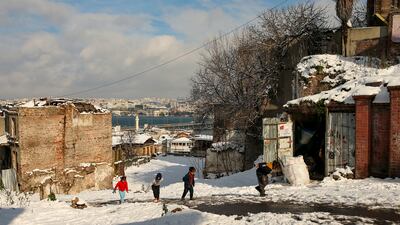
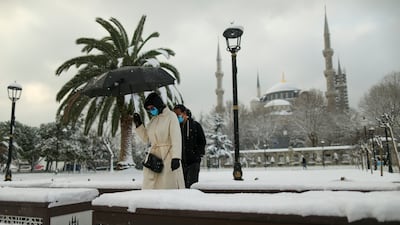
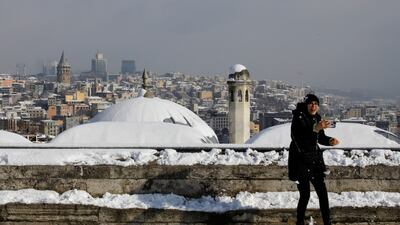
Across the city of 16 million, others took the opportunity to enjoy the weather.
In Beyoglu, the European district that includes tourism spots such as Taksim Square and Istiklal Avenue, one man was pictured riding a white horse through the snow and slush, to the delight and cheers of pedestrians.
Further west, PE teacher Fatih Isik dug out his skis and posted footage of himself off-piste on the streets of Avcilar. “Thank you to the authorities who turned Istanbul into Uludag,” he wrote, referring to the Turkish ski resort.
As many roads remained hazardous to traffic, there were instances of community spirit across Istanbul.
When a local bus became stuck on an icy road in Uskudar, one motorist attaching a tow rope and other passers-by, perhaps a little optimistically, lent a hand by getting behind the flailing bus to give it a shove.
Meanwhile, the meteorology authority announced heavy snow was expected late Tuesday around Kocaeli and Yalova to the south of Istanbul.
The effects of Monday’s severe storm remained in evidence, with cars abandoned on highways as snow of up to a metre deep was reported in remote parts of Istanbul province.
Governor Ali Yerlikaya announced that major roads from the north and south were reopened, although bus services remained suspended until Wednesday. Public ferries across the Bosphorus were also cancelled.
He said more than 5,000 people stranded on the roads had been rescued and nearly 3,200 placed in hotels and other accommodation. More than 18,000 personnel and 5,000 vehicles were involved in tackling some of the problems caused by the weather, such as repairing energy infrastructure and co-ordinating traffic.
Istanbul Metropolitan Municipality announced that about 48,000 travellers stranded on major roads had been supplied with water, tea and soup while more than 55,000 tonnes of salt had been scattered to help the city get moving again.
Municipal veterinary teams distributed two tonnes of food for street cats and dogs across the city.
Nurseries and daycare centres were shut and many public-sector employees were given administrative leave until Thursday. Istanbul universities were suspended until Monday and most postponed exams due to be held this week.
In southern Turkey, snow covered the Mediterranean beaches of Antalya for the first time in 29 years.

Timeline
2012-2015
The company offers payments/bribes to win key contracts in the Middle East
May 2017
The UK SFO officially opens investigation into Petrofac’s use of agents, corruption, and potential bribery to secure contracts
September 2021
Petrofac pleads guilty to seven counts of failing to prevent bribery under the UK Bribery Act
October 2021
Court fines Petrofac £77 million for bribery. Former executive receives a two-year suspended sentence
December 2024
Petrofac enters into comprehensive restructuring to strengthen the financial position of the group
May 2025
The High Court of England and Wales approves the company’s restructuring plan
July 2025
The Court of Appeal issues a judgment challenging parts of the restructuring plan
August 2025
Petrofac issues a business update to execute the restructuring and confirms it will appeal the Court of Appeal decision
October 2025
Petrofac loses a major TenneT offshore wind contract worth €13 billion. Holding company files for administration in the UK. Petrofac delisted from the London Stock Exchange
November 2025
180 Petrofac employees laid off in the UAE
The specs
Engine: 1.5-litre turbo
Power: 181hp
Torque: 230Nm
Transmission: 6-speed automatic
Starting price: Dh79,000
On sale: Now
Jetour T1 specs
Engine: 2-litre turbocharged
Power: 254hp
Torque: 390Nm
Price: From Dh126,000
Available: Now
Key findings of Jenkins report
- Founder of the Muslim Brotherhood, Hassan al Banna, "accepted the political utility of violence"
- Views of key Muslim Brotherhood ideologue, Sayyid Qutb, have “consistently been understood” as permitting “the use of extreme violence in the pursuit of the perfect Islamic society” and “never been institutionally disowned” by the movement.
- Muslim Brotherhood at all levels has repeatedly defended Hamas attacks against Israel, including the use of suicide bombers and the killing of civilians.
- Laying out the report in the House of Commons, David Cameron told MPs: "The main findings of the review support the conclusion that membership of, association with, or influence by the Muslim Brotherhood should be considered as a possible indicator of extremism."
COMPANY PROFILE
Founders: Alhaan Ahmed, Alyina Ahmed and Maximo Tettamanzi
Total funding: Self funded
Ten tax points to be aware of in 2026
1. Domestic VAT refund amendments: request your refund within five years
If a business does not apply for the refund on time, they lose their credit.
2. E-invoicing in the UAE
Businesses should continue preparing for the implementation of e-invoicing in the UAE, with 2026 a preparation and transition period ahead of phased mandatory adoption.
3. More tax audits
Tax authorities are increasingly using data already available across multiple filings to identify audit risks.
4. More beneficial VAT and excise tax penalty regime
Tax disputes are expected to become more frequent and more structured, with clearer administrative objection and appeal processes. The UAE has adopted a new penalty regime for VAT and excise disputes, which now mirrors the penalty regime for corporate tax.
5. Greater emphasis on statutory audit
There is a greater need for the accuracy of financial statements. The International Financial Reporting Standards standards need to be strictly adhered to and, as a result, the quality of the audits will need to increase.
6. Further transfer pricing enforcement
Transfer pricing enforcement, which refers to the practice of establishing prices for internal transactions between related entities, is expected to broaden in scope. The UAE will shortly open the possibility to negotiate advance pricing agreements, or essentially rulings for transfer pricing purposes.
7. Limited time periods for audits
Recent amendments also introduce a default five-year limitation period for tax audits and assessments, subject to specific statutory exceptions. While the standard audit and assessment period is five years, this may be extended to up to 15 years in cases involving fraud or tax evasion.
8. Pillar 2 implementation
Many multinational groups will begin to feel the practical effect of the Domestic Minimum Top-Up Tax (DMTT), the UAE's implementation of the OECD’s global minimum tax under Pillar 2. While the rules apply for financial years starting on or after January 1, 2025, it is 2026 that marks the transition to an operational phase.
9. Reduced compliance obligations for imported goods and services
Businesses that apply the reverse-charge mechanism for VAT purposes in the UAE may benefit from reduced compliance obligations.
10. Substance and CbC reporting focus
Tax authorities are expected to continue strengthening the enforcement of economic substance and Country-by-Country (CbC) reporting frameworks. In the UAE, these regimes are increasingly being used as risk-assessment tools, providing tax authorities with a comprehensive view of multinational groups’ global footprints and enabling them to assess whether profits are aligned with real economic activity.
Contributed by Thomas Vanhee and Hend Rashwan, Aurifer
Avatar: Fire and Ash
Director: James Cameron
Starring: Sam Worthington, Sigourney Weaver, Zoe Saldana
Rating: 4.5/5
RESULTS
Men – semi-finals
57kg – Tak Chuen Suen (MAC) beat Phuong Xuan Nguyen (VIE) 29-28; Almaz Sarsembekov (KAZ) beat Zakaria Eljamari (UAE) by points 30-27.
67kg – Mohammed Mardi (UAE) beat Huong The Nguyen (VIE) by points 30-27; Narin Wonglakhon (THA) v Mojtaba Taravati Aram (IRI) by points 29-28.
60kg – Yerkanat Ospan (KAZ) beat Amir Hosein Kaviani (IRI) 30-27; Long Doan Nguyen (VIE) beat Ibrahim Bilal (UAE) 29-28
63.5kg – Abil Galiyev (KAZ) beat Truong Cao Phat (VIE) 30-27; Nouredine Samir (UAE) beat Norapat Khundam (THA) RSC round 3.
71kg – Shaker Al Tekreeti (IRQ) beat Fawzi Baltagi (LBN) 30-27; Amine El Moatassime (UAE) beat Man Kongsib (THA) 29-28
81kg – Ilyass Hbibali (UAE) beat Alexandr Tsarikov (KAZ) 29-28; Khaled Tarraf (LBN) beat Mustafa Al Tekreeti (IRQ) 30-27
86kg – Ali Takaloo (IRI) beat Mohammed Al Qahtani (KSA) RSC round 1; Emil Umayev (KAZ) beat Ahmad Bahman (UAE) TKO round
A new relationship with the old country
Treaty of Friendship between the United Kingdom of Great Britain and Northern Ireland and the United Arab Emirates
The United kingdom of Great Britain and Northern Ireland and the United Arab Emirates; Considering that the United Arab Emirates has assumed full responsibility as a sovereign and independent State; Determined that the long-standing and traditional relations of close friendship and cooperation between their peoples shall continue; Desiring to give expression to this intention in the form of a Treaty Friendship; Have agreed as follows:
ARTICLE 1 The relations between the United Kingdom of Great Britain and Northern Ireland and the United Arab Emirates shall be governed by a spirit of close friendship. In recognition of this, the Contracting Parties, conscious of their common interest in the peace and stability of the region, shall: (a) consult together on matters of mutual concern in time of need; (b) settle all their disputes by peaceful means in conformity with the provisions of the Charter of the United Nations.
ARTICLE 2 The Contracting Parties shall encourage education, scientific and cultural cooperation between the two States in accordance with arrangements to be agreed. Such arrangements shall cover among other things: (a) the promotion of mutual understanding of their respective cultures, civilisations and languages, the promotion of contacts among professional bodies, universities and cultural institutions; (c) the encouragement of technical, scientific and cultural exchanges.
ARTICLE 3 The Contracting Parties shall maintain the close relationship already existing between them in the field of trade and commerce. Representatives of the Contracting Parties shall meet from time to time to consider means by which such relations can be further developed and strengthened, including the possibility of concluding treaties or agreements on matters of mutual concern.
ARTICLE 4 This Treaty shall enter into force on today’s date and shall remain in force for a period of ten years. Unless twelve months before the expiry of the said period of ten years either Contracting Party shall have given notice to the other of its intention to terminate the Treaty, this Treaty shall remain in force thereafter until the expiry of twelve months from the date on which notice of such intention is given.
IN WITNESS WHEREOF the undersigned have signed this Treaty.
DONE in duplicate at Dubai the second day of December 1971AD, corresponding to the fifteenth day of Shawwal 1391H, in the English and Arabic languages, both texts being equally authoritative.
Signed
Geoffrey Arthur Sheikh Zayed
Company%20profile
%3Cp%3E%3Cstrong%3ECompany%20name%3A%3C%2Fstrong%3E%20Fasset%0D%3Cbr%3E%3Cstrong%3EStarted%3A%20%3C%2Fstrong%3E2019%0D%3Cbr%3E%3Cstrong%3EFounders%3A%3C%2Fstrong%3E%20Mohammad%20Raafi%20Hossain%2C%20Daniel%20Ahmed%0D%3Cbr%3E%3Cstrong%3EBased%3A%3C%2Fstrong%3E%20Dubai%0D%3Cbr%3E%3Cstrong%3ESector%3A%20%3C%2Fstrong%3EFinTech%0D%3Cbr%3E%3Cstrong%3EInitial%20investment%3A%3C%2Fstrong%3E%20%242.45%20million%0D%3Cbr%3E%3Cstrong%3ECurrent%20number%20of%20staff%3A%3C%2Fstrong%3E%2086%0D%3Cbr%3E%3Cstrong%3EInvestment%20stage%3A%3C%2Fstrong%3E%20Pre-series%20B%0D%3Cbr%3E%3Cstrong%3EInvestors%3A%3C%2Fstrong%3E%20Investcorp%2C%20Liberty%20City%20Ventures%2C%20Fatima%20Gobi%20Ventures%2C%20Primal%20Capital%2C%20Wealthwell%20Ventures%2C%20FHS%20Capital%2C%20VN2%20Capital%2C%20local%20family%20offices%3C%2Fp%3E%0A
Mercer, the investment consulting arm of US services company Marsh & McLennan, expects its wealth division to at least double its assets under management (AUM) in the Middle East as wealth in the region continues to grow despite economic headwinds, a company official said.
Mercer Wealth, which globally has $160 billion in AUM, plans to boost its AUM in the region to $2-$3bn in the next 2-3 years from the present $1bn, said Yasir AbuShaban, a Dubai-based principal with Mercer Wealth.
“Within the next two to three years, we are looking at reaching $2 to $3 billion as a conservative estimate and we do see an opportunity to do so,” said Mr AbuShaban.
Mercer does not directly make investments, but allocates clients’ money they have discretion to, to professional asset managers. They also provide advice to clients.
“We have buying power. We can negotiate on their (client’s) behalf with asset managers to provide them lower fees than they otherwise would have to get on their own,” he added.
Mercer Wealth’s clients include sovereign wealth funds, family offices, and insurance companies among others.
From its office in Dubai, Mercer also looks after Africa, India and Turkey, where they also see opportunity for growth.
Wealth creation in Middle East and Africa (MEA) grew 8.5 per cent to $8.1 trillion last year from $7.5tn in 2015, higher than last year’s global average of 6 per cent and the second-highest growth in a region after Asia-Pacific which grew 9.9 per cent, according to consultancy Boston Consulting Group (BCG). In the region, where wealth grew just 1.9 per cent in 2015 compared with 2014, a pickup in oil prices has helped in wealth generation.
BCG is forecasting MEA wealth will rise to $12tn by 2021, growing at an annual average of 8 per cent.
Drivers of wealth generation in the region will be split evenly between new wealth creation and growth of performance of existing assets, according to BCG.
Another general trend in the region is clients’ looking for a comprehensive approach to investing, according to Mr AbuShaban.
“Institutional investors or some of the families are seeing a slowdown in the available capital they have to invest and in that sense they are looking at optimizing the way they manage their portfolios and making sure they are not investing haphazardly and different parts of their investment are working together,” said Mr AbuShaban.
Some clients also have a higher appetite for risk, given the low interest-rate environment that does not provide enough yield for some institutional investors. These clients are keen to invest in illiquid assets, such as private equity and infrastructure.
“What we have seen is a desire for higher returns in what has been a low-return environment specifically in various fixed income or bonds,” he said.
“In this environment, we have seen a de facto increase in the risk that clients are taking in things like illiquid investments, private equity investments, infrastructure and private debt, those kind of investments were higher illiquidity results in incrementally higher returns.”
The Abu Dhabi Investment Authority, one of the largest sovereign wealth funds, said in its 2016 report that has gradually increased its exposure in direct private equity and private credit transactions, mainly in Asian markets and especially in China and India. The authority’s private equity department focused on structured equities owing to “their defensive characteristics.”