

The UN will invite Sudanese military leaders, political parties and other groups to take part in a “political process” to end the crisis unleashed by the military takeover of their country in October.
In the weeks after the coup, UN mediation led to Prime Minister Abdalla Hamdok being reinstated, but his resignation on January 2 has deepened uncertainty on Sudan’s political future and a transition towards elections, scheduled for 2023.
Neighbourhood-based resistance committees, political parties and other pro-democracy groups are campaigning under a “no negotiation” slogan, and at least 60 people have died in crackdowns by security forces.
Unless a new course towards a transition and credible elections is charted, more instability within and beyond Sudanese borders is likely, analysts and diplomats have said.
-

Demonstrators gather in Sudan's capital Khartoum to protest against the October 2021 military takeover. AP -
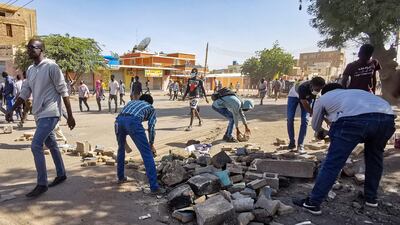
These latest protests follow the resignation of civilian prime minister Abdalla Hamdok this week, leaving the military fully in charge of the country. AFP -
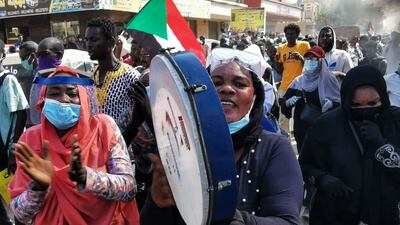
The military takeover led by Gen Abdel Fattah Al Burhan derailed Sudan's democratic transition and was widely criticised by the international community. AFP -
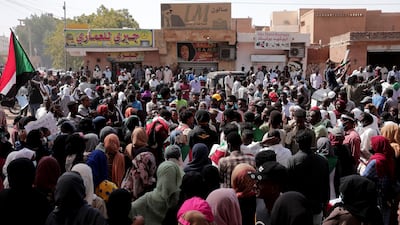
Sudanese took to the streets in the capital, Khartoum, and other cities in anti-coup protests as the country plunged further into turmoil. AP Photo -
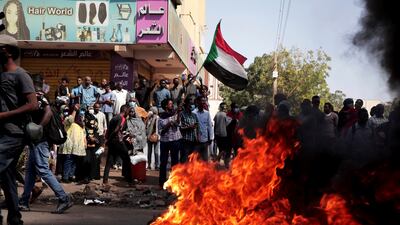
Security forces used tear gas to disperse thousands of pro-democracy protesters. AP -
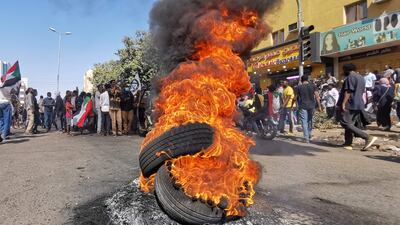
About 60 people have been killed and hundreds injured during the series of protests since last October's military takeover. AFP -
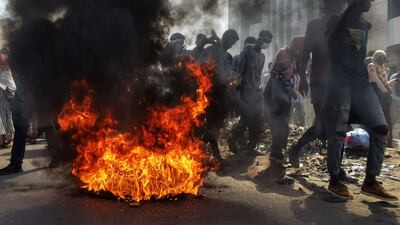
Protesters walk past burning tyres in the capital Khartoum. AFP -
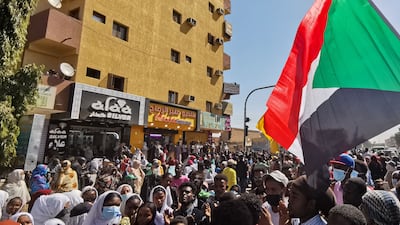
Protesters fly the Sudanese flag as they take to the streets of Khartoum. AFP -
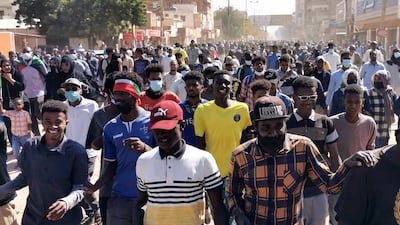
Protesters rally against military rule in Sudan. AFP


“All measures taken to date have not succeeded in restoring the course of this transformation,” UN Special Representative Volker Perthes said.
“The ... repeated violence against largely peaceful protesters has only served to deepen the mistrust among all political parties in Sudan.”
Sudan’s military, armed movements, political parties, civil society and resistance committees will be invited to participate, the UN statement said.
Security crackdowns continue
The use of lethal force to disburse protests is now a regular occurrence. Security forces shot dead three protesters and fired tear gas in Sudan on Thursday as crowds thronged the capital Khartoum and other cities in more anti-military rallies, medics and Reuters witnesses said.
The people killed on Thursday were all protesters and died from shots fired by security personnel during rallies in the cities of Omdurman and Bahri, across the River Nile from Khartoum, the Central Committee of Sudanese Doctors said.
Protesters tried once again to reach the presidential palace in the capital to keep up pressure on the military. The military has justified its actions as a “correction” needed to stabilise the transition.
It said peaceful protests are allowed and those responsible for causing casualties will be held to account.
In Omdurman, where several protesters have been killed in the past week, a protester said that security forces fired live rounds and tear gas, and ran over several protesters with armoured vehicles.
“There was incredible violence today. The situation in Omdurman has become very difficult. Our friends have died, this situation can’t please God,” one protester said.
Khartoum State’s health ministry said security forces had raided Arbaeen Hospital in Omdurman, attacking medical staff and injuring protesters. It said the forces also besieged Khartoum Teaching Hospital and fired tear gas inside the building.
In Bahri, a witness saw forces use heavy tear gas and stun grenades, with some canisters landing on houses and a school.
Protesters were prevented from reaching the bridge to Khartoum, the witness said.
In a statement, Sudanese police said: “The demonstrations witnessed a deviation from peacefulness and cases of aggression and violence by some demonstrators towards the forces present,”.
The statement said some members of the police and armed forces had been injured, and that three people had been arrested over the killing of two citizens in Omdurman.
Sixty people were arrested overall, it said.
UAE welcomes UN involvement
The UAE, Saudi Arabia, UK and US have welcomed the announcement that the UN is assisting discussions to resolve Sudan’s political crisis.
The countries, known as the Quad for Sudan, said: "We strongly support this UN-facilitated, Sudanese-led dialogue initiative. We urge all Sudanese political actors to seize this opportunity to restore the country’s transition to civilian democracy, in line with the 2019 Constitutional Declaration.
"We look forward to this being a result-oriented process that will guide the country towards democratic elections, in line with the Sudanese people’s manifest aspirations for freedom, democracy, peace, justice and prosperity."

