Lebanese Prime Minister Najib Mikati rebuked Hezbollah leader Hassan Nasrallah for his comments, distancing himself from the group. AP

Hezbollah's criticism of Saudi Arabia not in Lebanon's interest, says PM


  • English
  • Arabic

Hezbollah leader Hassan Nasrallah's recent verbal attack on Saudi Arabia does not serve Lebanon's national interest or represent the country's official stance, Prime Minister Najib Mikati said on Monday.

The comments come as Lebanese authorities are trying to mend relations with Saudi Arabia that hit a new low in October when the kingdom recalled its ambassador from Beirut and banned all Lebanese imports.

The Saudi move followed comments by a Lebanese Cabinet minister who said in a televised interview that the war in Yemen was futile and called it "an aggression" by the Saudi-led coalition.

A number of other Gulf states also withdrew ambassadors and expelled Lebanese envoys over what they said was Hezbollah's dominance of Lebanon.

In a speech on Monday, Hezbollah leader Hassan Nasrallah lashed out at Saudi Arabia accusing it of being responsible for terrorism.

In response, Mr Mikati rebuked the leader for his comments, distancing himself from the group.

“What … Nasrallah said about the kingdom of Saudi Arabia this evening does not represent the position of the Lebanese government and most Lebanese. It is not in Lebanon's interest to offend any Arab country, especially the Gulf states," said Mr Mikati.

“For God's sake, have mercy on Lebanon and the Lebanese people and stop the hateful sectarian and political rhetoric.”

Lebanese officials including President Michel Aoun, a Hezbollah ally, and Mr Mikati have called for dialogue with Saudi Arabia to resolve the ongoing diplomatic crisis, which added burden to an economic meltdown now in its third year.

Saudi Arabia has called on Lebanon to end “terrorist Hezbollah's” influence over the state.

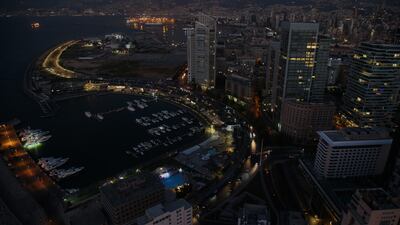
  • A view of Lebanon's capital, Beirut, with the lights on only in some buildings. Lebanese rely on highly polluting diesel generators run by private neighbourhood operators to make up for shortfalls in electricity supply from the state utility. EPA
    A view of Lebanon's capital, Beirut, with the lights on only in some buildings. Lebanese rely on highly polluting diesel generators run by private neighbourhood operators to make up for shortfalls in electricity supply from the state utility. EPA
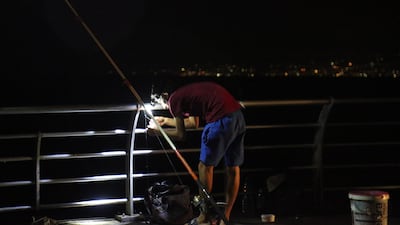
  • A fisherman uses a headlamp at the seaside corniche in Beirut, Lebanon. EPA
    A fisherman uses a headlamp at the seaside corniche in Beirut, Lebanon. EPA
  • A vendor sells LED balloons in full darkness at the corniche in Beirut. EPA
    A vendor sells LED balloons in full darkness at the corniche in Beirut. EPA
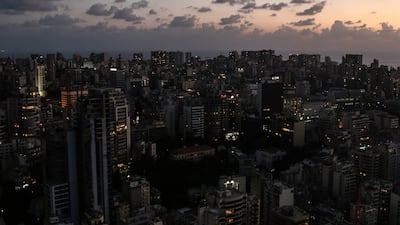
  • The near collapse of the national grid has increased the duration of power cuts across Lebanon. EPA
    The near collapse of the national grid has increased the duration of power cuts across Lebanon. EPA
  • Residents of Beirut are experiencing power cuts of up to 20 hours a day. EPA
    Residents of Beirut are experiencing power cuts of up to 20 hours a day. EPA

The Sunni Mr Mikati's government has several ministers backed by Hezbollah and its ally, the Amal movement.

The Lebanese prime minister formed a government in September with the aim of negotiating an International Monetary Fund support programme and kick-starting economic recovery.

But he has been unable to convene the Cabinet since October 12 amid demands by Hezbollah and Amal to limit the probe into the deadly August 2020 Beirut blast.


RESULTS
%3Cp%3E3.30pm%3A%20Al%20Maktoum%20Challenge%20Round%203%20%E2%80%93%20Group%201%20(PA)%20%2475%2C000%20(Dirt)%202%2C000m%3Cbr%3EWinner%3A%20Jugurtha%20De%20Monlau%2C%20Pat%20Dobbs%20(jockey)%2C%20Jean-Claude%20Pecout%20(trainer)%3C%2Fp%3E%0A%3Cp%3E4.05pm%3A%20Dubai%20City%20Of%20Gold%20%E2%80%93%20Group%202%20(TB)%20%24250%2C000%20(Turf)%202%2C410m%3Cbr%3EWinner%3A%20Global%20Storm%2C%20William%20Buick%2C%20Charlie%20Appleby%3C%2Fp%3E%0A%3Cp%3E4.40pm%3A%20Burj%20Nahaar%20%E2%80%93%20Group%203%20(TB)%20%24250%2C000%20(D)%201%2C600m%3Cbr%3EWinner%3A%20Discovery%20Island%2C%20James%20Doyle%2C%20Bhupat%20Seemar%3C%2Fp%3E%0A%3Cp%3E5.15pm%3A%20Nad%20Al%20Sheba%20Turf%20Sprint%20%E2%80%93%20Group%203%20(TB)%20%24250%2C000%20(T)%201%2C200m%3Cbr%3EWinner%3A%20Al%20Dasim%2C%20Mickael%20Barzalona%2C%20George%20Boughey%3C%2Fp%3E%0A%3Cp%3E5.50pm%3A%20Al%20Bastakiya%20%E2%80%93%20Listed%20(TB)%20%24170%2C000%20(D)%201%2C900m%3Cbr%3EWinner%3A%20Go%20Soldier%20Go%2C%20Adrie%20de%20Vries%2C%20Fawzi%20Nass%3C%2Fp%3E%0A%3Cp%3E6.25pm%3A%20Al%20Maktoum%20Challenge%20Round%203%20%E2%80%93%20Group%201%20(TB)%20%24450%2C000%20(D)%202%2C000m%3Cbr%3EWinner%3A%20Salute%20The%20Soldier%2C%20Adrie%20de%20Vries%2C%20Fawzi%20Nass%3C%2Fp%3E%0A%3Cp%3E7.10pm%3A%20Ras%20Al%20Khor%20%E2%80%93%20Conditions%20(TB)%20%24300%2C000%20(T)%201%2C400m%3Cbr%3EWinner%3A%20Al%20Suhail%2C%20William%20Buick%2C%20Charlie%20Appleby%3C%2Fp%3E%0A%3Cp%3E7.45pm%3A%20Jebel%20Hatta%20%E2%80%93%20Group%201%20(TB)%20%24350%2C000%20(T)%201%2C800m%3Cbr%3EWinner%3A%20Alfareeq%2C%20Dane%20O%E2%80%99Neill%2C%20Charlie%20Appleby%3C%2Fp%3E%0A%3Cp%3E8.20pm%3A%20Mahab%20Al%20Shimaal%20%E2%80%93%20Group%203%20(TB)%20%24250%2C000%20(D)%201%2C200m%3Cbr%3EWinner%3A%20Sound%20Money%2C%20Mickael%20Barzalona%2C%20Bhupat%20Seemar%3C%2Fp%3E%0A

Mercer, the investment consulting arm of US services company Marsh & McLennan, expects its wealth division to at least double its assets under management (AUM) in the Middle East as wealth in the region continues to grow despite economic headwinds, a company official said.

Mercer Wealth, which globally has $160 billion in AUM, plans to boost its AUM in the region to $2-$3bn in the next 2-3 years from the present $1bn, said Yasir AbuShaban, a Dubai-based principal with Mercer Wealth.

Within the next two to three years, we are looking at reaching $2 to $3 billion as a conservative estimate and we do see an opportunity to do so,” said Mr AbuShaban.

Mercer does not directly make investments, but allocates clients’ money they have discretion to, to professional asset managers. They also provide advice to clients.

“We have buying power. We can negotiate on their (client’s) behalf with asset managers to provide them lower fees than they otherwise would have to get on their own,” he added.

Mercer Wealth’s clients include sovereign wealth funds, family offices, and insurance companies among others.

From its office in Dubai, Mercer also looks after Africa, India and Turkey, where they also see opportunity for growth.

Wealth creation in Middle East and Africa (MEA) grew 8.5 per cent to $8.1 trillion last year from $7.5tn in 2015, higher than last year’s global average of 6 per cent and the second-highest growth in a region after Asia-Pacific which grew 9.9 per cent, according to consultancy Boston Consulting Group (BCG). In the region, where wealth grew just 1.9 per cent in 2015 compared with 2014, a pickup in oil prices has helped in wealth generation.

BCG is forecasting MEA wealth will rise to $12tn by 2021, growing at an annual average of 8 per cent.

Drivers of wealth generation in the region will be split evenly between new wealth creation and growth of performance of existing assets, according to BCG.

Another general trend in the region is clients’ looking for a comprehensive approach to investing, according to Mr AbuShaban.

“Institutional investors or some of the families are seeing a slowdown in the available capital they have to invest and in that sense they are looking at optimizing the way they manage their portfolios and making sure they are not investing haphazardly and different parts of their investment are working together,” said Mr AbuShaban.

Some clients also have a higher appetite for risk, given the low interest-rate environment that does not provide enough yield for some institutional investors. These clients are keen to invest in illiquid assets, such as private equity and infrastructure.

“What we have seen is a desire for higher returns in what has been a low-return environment specifically in various fixed income or bonds,” he said.

“In this environment, we have seen a de facto increase in the risk that clients are taking in things like illiquid investments, private equity investments, infrastructure and private debt, those kind of investments were higher illiquidity results in incrementally higher returns.”

The Abu Dhabi Investment Authority, one of the largest sovereign wealth funds, said in its 2016 report that has gradually increased its exposure in direct private equity and private credit transactions, mainly in Asian markets and especially in China and India. The authority’s private equity department focused on structured equities owing to “their defensive characteristics.”

Innotech Profile

Date started: 2013

Founder/CEO: Othman Al Mandhari

Based: Muscat, Oman

Sector: Additive manufacturing, 3D printing technologies

Size: 15 full-time employees

Stage: Seed stage and seeking Series A round of financing 

Investors: Oman Technology Fund from 2017 to 2019, exited through an agreement with a new investor to secure new funding that it under negotiation right now. 

Updated: January 04, 2022, 9:23 AM