

Tunisia is imposing tighter entry requirements following the discovery of the fast-spreading Omicron variant of Covid-19.
The national scientific advisory committee and government is considering a potential border closure to prevent another wave of the disease from overwhelming the healthcare system.
Rapid testing identified the genetic code for Omicron in a passenger arriving on a flight from Turkey, Hechmi Louzir, the director of the Pasteur Institute in Tunis, said last night.
The passenger is asymptomatic and has been quarantined. All other passengers were fully vaccinated and tested negative.
Tunisia suffered a catastrophic wave of Covid-19 infections in July that stretched frontline services to breaking point, causing a scandal when images of patients and dead bodies lying in corridors flooded the press.
Tunisia had failed to get its vaccination programme implemented effectively and was woefully short of oxygen and doctors.
-
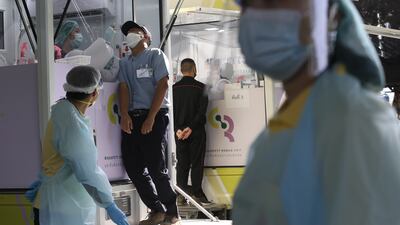
Health workers administer Covid-19 nasal swab tests during a mass vaccination drive to prevent the spread of the Omicron variant in Bangkok, Thailand. EPA -
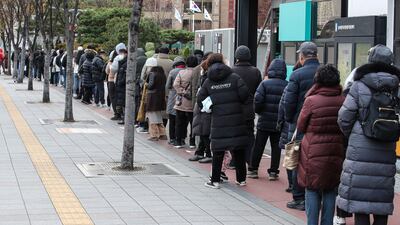
People queue outside a Covid-19 testing centre in Seoul's south-eastern district of Songpa. EPA -
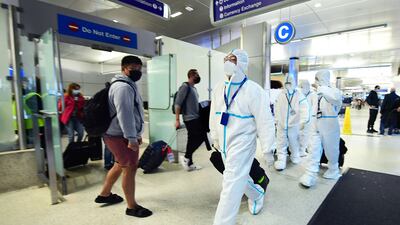
Air China crew members arrive at Los Angeles International Airport in hazmat suits after the county reported its first case of the Omicron variant. AFP -
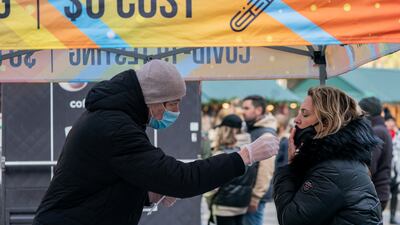
A woman has a nasal swab sample collected at a Covid-19 testing centre in New York. Reuters -
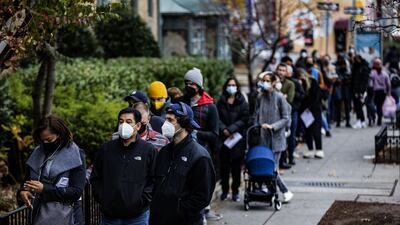
People wait outside a health centre in Washington that is offering free coronavirus vaccines. AFP -

A woman wears a face mask in front of the Brandenburg Gate in Berlin, Germany. EPA -

A pedestrian wearing a face mask looks at Christmas window displays in Paris, France. EPA -
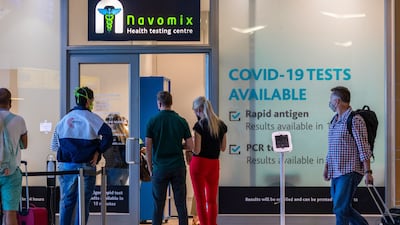
Passengers queue outside a Covid-19 testing centre at Cape Town International Airport, South Africa. Bloomberg -
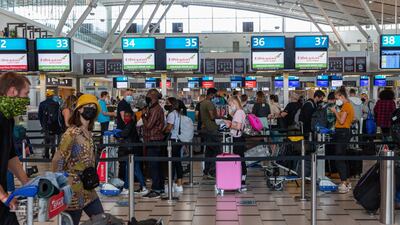
Passengers queue at check-in desks at Cape Town International Airport, South Africa. Bloomberg


Many doctors had left the country to find better work opportunities abroad.
However, since the July Covid-19 wave, Tunisian authorities have rolled out mass vaccination campaigns, with 5,225,716 people vaccinated to date.
From December 22, Tunisians and foreign residents must show proof of vaccination to access all public and private spaces, such as state institutions, hospitals and businesses.
According to Presidential Decree No.1 of October 22, this will also apply to university students and staff. The ministry of higher education and scientific research has stated proof of vaccination is mandatory to access university campuses.
Covid-19 figures are on the rise again, mostly detected in children, resulting in many schools being closed in the coastal town of Monastir and in Medenine, which lies close to the border with Libya. A further seven classes have been shut after 43 new infections were detected in the past ten days.
However, Riadh Daghfous of the scientific committee which advises the government on Covid-19 policy has expressed hesitancy over the question of vaccinating children.
Prior to July, Tunisia had struggled to get enough vaccines from donor nations but a steady supply of shots is now making its way into the country, enabling health services to offer booster vaccinations to adults over 18.
Saudi Arabia recently donated 40,000 tonnes of oxygen for Covid-19 patients, however the coronavirus is not the only risk to the economically fragile country.
The president of the Tunisian Association of Pharmacists, Nadhem Chakri, said on Tunisian radio that a shortage of more than 532 medicines, including insulin for diabetics, is compromising the health service’s ability to deliver basic healthcare.
Wary of another massive wave of Covid-19 wreaking economic havoc, Tunisia’s scientific committee has been speaking of the need to close borders again, particularly the eastern land border with Libya.
Tunisia’s refusal to reopen this border in September caused tensions between the neighbouring states to rise. For now, as Libya looks forward to its first free elections after years of conflict, this border remains open.

