


Until he was removed by the military last week, Sudan's prime minister Abdalla Hamdok ran the country's transition as a former United Nations economist, laser-focused on repairing the ties to international bodies that can help bail the country out, as well as pushing through deep reforms he hoped would solve the country's financial woes.
Sudanese economists and independent political analysts worry that in this pursuit of fast reforms, he may have neglected critical issues that the military say led them to seize power on Monday.
First is the deep rifts between parties and competing agendas after decades of oppression under autocrat Omar Al Bashir. The second is the painful impact his economic reforms had in the short term on the vast majority of the 44 million people already squeezed by years of neglect, a deep financial crisis and the Covid-19 pandemic.
On Tuesday, military head Gen Abdel Fattah Al Burhan paid tribute to the civilian leader he removed from power and said he agreed with Mr Hamdok's initiatives on numerous occasions but ultimately the prime minister was unable to work freely as long as he was being politically held back. The general's main criticism was reserved for the Forces of Freedom of Change (FFC), the pro-democracy umbrella group that led the 2019 uprising against Al Bashir and formed Mr Hamdok's power base.
-
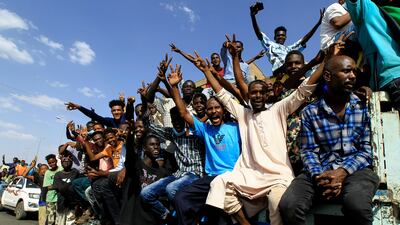
Protesters demonstrate against the Sudanese military's seizure of power and removal of the civilian government, in the capital Khartoum. Reuters -
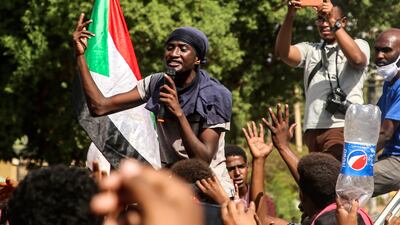
Thousands of Sudanese people took to the streets in the capital of Khartoum, above, and other major cities across the country to demand the country's transition to democratic rule be put back on track. EPA -
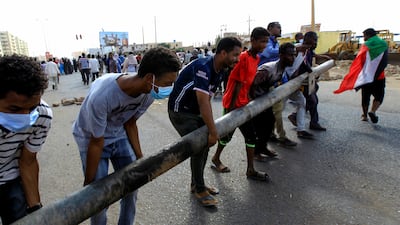
Protesters carry a barricade as they demonstrate against the Sudanese military, in the capital Khartoum. Reuters -

A Sudanese protester flashes a victory sign near a burning tyre as thousands of people joined anti-coup protests in Khartoum. EPA -
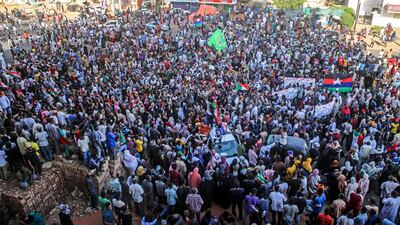
Thousands of Sudanese people participated in anti-military protests in the capital Khartoum. EPA -

A Sudanese protester dressed up as Spider-Man, stands on car during an anti-coup protest in the capital Khartoum. EPA -
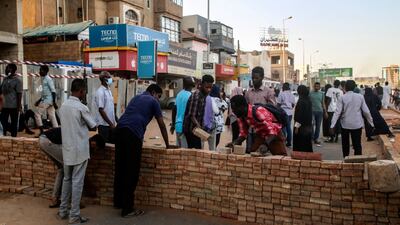
Demonstrators build a barricade on a street in the capital Khartoum during an anti-coup protest. EPA -
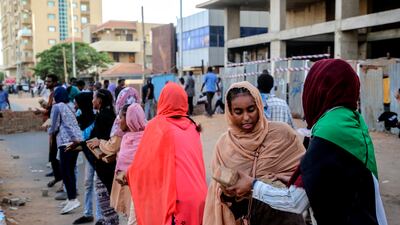
Sudanese women during anti-coup protests as a part of nationwide demonstrations against the military takeover of the government on October 25, in the capital Khartoum. EPA -

Protesters raised slogans demanding the exit of Gen Abdel Fattah Al Burhan, in the capital Khartoum. AP Photo -

Protesters declared 'the revolution will continue' during a demonstration in Khartoum. AP -

'Going back is impossible' was among slogans raised by Sudanese protesters in the capital Khartoum. AP


Gen Al Burhan said he offered concessions to the FFC, which were rebuffed. The FFC has condemned the military's moves and demanded the army head step down.
“I think the transitional government was pushed into a lot of firefighting, which left them little time for more strategic and key political projects,” Husameldin Elnasri, a Khartoum-based strategist, economist and Managing Director of Dabara Consulting, told The National.
Mr Elnasri, a staunch supporter of Mr Hamdok, said he sees why the prevailing sense in the country is that the prime minister tried to confine himself to matters of the economy since being appointed in 2019.
Mr Hamdok was put forward by the FFC after weeks of negotiation with the military in the summer of 2019 on the shape of transition after nearly 30 years of Al Bashir's rule. But, since then they locked horns over several decisions he made, chiefly his suggested model of power-sharing with the army generals and the painful economic reforms.
There were sharp divisions in the civilian alliance. In September, 20 political parties banded together to criticise the bloc for "hijacking the revolution and mismanagement of the transitional period."
They accused other parties within the alliance of antagonising the army since the power-sharing negotiations have been fraught with difficulties and problems from the start.
Divisions reached a climax in the week before the military's take over with a sit-in staged by hundreds of activists in front of the presidential palace to demand the dissolution of the government.
They shouted: “Down with the government of hunger” as ordinary Sudanese keep waiting for hours every day to buy bread and fuel.
The pro-military sit-in was backed by key political figures in Mr Hamdok’s cabinet, including his finance and economic planning minister Gebriel Ibrahim Mohammed.
The embattled prime minister, who was released by the army and returned home under guard after his detention on Monday, was caught between the factions of the FFC and the army.
Mr Hamdok’s allies have made it clear that there will be no compromise with the army on demands made after an attempted coup last month, like dissolving the 18-member committee set up to retrieve hundreds of millions of dollars in land, property and companies in Khartoum from the toppled regime of Al Bashir.
"People expected more of this government on the front of transitional justice. The government was also expected to be more inclusive and complete all the promised institutions, including the parliament and the constitutional court. People took the street also because they were not happy about general Al Burhan and General Mohamed Hamdan Dagalo, or Hemedti, and their attempts to hold on to power," said Mr Elnasri, summarising some of the differences of opinion.
Tim Phillips, the founder and CEO of Beyond Conflict, a Boston-based NGO that helped in transitions to democracy and national reconciliations in dozens of countries, says politicians fear alienating the masses who were longing for a democratic Sudan.
“Politicians are often constrained by their previous public positions, the pressure of party politics and narrow interests. Politicians often get elected by touting that they won’t compromise on key issues, which often boxes them in when compromise is needed. The public, on the other hand, don’t face the same pressures or incentives and have more flexibility to look for compromises that politicians often struggle with,” Mr Philips told The National.
Hamdok’s 'tragic flaw'
Mr Hamdok, 65, has been an economist in key international institutions, like the World Bank, for most of his career.
He settled the long outstanding issue of Sudan's accused support of terrorism after Al Bashir hosted Al Qaeda leader Osama bin Laden in the 1990s. Mr Hamdok agreed to compensation for families of the victims in order to be removed from Washington's list of state sponsors and allow it to open up move avenues for international bodies, lenders and governments to aid the transitional administration.
He has also made strides in the talks with the World Trade Organisation (WTO) to join it after nearly two decades of failed attempts under the former dictator.
His tweets reflect his business mindset and financial acumen.
At the Paris Conference in May in which the International Monetary Fund (IMF) agreed to clear some of Sudan’s backbreaking external debt arrears, he tweeted a well-produced video that he said aims to "present Sudan in a new way as a country rich in natural resources and diverse cultures, and also aims to attract investments and tourism."
But his painful economic reforms came at the expense of the overwhelming majority of Sudanese. Inflation rose to more than 340 per cent and there are shortages of everything from power to medicines and bread.
This pursuit of accessing Western economic support while turning a blind eye to the impact the reforms had on livelihoods was Mr Hamdok's ''tragic flaw'', said Zaynab Mohamed, a political analyst on Sudan in the UK-based Oxford Economics, an institute that specialises in assessing and analysing economic, social and business impacts.
“It has created the environment in which this coup was possible. Making massive payments to be removed from the US State Sponsors of Terrorism List and clear its arrears in recent months was painful,” said Ms Mohamed.
Mr Hamdok’s transitional government paid $335 million to victims of past attacks against the United States in April as part of an agreement that removed the country from the US terror blacklist.
The attacks included the 1998 bombings of the US embassies in Kenya and Tanzania by Al Qaeda, which was backed by Al Bashir.
“Also, the implementation of the recommended reforms, particularly the subsidies removal and currency devaluation, has contributed to the sharp rise in the cost of living. It is certainly probable that being a World Bank-trained economist, Mr Hamdok was blind to the disruptive effects of the reforms – that, being orthodox in his outlook he was insufficiently sensitive to how angry more expensive fuel, medicine and basic goods were making people,” added Ms Mohamed.
Mr Elnasri, the Sudanese economist, agreed.
“I believe the economic reforms were too hard too soon, making it hard for almost everyone to cope with," he said.
"However, we were left with very little room for negotiation and bargaining with the creditors and international organisations as a country. Given a choice, we would have spread the reforms over two or three years rather than the few months we were given. Having said that, it started paying off with the inflation going down and the stability of the exchange rate.”
The coup against Mr Hamdok, however, could unify the FCC and concentrate minds among those pushing for civilian rule.
Demonstrations backing the democratic transition continued through the week with the FCC and other forces vowing to fight on against the coup despite several protesters being killed and dozens wounded when security forces used live ammunition to disperse crowds this week.
Hundreds of thousands took to the streets on Saturday to denounce the military take over and demand Gen Al Burhan "leave".

